Boat Shrink Wrap Cost: What Sets the Price
Boat shrink wrap cost explained without guesswork: how yards quote per foot, what raises the price, DIY costs, a cover over several winters, and what to ask.
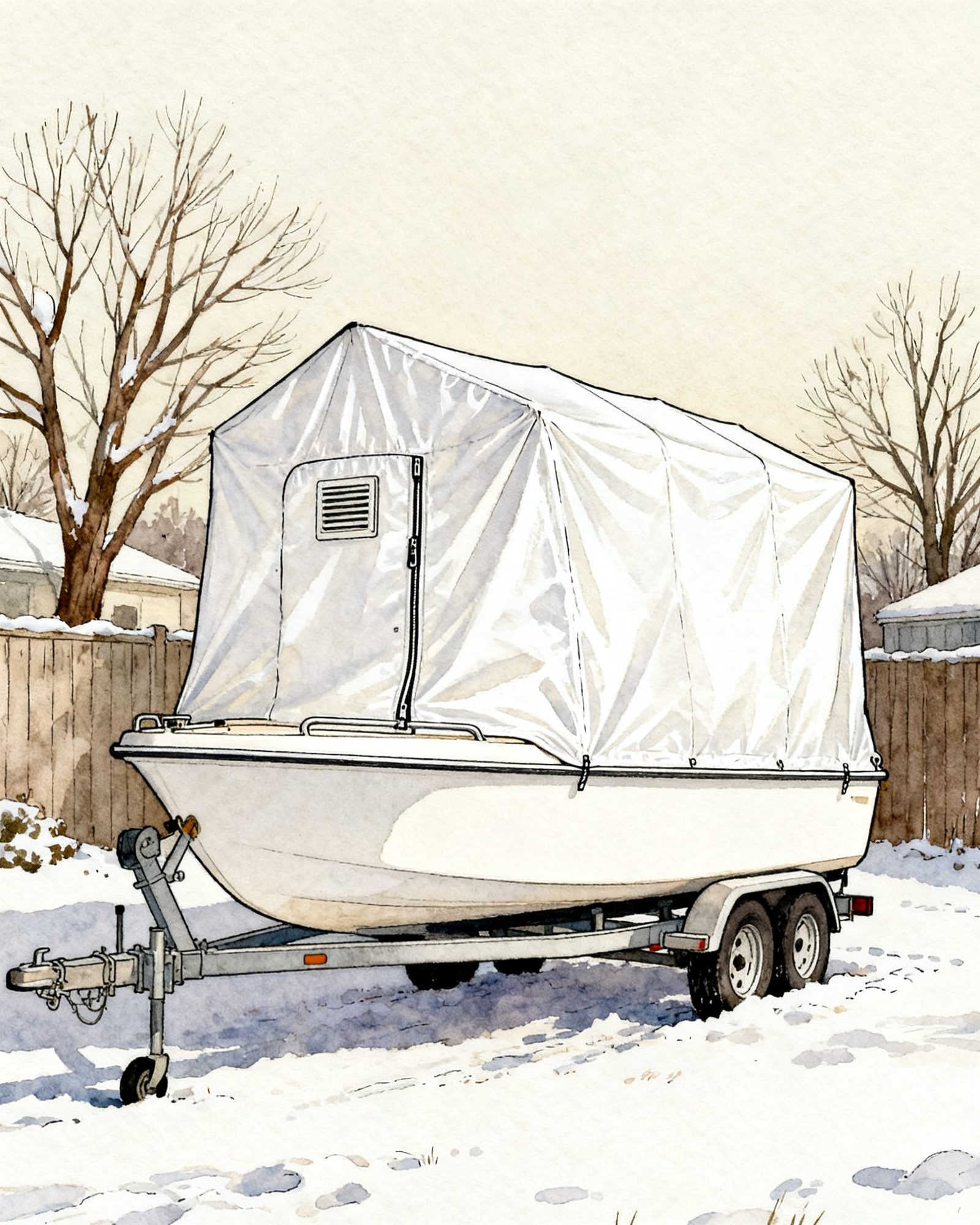
Boat shrink wrap cost is set mostly by the boat’s length, because yards usually quote per foot of boat length, as Boating magazine reports, and then by everything that makes the job bigger: height and beam, towers, T-tops, radar arches and flybridges, the support frame, the number of vents and doors, and whether removal and recycling in spring are included. There is no honest single figure to print. Rates vary from one area and one yard to the next, and the per-foot numbers repeated across the web conflict with one another, so this page gives no prices. What it does give is the list of cost factors, what each one changes, and the questions that make two quotes comparable, so you can tell a fair price from a padded one.
How yards quote: per foot of length
Boating magazine notes that yards charge by the foot of boat length for shrink-wrap service, and that flybridges, radar arches and other appendages typically increase the price. A per-foot rate looks simple, but two things decide what you actually pay.
What “length” means on the quote. Ask whether the yard measures the hull length or the overall length, including a swim platform, a bow pulpit, an outboard on a bracket or a trolling motor. Those parts have to be covered too. As an illustration, a boat sold as a 20-footer with a 2-foot swim platform and an outboard hanging past the transom can measure 23 feet or more overall, and a yard pricing overall length will charge for all of it.
What the rate covers. Some quotes include the support frame, vents and a zip door; others list them separately. Some include removal in spring and recycling the film, and Boating magazine notes that reputable yards recycle it for you. A low per-foot rate with extras added on can end up higher than an all-in rate.
What raises or lowers the price
| Factor | Why it changes the cost | What to ask |
|---|---|---|
| Length | The basis of a per-foot quote; longer boats also need more posts and vents | Hull length or overall length? |
| Height and beam | A taller or wider boat needs a wider roll of film | Is a T-top or windshield frame included in the price? |
| Towers, T-tops, arches, flybridges | Boating magazine says these appendages typically raise the price | Is the tower wrapped in, or taken down first? |
| Support frame | More uprights and strapping on longer or flatter boats; wood or a reusable frame | Is the frame included? Can a reusable frame be used? |
| Vents and doors | Each vent and the zip door is an extra item and extra labor | How many vents are included? Is a door included? |
| Sailboats | Mast down, the wrap needs uprights along the length | Is the mast unstepped by the yard or by you? |
| Pontoons | A flat deck needs a frame for a ridge; fences and a bimini add height | Is the bimini taken down or wrapped over? |
| Where it is done | At the yard, at your house, or in the water | Is there a travel or in-water charge? |
| Spring | Cutting the wrap off and recycling it is work too | Are removal and recycling included? |
Why height and beam matter
A shrink-wrap maker’s instructions size the film from the top of the support post, over the widest part of the boat, to about 8 inches below the rub rail, doubled, plus 2 feet. A higher frame or a wider beam therefore means a wider, heavier roll of film, which is one reason a boat with a hardtop or a tall windshield can cost more to wrap than a low open boat of the same length. The full method is in how to shrink wrap a boat.
Why the frame and vents add up
The same maker’s diagrams call for a minimum of 1 support post for every 6 feet of length, so a longer boat needs more uprights and more strapping. Its venting guide also rises with length: 3 vents up to 18 feet, and more pairs of vents as the boat gets longer, with extras along the sides on the largest boats. Every vent is a part and a few minutes of labor, and the maker’s advice is that it is better to over-ventilate than to fit too few. A quote that skimps on vents is not a saving: moisture trapped under the wrap feeds mildew.
Sailboats and pontoons
On a sailboat with the mast down, the maker’s instructions put an upright in the cockpit and then one every 5 to 6 feet to the bow, with the center strap at least 18 inches above the stanchions, so there is more frame to build than on a powerboat of the same length. On a pontoon, the instructions reverse the usual order: the film goes on first and the perimeter band is installed over it, just below the decking. A flat pontoon deck also needs a frame to give the wrap a ridge, and fences, gates and a bimini add height and corners; ask how the yard handles each.
Doing it yourself: what you pay for
A do-it-yourself wrap trades the labor charge for equipment, materials, your time and the risks of an open flame. Boating magazine lists the materials as vents, strapping, a zipper door, vertical supports, a shrink-wrap knife, tape, adhesive spray and protective gloves, on top of the film and a propane heat tool.
Bought once (or borrowed):
- A propane heat tool made for shrink wrap, with its regulator and hose.
- A 20 pound propane tank, the size the shrink-wrap maker’s list compares to a home barbecue tank.
- A sturdy step ladder tall enough that you never stand on the upper rungs.
- A fire extinguisher, safety glasses and flame-retardant or leather gloves.
Bought every season:
- Film, in a roll wide enough for your boat’s measurement.
- Strapping for the perimeter band, belly bands and ridge, and shrink-wrap tape.
- Self-adhesive vents and, if you want winter access, a zip door.
- Lumber or replacement parts for the frame, plus padding for sharp corners.
Boating magazine’s verdict is that doing it yourself may make sense if you pool resources with a group of boaters to share the labor and materials cost, and otherwise is best left to the yard unless you are handy with a heat gun and plan to do it every season. The costs that do not appear on a receipt count too: a helper or two, a calm day with wind no harder than the heat-tool maker’s 10 mph limit, and the risk of a burn hole or worse. Before you buy a tool, read shrink-wrap safety.
Shrink wrap or a cover over several winters
Wrap is paid for every fall and thrown away or recycled every spring. A fitted cover is paid for once. Boating magazine says fitted covers are more expensive up front than shrink wrap but can last eight to 10 years, maybe more. To compare fairly, add what a cover needs to survive a winter outdoors: in the BoatUS Foundation’s winter trial, as reported by BoatTest.com, the supports that came with the covers were not strong enough and some poles broke under pooled water, so a cover needs a sturdier frame and checks after storms.
Two things can settle the question before you price anything. BoatTest.com reports that some yards require shrink wrap for boats in rack storage, so read the storage contract first. And Discover Boating calls indoor storage the more expensive option but the most protective one; a boat under a roof needs no wrap at all. The full trade-off, including snow, access and mildew, is in the comparison of a boat cover and shrink wrap, and the storage side in indoor or outdoor winter boat storage.
How to get quotes you can compare
- Measure the boat overall. Bow pulpit to the back of the swim platform or outboard. Write down the beam and the height of the highest point you want covered.
- List what sticks up. T-top, tower, radar arch, bimini, windshield, flybridge, mast. Decide which ones come down before wrapping and who does that.
- Decide what you need in winter. If you want to get aboard, ask for a zip door. Plan to finish all engine and interior work before the wrap goes on; engine winterizing itself belongs to the engine maker’s manual or a marine mechanic; ask whether a quote includes it (see what boat winterizing costs and what is included).
- Ask each wrapper the same questions. Overall or hull length? Frame included, and what is it made of? How many vents, and where? Door included? Removal and recycling in spring included? Any travel or in-water charge? Is the business insured for working on your boat?
- Compare like with like. Line the answers up item by item. The lowest per-foot rate is only the lowest price if it covers the same frame, vents, door and spring removal as the others.
- Check what the marina allows. If you were planning to wrap it yourself at a marina, ask first: NFPA 303, the US fire standard for marinas and boatyards, in the edition its committee reviewed in 2023, says shrink-wrap operations shall be approved.
Spring removal and recycling are part of the cost
Shrink wrap is low-density polyethylene. Woods Hole Sea Grant notes that it cannot go in curbside bins and needs special processing, and programs that collect it want it clean, with strapping, vents and zipper doors removed. Some programs charge nothing to residents: Woods Hole Sea Grant’s 2023 Cape Cod announcement says there was no fee or sticker for residents to drop off boat wrap. But programs are not everywhere, so if a yard includes removal and recycling, that is worth something. How to do it yourself is in recycling boat shrink wrap.
Common questions
How much does it cost to shrink wrap a boat per foot?
It depends on where you live, the shape of the boat and what the quote includes, which is why no single figure is given here. Boating magazine reports that yards charge by the foot of boat length; the useful move is to get two or three local quotes measured the same way and covering the same items.
Is it cheaper to shrink wrap your own boat?
Sometimes, over several seasons. A do-it-yourselfer buys a propane heat tool once and film, strapping, tape and vents every year, and puts in their own time and a helper's. Boating magazine's verdict is that it makes sense mainly if you are handy with a heat gun and plan to wrap every season, or share the labor and materials with a group of boaters.
Does it cost more to shrink wrap a pontoon boat?
A pontoon is wide and flat, so it needs a support frame to give the wrap a ridge for snow and rain, and fences, gates and a bimini add height and corners. Those are the things that move any wrap's price. Ask the yard whether it prices a pontoon by length alone or adds for the frame and the bimini.
Is shrink wrapping a boat worth the cost?
For a boat stored outdoors through a snowy winter it usually is, since a professional wrap sheds snow and rain and someone else does the work. Indoors it is not needed. If you keep the boat for many seasons, compare the yearly wrap against a fitted cover with a proper frame.
Can boat shrink wrap be reused to save money?
Boating magazine calls shrink wrap single-use, and it is normally cut off in spring. Woods Hole Sea Grant's recycling program site does carry a video on reusing shrink wrap for multiple seasons, but most wrap is replaced every year.
Sources
Read next
Boat Cover vs Shrink Wrap: Which Is Better for Winter?
Boat cover vs shrink wrap for winter: snow, ventilation and mildew, winter access, seasons of use, waste and cost factors, and how storage and climate decide it.
How to Shrink Wrap a Boat for Winter, Step by Step
How to shrink wrap a boat yourself: the support frame, perimeter band, heat welding, vents and doors, fire and carbon monoxide safety, and recycling in spring.
How to Recycle Boat Shrink Wrap in Spring
How to recycle boat shrink wrap: why it can't go in curbside bins, cutting it off clean, what to strip, how to roll it, and where collection programs exist.
What Boat Winterizing Costs and What Is Included
The cost to winterize a boat depends on size, engines, systems aboard, timing and storage. The factors in plain words, DIY supplies, and what to ask a yard.
Fogging a Boat Engine for Winter Storage
What fogging oil does, when to fog a boat engine, and how it is done on carbureted, fuel-injected and direct-injection outboards and on inboards, safely.