Winter Boat Storage: Indoor or Outdoor?
Indoor vs outdoor boat storage for winter: dry stack, heated or unheated buildings, a garage, a yard, a trailer or the water, and how to cover each.
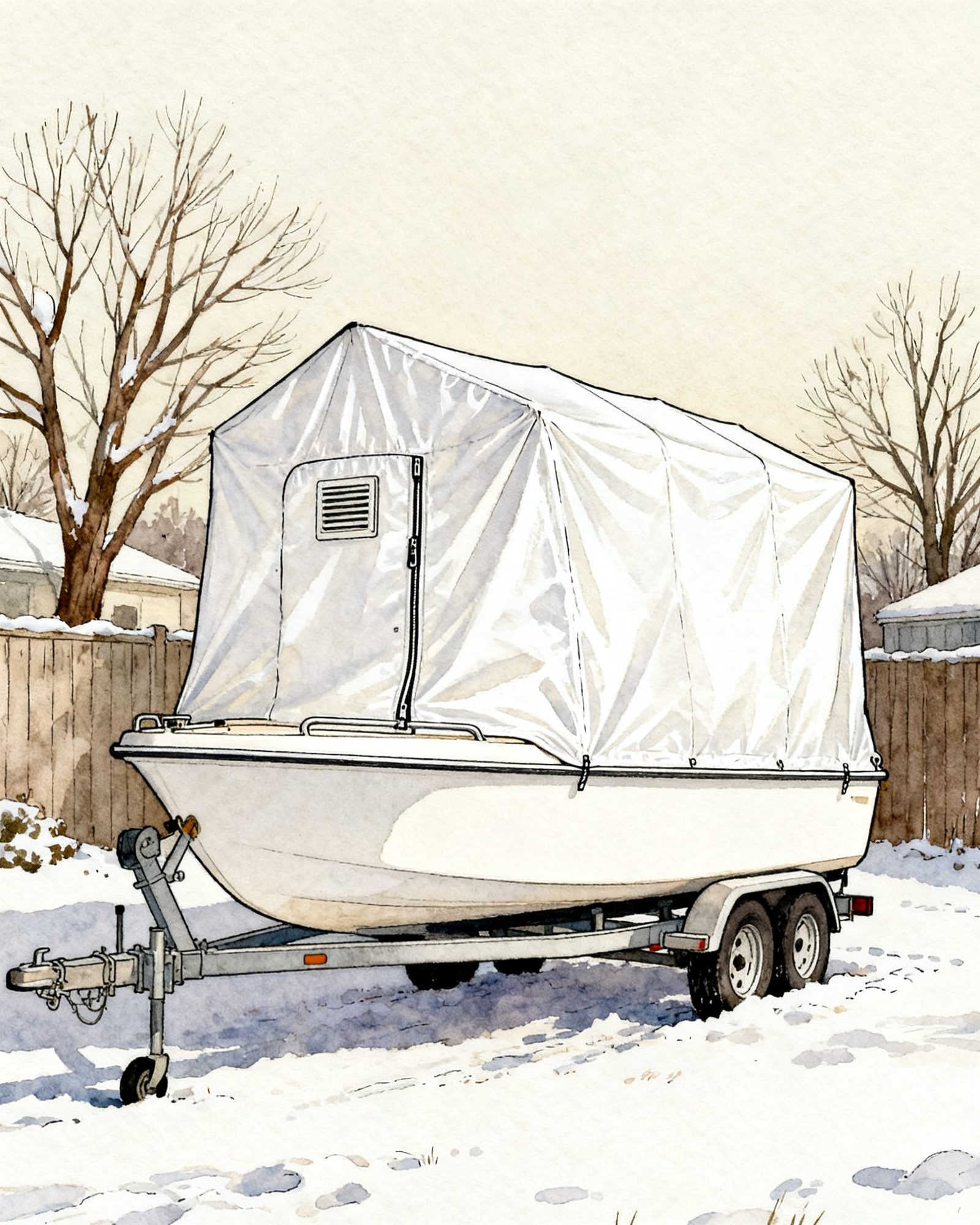
For winter boat storage, indoors protects the boat best and costs more; outdoors is cheaper and more common, and works well if the boat is properly covered. Discover Boating, the boat industry’s consumer site, calls indoor storage “a more expensive option” that “also offers the most protection for your boat”, and says dry outdoor storage is “certainly a more popular option”, relatively safe and inexpensive compared with most alternatives. The choice then decides the covering. A boat under a roof needs only a light cover against dust; a boat outdoors needs shrink wrap or a waterproof, well-supported, vented cover and checks after storms; a boat left in the water needs a mild climate, or full winterizing and an agitator. Budget, climate, how often you want to get aboard, and the size of the boat settle the rest.
The options side by side
| Where | Protection | What covering it needs | Winter access | Watch out for |
|---|---|---|---|---|
| Indoor dry stack (racks in a building) | Shelved away from weather and water | Whatever the facility requires | Through the facility; often year-round storage | Contract rules, availability |
| Indoor building, heated or unheated | Roof against snow, ice and sun | Light, breathable dust cover | Depends on the facility | What happens if heat fails; rodents |
| Home garage or pole barn | Roof, and the boat is at hand | Light dust cover | Whenever you like | Space and height; never run engines inside |
| Outdoor at a yard, on a trailer or stands | Least, unless well covered | Shrink wrap or a waterproof cover on a strong frame | Easy with a cover, through a door with wrap | Snow load, security, wind |
| Outdoor at home on a trailer | Same as a yard, but you check it yourself | Shrink wrap or a supported cover tied to the trailer | Whenever you like | Snow, pooled water, mice |
| In the water | Depends on climate and the agitator | A covering that survives wind and stays reachable | At the slip | Ice damage if power fails |
Indoor boat storage
Dry stack and rack storage
Discover Boating describes dry stack as a covered facility where boats sit on large racks inside a building, and notes that a boat kept in an indoor dry stack usually lives there year-round. The boat stays “shelved away from weather, water” and cleaner than one kept in a slip or towed. Racks, indoors or out, come with the facility’s rules: BoatTest.com reports that some yards require shrink wrap for boats in rack storage, because the extra weight of water pooled on a cover could cause a collapse. Read the contract before buying a cover for a rack.
Heated or unheated buildings
Indoor storage comes in two kinds: buildings that are heated through the winter and buildings that are only a roof and walls. Either one keeps snow, ice, rain and sun off the boat, which is most of what a winter cover is fighting outdoors. Heat adds a more comfortable place to work in winter and keeps the building warmer than outdoors, but only for as long as the heat stays on. Before you pay for it, ask the facility how the building is heated, what it is kept at, and what happens if the heat fails. Winterize the engine either way, as the engine maker’s manual or your mechanic directs; a heated building is not a reason to skip it, because the heat can fail. For an outboard, the general method is in how to winterize an outboard motor.
A home garage or pole barn
Discover Boating’s caution about indoor storage is that it can be inflexible “unless you have a multiple-vehicle garage or pole barn”. If you do, the boat is at hand all winter. Measure the door opening and the ceiling against the boat on its trailer, including the windshield, any T-top or tower, and the bimini frame. Discover Boating advises storing trailerable boats with the drain plug removed and the bow raised so water can run out.
One hard rule for home storage: never run the engine or a generator inside the garage. The CDC’s carbon monoxide guidance is never to use a generator inside a home or garage, even with doors and windows open, and it lists small engines among the sources of the gas.
Covering a boat indoors
A boat under a roof does not need shrink wrap. A light, breathable cover keeps off dust, bird and rodent droppings and scuffs, and should still let air move beneath it. Discover Boating’s fall lay-up advice applies indoors as much as out: adequate air circulation is the best way of combating mildew, dirt and grease promote it, and loose cushions, linens and life jackets are better stored somewhere warm and dry off the boat.
Outdoor boat storage
At a yard
Discover Boating calls dry outdoor storage relatively safe and protective for the boat and inexpensive compared with most alternatives, with one potential downside: security. The facility should be fenced and locked and have some form of security system or video surveillance. Outdoors, the boat must be shrink-wrapped, parked under a storage canopy or otherwise covered to keep water out and prevent weathering, and Discover Boating calls a professional shrink-wrap job “by far the best way to cover a boat for winter storage”. A proper wrap, it says, is “both water-repellent and vented to allow moist air to escape”. If you would rather wrap the boat yourself, read how to shrink wrap a boat first, including its fire and carbon monoxide sections.
On a trailer at home
The covering choices are the same as at a yard, but the checking is yours. Tie the cover’s straps to the trailer frame, keep the drain plug out and the bow raised, and go out after every heavy snow or rain. In the BoatUS Foundation’s winter cover trial, as BoatTest.com reports it, water collected in the covers and loaded the straps and buckles, the supports that came with the covers were not strong enough, and some poles broke under pooled water.
On jackstands
BoatTest.com passes on a warning from the same trial: never tie a cover to jackstands. In strong wind or heavy precipitation, the tension can pull the supports out from under the boat. A boat on stands needs a cover with its own secure tie-down points, or a wrap.
Shrink wrap, a cover or a tarp
Outdoors, the real choice is between shrink wrap and a waterproof fitted cover on a strong frame; the comparison of a boat cover and shrink wrap sets them side by side. A tarp is the weak option: Discover Boating warns that if a tarp isn’t supported and secured just right, leaks, rips and complete collapses are common, and that owners who tie tarps on until the boat looks like a rolled roast are “asking for a mildewy mess”. Whatever goes on must breathe. Discover Boating’s lay-up advice is that covers should be padded against chafe, well secured against buffeting and well ventilated, and boat cover vents explains where vents go and why.
In the water all winter
Discover Boating says some people keep their boats in the water all year. That is acceptable in temperate areas, or elsewhere with full winterizing and an agitator. The risk it names is the power supply: if power fails and the agitator stops, the hull can freeze in place and ice damage can occur. A boat in a slip also needs a covering that stands up to wind and that you can reach and re-tie through the winter.
Rodents, wherever the boat sits
Mice move into stored boats indoors and out. Discover Boating’s offseason advice:
- Clean out food first. Make sure the boat is free of food, crumbs and trash, then wipe it down.
- Close the gaps. Patch holes with steel wool, wire mesh or caulk, especially around the engine, wiring, vents, under seats and in the bilge.
- Take the soft goods off. Consider removing cushions and upholstery and storing them separately, or in containers rodents cannot get into.
- Raise the boat. Indoor storage is ideal, and raising the boat off the ground makes it harder for rodents to climb aboard.
- Vent with care. Use vented covers or dehumidifiers for airflow, but make sure the vents are not large enough for mice to squeeze through.
- Trap if they are already aboard. Set traps near the engine compartment and food storage and check them regularly.
How to choose
- What does your winter bring? Heavy snow and long freezes favor a roof, or a professional wrap over a sloped frame.
- What does the budget allow? Discover Boating calls indoor storage the more expensive option; compare it with an outdoor spot plus a wrap or cover every season, as laid out in what boat shrink wrap costs and why.
- Do you want winter access? A home garage or an outdoor boat under a cover is easiest to reach; Discover Boating notes that indoor storage can be inflexible, and a dry stack is reached only through the facility.
- How secure is the site? Look for fencing, locks and cameras outdoors.
- What does the contract require? Some rack yards require shrink wrap; some marinas set their own rules for who may wrap on site.
- Who will check it? An outdoor boat needs someone to clear snow, bail pooled water and re-tension straps through the winter.
Common questions
Is it better to store a boat inside or outside in winter?
Inside protects the boat better: Discover Boating calls indoor storage the option that offers the most protection, and the more expensive one. Outdoor storage is the more popular choice and works well when the boat is properly wrapped or covered, vented and checked through the winter.
Is heated boat storage worth it?
It depends on what you need it for. Any roof keeps snow, ice and sun off the boat; heat adds comfort for winter work and keeps the building warmer than outdoors, but only as long as the heat stays on. Ask the facility how the building is heated and what happens if the heat fails, and winterize the engine as its maker or your mechanic advises either way.
Do I need to shrink wrap a boat stored indoors?
Usually not. Under a roof the job is keeping dust, droppings and scuffs off, which a light, breathable cover does. Some yards do require shrink wrap for boats in rack storage, BoatTest.com reports, so read the storage contract before you decide.
Can I leave my boat outside in winter without a cover?
It is a poor idea anywhere it snows or rains much. Discover Boating says outdoor storage means shrink-wrapping the boat, parking it under a canopy or otherwise covering it to keep water out and prevent weathering, and that upholstery left open to the elements needs covering.
Can I keep my boat in the water over the winter?
Discover Boating says some owners do, in temperate areas or with full winterizing and an agitator. If the power fails and the agitator stops, it warns, the hull can freeze in place and ice damage can occur.
Sources
Read next
Boat Cover vs Shrink Wrap: Which Is Better for Winter?
Boat cover vs shrink wrap for winter: snow, ventilation and mildew, winter access, seasons of use, waste and cost factors, and how storage and climate decide it.
How to Shrink Wrap a Boat for Winter, Step by Step
How to shrink wrap a boat yourself: the support frame, perimeter band, heat welding, vents and doors, fire and carbon monoxide safety, and recycling in spring.
Snow on a boat cover: load, sag and what to do
Why snow is the heaviest load a boat cover carries, the winter frame it needs, clearing snow safely from the ground, ice, and when shrink wrap is better.
Fuel Stabilizer for Boat Storage: Ethanol and the Tank
How to use fuel stabilizer for boat storage, why ethanol fuel separates, how full the tank should be over winter, portable tanks, E15 and fuel safety.
What Boat Winterizing Costs and What Is Included
The cost to winterize a boat depends on size, engines, systems aboard, timing and storage. The factors in plain words, DIY supplies, and what to ask a yard.