Shrink Wrap Safety: Heat Tools, Fire, Falls and CO
Boat shrink wrap safety step by step: the propane heat tool, fire and what to do if the film burns, wind, ladders, and carbon monoxide under a wrapped boat.
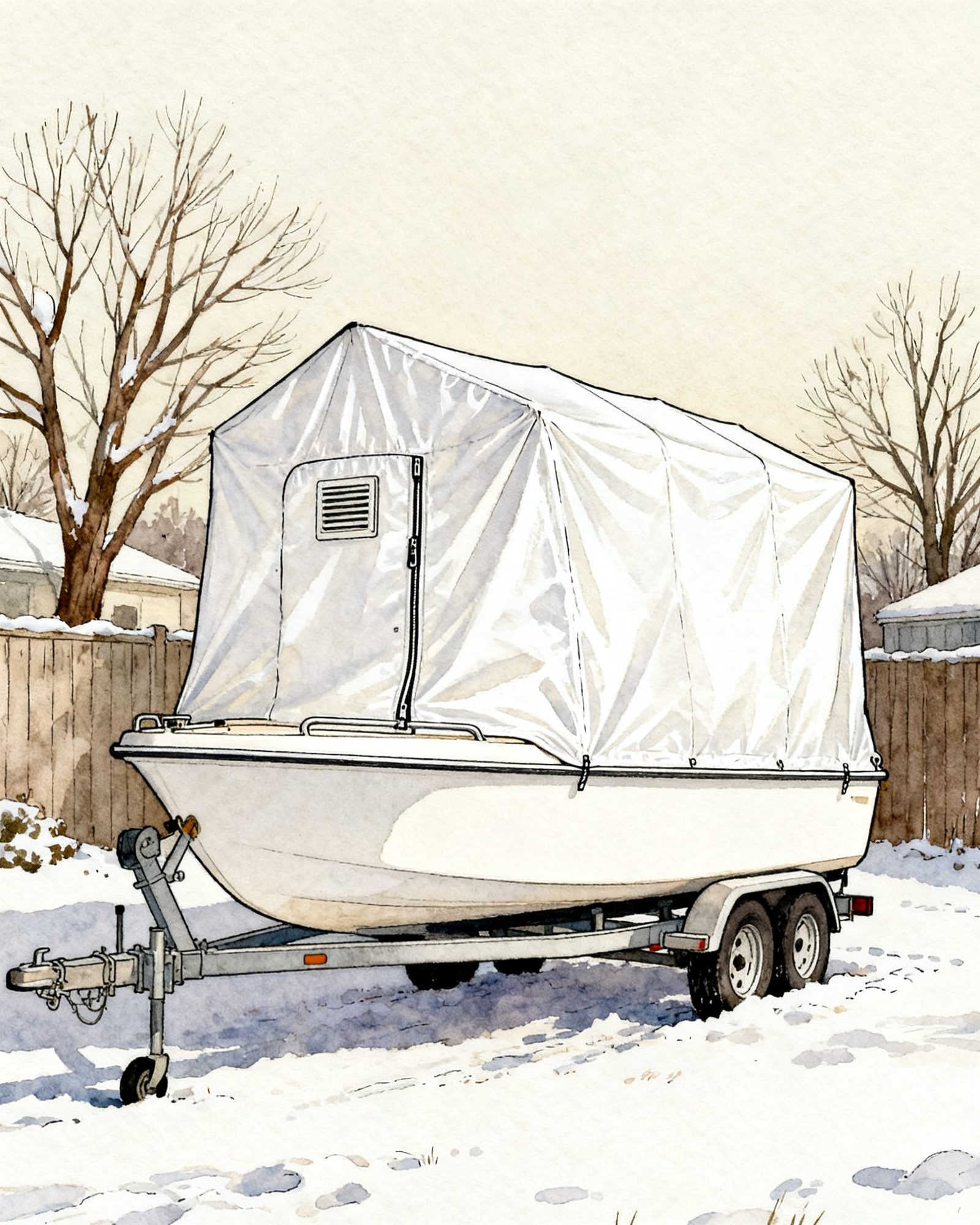
Shrink wrap safety comes down to four hazards: the open flame of the propane heat tool, film that can catch fire and drop burning plastic onto whatever is below, falls from a ladder, and carbon monoxide trapped under a wrapped boat. Each has a plain answer. Keep a fire extinguisher at hand and the work area clear, never wrap outdoors when the wind is harder than 10 mph (the limit in a heat-tool maker’s safety guide), work from a sturdy ladder without overreaching, close the propane tank and purge the hose when you finish, and do every job that needs someone inside the boat, above all anything that runs the engine, before the wrap goes on. Always follow the heat tool’s and the film’s own instructions; where they are stricter than anything below, they win.
The four hazards at a glance
| Hazard | Where it comes from | The precaution that matters most |
|---|---|---|
| Fire | Open-flame heat tool, film that ignites, burning plastic dropping onto material below | Extinguisher at hand, clear work area, keep the heat moving, watch the boat afterward |
| Propane | Leaking fittings or a cracked hose; gas left in the hose | Check fittings and hose before lighting; close the tank and purge the hose after every job |
| Falls | Ladder work over the top of the boat, wind on loose film | Sturdy ladder of the right height, no overreaching, never stand on the wrap |
| Carbon monoxide | Engines, generators or heaters run under a wrap; trapped exhaust | All engine and interior work done first; nothing burning fuel under the wrap; air the boat before entering |
The full wrapping method, from the frame to the vents, is in how to shrink wrap a boat; this page goes deeper on the safety side of each step.
Is this a job to do yourself?
Boating magazine calls dealing with open flame “the scariest part of shrink-wrapping”, and its verdict is that doing your own wrap makes sense mainly if you are handy with a heat gun and plan to do it every season, or share the work with a group of boaters. Discover Boating, the boat industry’s consumer site, calls a professional job “by far the best way to cover a boat for winter storage”.
Leave it to a yard when:
- you have never used a propane heat tool and cannot practice first (Boating magazine suggests practicing on a wood or plastic box);
- the top of the boat cannot be reached from a step ladder without leaning out, as on boats with a flybridge, tower or arch;
- you would be working alone: Boating magazine notes you may need a few extra hands to get the film straight around the boat;
- the boat sits in a crowded yard close to other boats, or the marina has not said yes.
On that last point: NFPA 303, the US fire standard for marinas and boatyards, in the edition its committee reviewed in 2023, says “shrink-wrap operations and devices used for shrink-wrap operations shall be approved.” Ask the marina before you arrive with a heat tool. If a fitted cover would spare you the flame altogether, weigh it in the comparison of a boat cover and shrink wrap.
Setting up the work site
Do these before the tool is lit. At each step, the thing to look for is in the second half of the line.
- Check the weather. The heat-tool maker’s guide says not to shrink wrap outdoors when the wind is harder than 10 mph. If the film is flapping on the frame or pulling out of a helper’s hands, stop for the day.
- Clear the area. The same guide says to keep the work area clear of debris, wood shavings, paper products, flammable chemicals and anything else that may catch fire from the heat of the tool. Look under and around the boat as well: burning film can drop down, as the shrink-wrap maker warns.
- Put the extinguisher where you can reach it. The shrink-wrap maker’s instructions say to keep a fire extinguisher available at all times, and the heat-tool guide says to keep one close by. Close by means on the ground next to the ladder, not in the garage.
- Inspect the propane setup. The heat-tool guide says to check all fittings for leaks and inspect the hose for cracks or loose connections. The maker’s equipment list calls for a 20 pound propane tank, the size found on a home barbecue.
- Tape over the fuel vents and pad sharp points. The shrink-wrap maker’s instructions call for taping over the fuel vents before wrapping, and Boating magazine explains it helps prevent igniting any fuel vapors. Remember to remove that tape at the end, as the instructions also say.
- Ventilate if you are indoors. The heat-tool guide says that when shrink wrapping indoors, the work area must be well ventilated.
- Dress for it. The guide says to wear safety glasses and gloves (flame retardant or leather is suggested), no loose clothing, and long hair tied back. Boating magazine adds that safety glasses guard against hot air blowback when sealing pleats and against rare drips of hot plastic, and suggests long sleeves and a welder’s glove on the hand opposite the gun.
- Brief your helper. Agree who holds the film, who moves the ladder, and who grabs the extinguisher.
Using the heat tool without starting a fire
The shrink-wrap maker’s caution is direct: the film can burn, “can ignite into open flame” if heat is applied incorrectly, and “can also drop down on to other combustible material and cause secondary ignition and fire.” These habits, from the heat-tool guide and the shrink-wrap maker’s instructions, prevent it:
- Keep the tool moving. Never hold the heat on one area for more than a few seconds. The film keeps shrinking after the heat moves away, so the spot you just passed is still changing.
- Never heat what you cannot see. If the far side of a pleat or the top of the boat is out of sight, move the ladder or yourself until it is in view.
- Go easy on corners and sharp points. The shrink-wrap maker’s instructions say to keep excess heat off corners and protruding objects so the film keeps its full thickness there.
- Start low. The same instructions begin at the bottom of the cover near one end, never in the middle, and work up; starting at the bottom lets the heat rise and helps the film shrink more quickly.
If the film catches fire
The shrink-wrap maker’s instruction is to stop what you are doing immediately and carefully inspect the area where you are working for a possible fire, including below the boat, where burning plastic may have dropped. This is the moment the extinguisher beside the ladder earns its place. If the fire is more than you can put out at once, get away from the boat and call 911. Do not go back to shrinking until you have checked the whole area.
Choosing a heat tool
Use a tool made for shrink-wrapping boats and follow its instructions. Boating magazine’s comparison found that the propane tools it looked at all self-ignite with the trigger pull and come with a regulator, 25 feet of hose and a carrying case, and that two of them include a dual-action safety integrated into the grip and an outer heat shield that stays cool to the touch. Features like these are worth looking for when you buy or rent.
Ladders and working at height
Most of the shrinking on the top of a boat is done from a ladder, with a lit tool in one hand.
- The right ladder. The shrink-wrap maker says you must have a sturdy step ladder tall enough that you won’t have to stand on the upper rungs when shrinking the top; an extension ladder works well on larger power boats with flybridges.
- No overreaching. The heat-tool guide says do not overreach, and keep proper footing and balance at all times. Climb down and move the ladder instead.
- Never climb onto the wrapped top. Film stretched over a frame is not a floor; reach the top from the ladder.
- Knives and saws. The maker also says to follow all necessary safety precautions when using a knife to cut strapping, sawing wood for the frame, and climbing ladders.
When the shrinking is done
- Patrol for holes while the tool is still set up. Check the whole cover for burn or puncture holes and patch them with shrink-wrap tape, rubbed down and lightly warmed with the gun as the maker describes.
- Shut down the propane. The heat-tool guide says each time you complete a shrink wrap project, turn off the propane tank and purge all gas from the hose attached to the heat tool.
- Remove the tape from the fuel vents, as the shrink-wrap maker’s sequence directs.
- Stay with the boat for a while. The committee that writes NFPA 303 treats shrink wrapping as a hot-work-like job. In 2022 a task group of that committee drafted proposals that included a fire watch and watching the boat after the work, because a hot spot left during wrapping could turn into a smoldering fire. Those were draft proposals, not adopted rules, but staying a while before you leave costs nothing.
The same task group’s drafts also mentioned wrapping in a dedicated area or an open area away from other combustible material, checking that the boat’s fuel filler caps are closed tight, and heat guns listed for their use. None of that is presented here as current law; treat it as a sensible checklist and follow your marina’s rules.
Carbon monoxide under a wrap
The fire risk is greatest while the tool is lit; the carbon monoxide risk starts once the boat is closed in. The US Coast Guard lists “inadequately ventilated canvas enclosures” and “exhaust gas trapped in enclosed places” among the ways carbon monoxide builds up on boats, and warns that it “can remain in or around your boat at dangerous levels even if your engine or the other boat’s engine is no longer running”. The CDC describes it as “an odorless, colorless gas that kills without warning”; its most common symptoms are headache, dizziness, weakness, upset stomach and vomiting.
A Maryland legislative fiscal note on a 2018 bill, HB 803, describes what happened on November 5, 2016: a worker winterized a boat that had already been shrink-wrapped, winterizing typically involves idling the engine, and he was pronounced dead from an overexposure to carbon monoxide. The bill would bar businesses that winterize boats from shrink wrapping a boat until all winterizing work that needs an employee inside is complete. The note is an analysis of a bill, not a law, and it does not say whether the bill passed. Its lesson for owners does not depend on that:
- Finish every engine job and every job inside the boat before wrapping. The engine winterizing itself belongs to the engine maker’s manual or a marine mechanic; the general method is in how to winterize an inboard or sterndrive boat.
- Never run an engine, generator or fuel-burning heater under the wrap. The CDC’s own rule for generators is never inside a home or garage, even with doors and windows open; a wrapped boat is a smaller closed space.
- Air the boat before you climb in during the winter: open the zip door and let it vent first, and treat a headache or dizziness aboard as a warning to get out into fresh air at once: they are among the most common symptoms the CDC lists.
A one-minute safety checklist
Before lighting: wind no harder than 10 mph, area clear, extinguisher beside you, fittings and hose checked, fuel vents taped, glasses and gloves on, helper briefed, all engine and interior work finished. While shrinking: keep the tool moving, never heat what you cannot see, never overreach. After: holes patched, tank closed, hose purged, vent tape off, boat watched for a while, and nothing that burns fuel ever runs under the wrap.
Common questions
Can boat shrink wrap catch fire?
Yes. A shrink-wrap maker's instructions warn that the film can burn, can ignite into open flame if heat is applied incorrectly, and can drop onto other combustible material and start a second fire. That is why the extinguisher stays within reach for the whole job, not in the truck.
Is it safe to go inside a shrink-wrapped boat in winter?
Only with care. Open the zip door and let the boat air out before climbing in, and never run an engine, generator or fuel-burning heater under the wrap. The US Coast Guard warns that carbon monoxide can stay at dangerous levels after an engine has stopped, and the CDC notes that the gas has no color or smell.
Can I shrink wrap my boat in the wind?
Not in much of it. The heat-tool maker's safety guide says not to shrink wrap outdoors when the wind is harder than 10 mph. Wind also turns loose film into a sail, which makes ladder work harder; pick a calm day and have a helper hold the film.
What kind of heat gun do I need to shrink wrap a boat?
A heat tool made for shrink-wrapping, used exactly as its instructions say. The tools Boating magazine compared are propane-fired and come with a regulator and 25 feet of hose; two of them add a dual-action safety in the grip and an outer heat shield that stays cool to the touch.
Do I need permission to shrink wrap my own boat at a marina?
Usually. NFPA 303, the US fire standard for marinas and boatyards, in the edition its committee reviewed in 2023, says shrink-wrap operations and the devices used for them shall be approved. Ask the marina before you bring a heat tool onto the property, and follow its rules.
Sources
- General safety guide from a shrink-wrap heat-tool maker (PDF)
- Installation instructions from a shrink-wrap maker (PDF)
- NFPA 303 First Draft agenda: Task Group on Shrink Wrap Hazards (PDF)
- U.S. Coast Guard Boating Safety: Carbon Monoxide Accumulation
- Maryland General Assembly: HB 803 Fiscal and Policy Note (2018)
Read next
How to Shrink Wrap a Boat for Winter, Step by Step
How to shrink wrap a boat yourself: the support frame, perimeter band, heat welding, vents and doors, fire and carbon monoxide safety, and recycling in spring.
Boat Shrink Wrap Cost: What Sets the Price
Boat shrink wrap cost explained without guesswork: how yards quote per foot, what raises the price, DIY costs, a cover over several winters, and what to ask.
Boat Cover vs Shrink Wrap: Which Is Better for Winter?
Boat cover vs shrink wrap for winter: snow, ventilation and mildew, winter access, seasons of use, waste and cost factors, and how storage and climate decide it.
Fogging a Boat Engine for Winter Storage
What fogging oil does, when to fog a boat engine, and how it is done on carbureted, fuel-injected and direct-injection outboards and on inboards, safely.
What Boat Winterizing Costs and What Is Included
The cost to winterize a boat depends on size, engines, systems aboard, timing and storage. The factors in plain words, DIY supplies, and what to ask a yard.