Snow on a boat cover: load, sag and what to do
Why snow is the heaviest load a boat cover carries, the winter frame it needs, clearing snow safely from the ground, ice, and when shrink wrap is better.
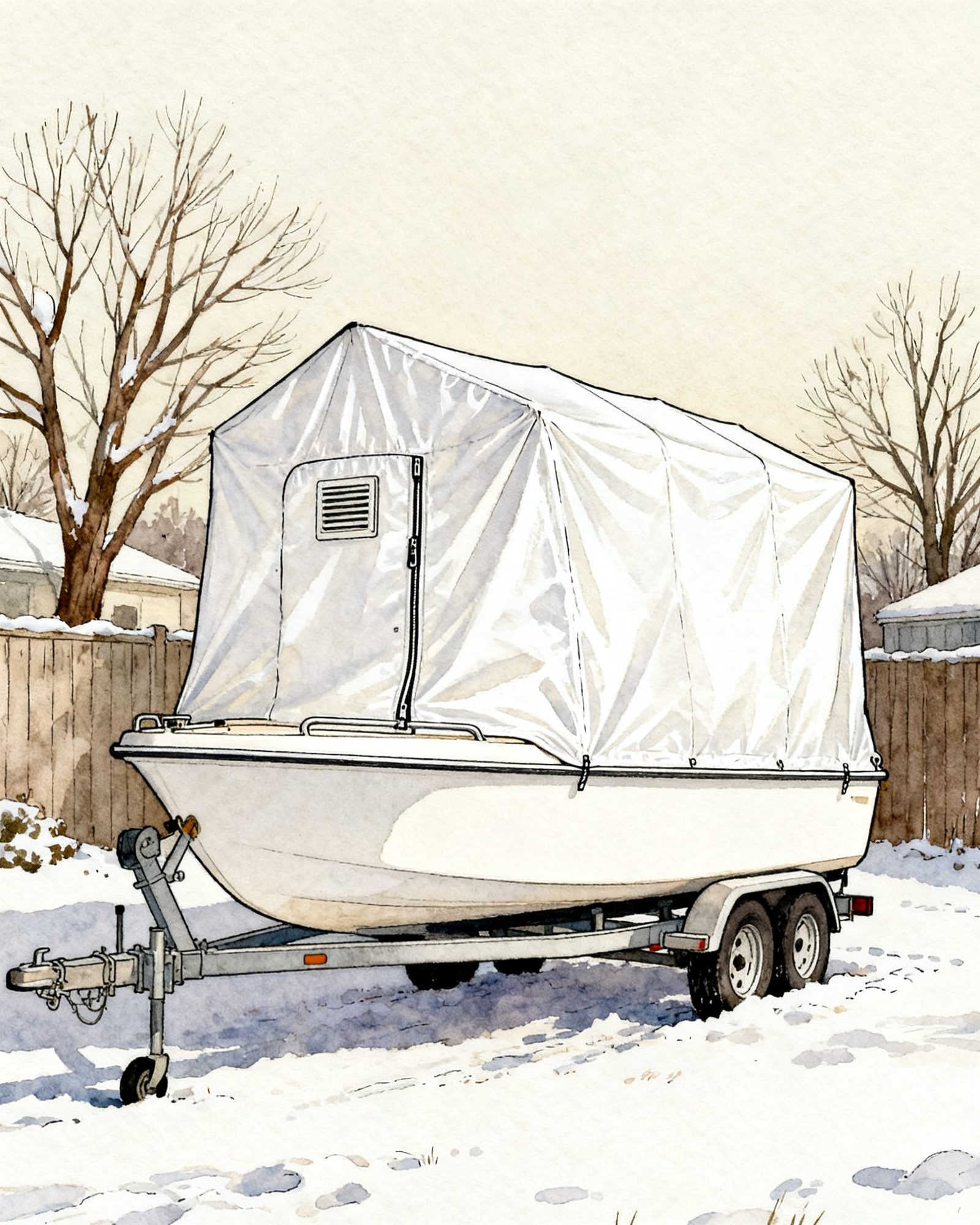
Snow on boat cover fabric is the hardest load a cover faces all year. It settles wherever the cover is flat or sagging, melts into pools that freeze again, and loads the straps, seams and supports until something gives. A cover survives a snowy winter outdoors only if it sits on a frame strong enough to give it a slope from end to end, is checked after every snowfall, and has the snow brushed off from the ground before it turns to ice. In the BoatUS Foundation’s winter cover trial, the poles supplied with covers broke under the load of pooling water, so the stock poles are not that frame. Never climb on a covered boat to clear snow, and never use anything sharp. Where snow is heavy and nobody can check the boat, shrink wrap or a building is the better answer.
Why snow is a cover’s worst load
A cover handles rain on a fitted, supported span because water runs off. Snow does not run off a gentle slope; it sits. Then it changes:
- It settles into sags. A light, dry snowfall becomes a dense layer that rests on the flattest parts of the cover, usually the cockpit behind the windshield and the open bow.
- It melts into pools. Sun and milder days turn the bottom of the layer to slush and water, which runs into the lowest point of the cover and stays there.
- It refreezes. Water that freezes in a sag holds the shape of the bowl, adds weight with every melt and snowfall, and turns the fabric stiff and easier to tear.
- It loads everything at once. The weight hangs from the straps and buckles, presses on the supports and pulls at the seams around them.
The BoatUS Foundation kept nine covers on powerboats from 17 to 25 feet through a Maryland winter with ice and snow, and its findings, as reported by Waterway Guide on BoatTest.com, match that sequence. Most covers “require a wood or metal frame for support”, “the supports that came with the cover (whether included or optional) weren’t robust enough”, and “poles broke under the load of pooling water.” Water collecting in the covers loaded the straps and buckles, so covers often needed bailing after rain or snow.
The boat underneath suffers too if the cover fails. Discover Boating’s lay-up advice notes that in winter, moisture between hardware and the deck, or in minute cracks in the gelcoat, repeatedly freezes; a cover that keeps snow and water off the deck limits that.
Before the first snow: set the cover up for it
Most snow damage is decided in the fall, by how the cover is supported.
- Build a frame, not a single peak. A ridge running from bow to stern, on uprights, gives the cover a slope along its whole length. Wood, pipe or a strap-and-pole system can do it, as long as nothing in the span is flat. A shrink-wrap maker’s instructions explain the uprights under a wrap on a sailboat with its mast down the same way: they give “the necessary pitch to allow snow and rain to run off”. Where poles go and why a single pole fails on a long span is covered in boat cover support poles.
- Stand the supports on something solid. Put each upright on a flat, firm part of the deck or cockpit sole, not on a cushion or a hatch that flexes. A support that sinks or skates sideways under snow lets the cover sag where it matters most.
- Pad the tops and the sharp points. Snow pushes the fabric hard onto everything under it. The BoatUS Foundation trial found that “even though the wear points were covered initially, sharp/wear points became evident as the covers settled”, so pad windshield corners, frame ends and support tops generously.
- Use a waterproof cover. The same trial separates waterproof from water-resistant covers and says, “Stick with waterproof for boat-storage covers.” Slush sitting on the fabric for days is exactly what a water-resistant cloth is not built for.
- Tie to the trailer, not the stands. Never tie a cover to jackstands: the BoatUS Foundation warns that in strong wind or heavy precipitation the tension can pull the supports out from under the boat.
- Fold the bimini and anything that sticks up. A raised bimini top or any canvas left up is a flat roof for snow. Fold and boot it before the cover goes on.
- Check the storage contract. BoatTest.com reports that “some yards require shrinkwrap for boats in rack storage because the extra weight, if water pooled, could cause collapse.”
Vents and snow
A cover still needs to breathe in winter, and a vent buried under snow does not. For shrink wrap, the maker’s instructions advise that “in areas receiving significant snow loads, vertical orientation is best as the vent will be less susceptible to snow cover-up.” A fabric cover’s vents are sewn where its maker put them, so the job there is to keep them clear: when you check after a snowfall, look at the vents as well as the sags.
Clearing snow safely
The aim is to take the weight off the cover without damaging the fabric or getting hurt.
- Stay on the ground. Never climb onto a covered boat in snow. The cover will not hold you, a deck under snow is slippery, and a fall from a boat on a trailer or stands is a long way down. Weight on a boat on jackstands can also shift it.
- Use something soft. A soft broom or a brush on a long handle. Nothing with a metal edge or a point: no shovel, no roof rake, no ice scraper.
- Work from the edges in and down. Brush snow down the slope and off the sides, a little at a time, so the load stays even on both sides rather than piling up on one. Stand to one side of where it will fall: snow sliding off a tall boat or a wrap comes down all at once.
- Leave a thin layer. Scraping down to the fabric risks wear and tears; a light layer left behind does no harm and slides off later.
- Clear sags gently. If a pool has formed under the snow, lift it slowly from underneath where you can reach from the ground, or bail it, rather than jabbing the low spot from above.
- No heat, no hot water, no salt. A heat gun, torch or heater near a cover is a fire risk; hot water melts snow into water that refreezes as ice; and de-icing salt is not made for cover fabric and ends up on the trailer and hardware.
- Stop if you cannot reach. If the snow is too high or too far in to reach from the ground, leave it and ask the yard or a helper with the right equipment. A ladder against a snow-covered boat is not a safe platform.
The best time is soon after the snow stops, while it is still light and loose. Wet, packed snow and snow that has started to melt and freeze are much heavier and harder to move.
Ice on the cover
Leave ice alone. Chipping or prying at ice on fabric is the quickest way to tear it, and a frozen cover is stiffer and more brittle than usual. Brush off the snow above it, let mild weather or sun melt it, and lift away loose pieces once they come free. After a thaw, look closely at the places where ice sat: the fabric, the seams and the strap points round a frozen pool are where tears start.
After each snowfall: a quick check
The BoatUS Foundation advises inspecting covers regularly, especially after snow or heavy rain, and removing pooled water. A round of the boat takes a few minutes:
- Look along the top for sags, flat areas and pools.
- Clear snow and water as above.
- Check every strap for slack or a buckle that has slipped, and re-tension.
- Make sure each support is still upright and seated; replace any that has bent or cracked.
- Check the boat is still sitting square on the trailer or stands.
- Clear the vents.
- Look at the padded points and the fabric around supports for new wear.
If the cover collapses
Do not climb on or into the boat while snow and water are on it. Clear the load from the ground first. Then, on a dry day when the deck is clear and you can stand safely, open the cover, replace or reinforce the broken support, check the cockpit for water and dry it out, and re-tension the cover. A support that failed once will fail again under the next heavy snowfall unless it is replaced with something stronger.
When a cover is the wrong answer to snow
A fabric cover on a good frame can come through a snowy winter, but only with an owner who checks it. It is the wrong choice when:
- The boat is far from home. Nobody will brush off snow after each storm.
- Snow is heavy and frequent. Each storm adds load faster than one person can clear it.
- The yard requires shrink wrap, as some do for rack storage.
- The cover is old and stretched. Fabric that already holds a bowl shape will hold snow in it.
In those cases, the alternatives are stronger. Discover Boating says “a professional shrink-wrap job is by far the best way to cover a boat for winter storage”, and Boating magazine notes that shrink wrap fits snugly and that inexpensive strapping usually provides the support needed to span open spaces. The trade-offs are weighed in boat cover vs shrink wrap, and the steps and safety rules in how to shrink wrap a boat. A wrap still needs a look after heavy snow: flat spots, loose straps and buried vents can occur on plastic too, and the same rule applies about never climbing on it.
Indoor storage removes the problem entirely. Discover Boating calls it the more expensive option, but the one that “offers the most protection for your boat”; the choice is set out in indoor or outdoor boat storage. A plain tarp is the weakest option of all under snow: Discover Boating warns that when a tarp isn’t supported and secured just right, “leaks, rips, and complete collapses are common.”
Common questions
Will snow damage my boat cover?
It can. Snow that sits in a sag turns to slush and water, stretches the fabric, loads the straps and buckles and can break the supports underneath, which is what the BoatUS Foundation saw in its winter cover trial. A cover on a strong frame with a real slope, checked after each snowfall, usually comes through a winter; a cover left on its stock poles may not.
Should I remove snow from my boat cover?
Yes, whenever it builds up on flat or sagging areas, and before it melts and freezes into ice. Do it from the ground with a soft brush or broom, and leave a thin layer rather than scraping the fabric. If you cannot reach it safely from the ground, leave it and ask the yard.
Does snow slide off shrink wrap?
Off a wrap built over a properly pitched frame, much of it does. Shrink wrap was also the top off-season choice of respondents in a BoatUS Foundation survey, about half of whom liked that someone else installs and removes it. A wrap with a flat area or a sagging strap still holds snow, so it needs checking too, and its vents must stay clear.
How much snow can a boat cover hold?
There is no safe figure to wait for. Neither the cover makers' instructions nor the BoatUS Foundation trial reported here gives a snow load a cover or its poles will carry, and wet, packed or partly melted snow weighs far more than the same depth of fresh powder. Treat any build-up on a flat or sagging area as a reason to clear it.
Can snow on the cover harm the boat underneath?
Through the cover, yes, if it fails: meltwater that gets in collects and can freeze aboard. Discover Boating advises storing a trailer boat with the drain plug out and the bow raised so water can run out, and notes that moisture in hardware joints and fine gelcoat cracks freezes repeatedly through a winter, which a cover that stays tight helps prevent.
Sources
Read next
Winter Boat Storage: Indoor or Outdoor?
Indoor vs outdoor boat storage for winter: dry stack, heated or unheated buildings, a garage, a yard, a trailer or the water, and how to cover each.
How to Shrink Wrap a Boat for Winter, Step by Step
How to shrink wrap a boat yourself: the support frame, perimeter band, heat welding, vents and doors, fire and carbon monoxide safety, and recycling in spring.
Boat Shrink Wrap Cost: What Sets the Price
Boat shrink wrap cost explained without guesswork: how yards quote per foot, what raises the price, DIY costs, a cover over several winters, and what to ask.
Fuel Stabilizer for Boat Storage: Ethanol and the Tank
How to use fuel stabilizer for boat storage, why ethanol fuel separates, how full the tank should be over winter, portable tanks, E15 and fuel safety.
What Boat Winterizing Costs and What Is Included
The cost to winterize a boat depends on size, engines, systems aboard, timing and storage. The factors in plain words, DIY supplies, and what to ask a yard.