How to measure for a bimini top: width, length, height
How to measure for a bimini top: mounting width between the mounts, length front to back, frame height from the mount up, plus headroom and folding clearance.
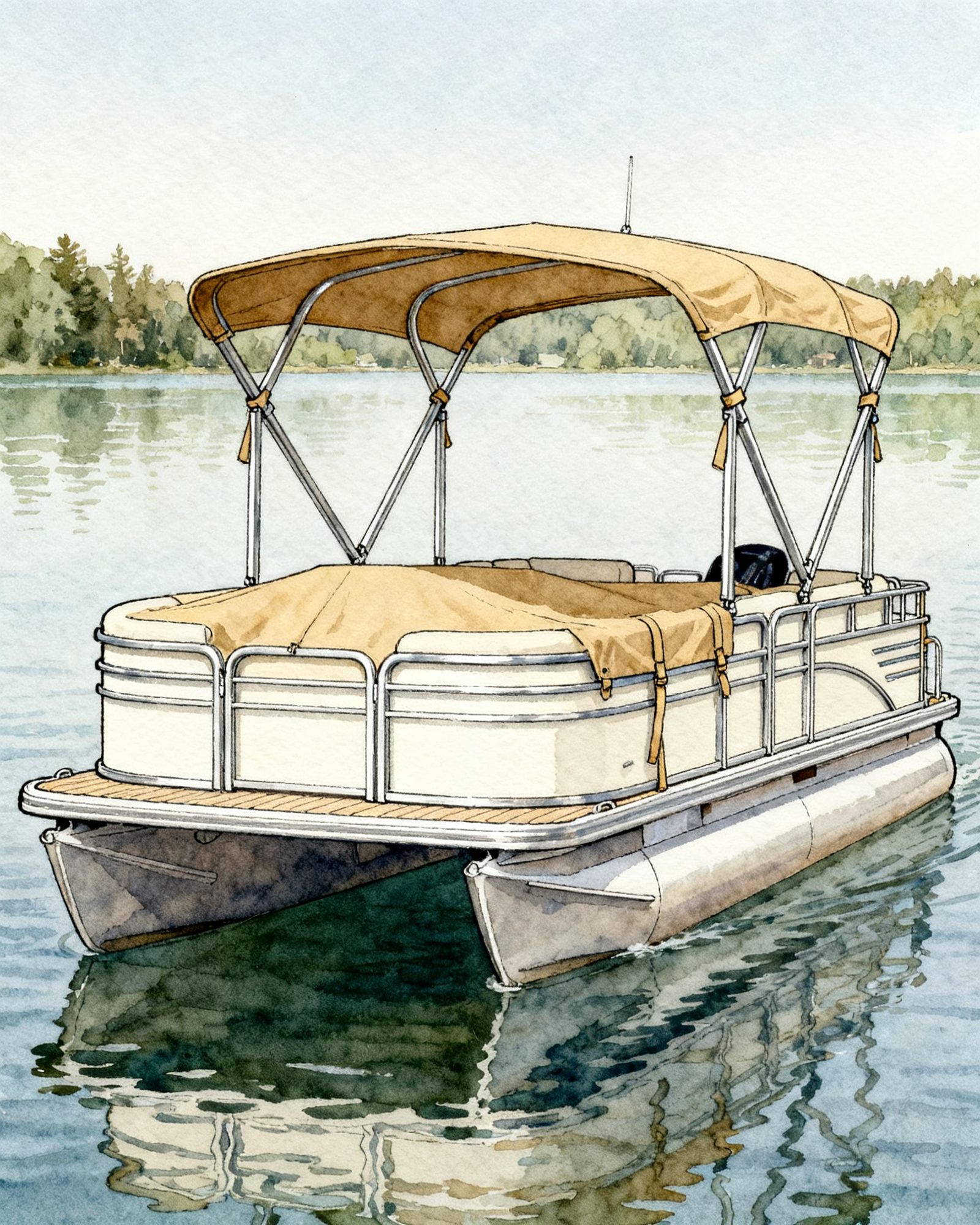
A bimini top is sold by three numbers: the mounting width (the distance across the boat between the two points where the frame attaches), the length (how far the raised top reaches from front to back) and the height (from the mounting point straight up to the top of the frame). To measure for a bimini top you take those three numbers on your own boat, at the exact spot where the mounts will go, and then check that the top clears everything around it when it is raised, folded and on the trailer. A tape measure, a roll of masking tape, a pen and a second person are all it takes.
The three numbers on every bimini listing
Complete tops are listed by a combination of the three measurements, and each one means something specific:
| Listing says | What it means | Where you measure it |
|---|---|---|
| Width (mounting width) | The span across the boat that the frame’s two ends must reach | Straight across, between the two mounting points |
| Length | How far front to back the raised top shades | Front to back along the boat, over the area you want covered |
| Height | How tall the frame stands above its mounts | From the mounting point straight up to the top of the frame |
Width is usually given as a range rather than one figure: one frame fits mounts set anywhere within that span. Listings put the three numbers in different orders, so go by the labels, not the position. Length usually comes in a few fixed sizes, and longer tops normally have more bows. Height comes in a few frame heights for each size.
A worked example, with illustrative figures: a listing that reads “height 46 in., length 6 ft, width 85 to 90 in.” fits a boat whose mounts are between 85 and 90 inches apart, shades about six feet of deck front to back, and stands 46 inches above the mounts. None of those numbers is the boat’s length or its beam.
Mounting width: the measurement that decides the fit
Mounting width is the one that has to be right. If the frame cannot reach both mounts comfortably, the top cannot be fitted however good it is. A bimini maker’s measuring instructions say to measure between the mounting points on each side of the boat and to make sure the tape is taut when you record the figure.
Three things trip people up:
- It is not the beam. The beam is the widest point of the hull, usually across the rub rail. The mounts sit on the deck, the gunwale top, the side of the cockpit or a rail, which is almost always narrower.
- It depends on where along the boat you measure. Most hulls narrow toward the bow and often toward the stern, so the width at the helm is not the width a few feet forward or aft. Measure only at the station where the frame’s ends will actually attach.
- It is not the frame width. The outside-edge-to-outside-edge frame measurement in a bimini maker’s fabric replacement instructions is for new canvas on an existing frame, not for choosing a complete top. For a complete top, mark the center of where each fitting will sit and measure between the marks; if a listing defines width another way, follow the listing.
Length: how much of the boat the top shades
A bimini maker’s measuring instructions describe length as the distance front to back along the section of the boat you want to cover, and length is what sets how much area the top shades. Decide that first: over the helm and the seats behind it, over the whole cockpit, or over the seating area of a pontoon.
On many designs the canopy reaches partly ahead of and partly behind the mounts, and straps run forward and aft from the canopy to fittings on the boat. So allow room beyond each end of the canopy for those straps to anchor on something solid, and for the canopy not to touch a windshield or a seat back.
Bow count follows length. A longer top needs more bows to hold the fabric up, so the length you choose largely decides whether you are looking at a 2-, 3- or 4-bow frame. The same maker puts the choice in plain terms: a 3-bow top for moderate coverage and a more compact footprint, a 4-bow top if maximizing shade is the priority. What else bow count changes is covered in choosing a bimini top: bows, frame and fabric.
Height: why the floor-to-mount distance matters
A bimini maker’s instructions say to measure from the mounting points vertically to choose the height, and to pick one with comfortable standing clearance. The catch is that the frame height in a listing starts at the mount, not at the floor. Your real headroom is:
floor to mount + frame height = height of the frame’s top above the floor
A worked example, again with illustrative figures: on a runabout whose deck hinges sit on the gunwale top 24 inches above the cockpit floor, a 48-inch frame puts the top of the frame about 72 inches, or six feet, above the floor. The same frame on a boat with mounts 10 inches above the floor gives only 58 inches. Measure the floor-to-mount distance where people will actually stand, not at the lowest step.
Two more points before choosing a height:
- The top is highest in the middle. The bows curve down to the mounts at each side, so headroom near the gunwale is lower than at the centerline. Check the height where the driver stands, which is often off center.
- Taller is not always better. A taller top gives more standing room but stands higher on the trailer, in a garage or under a low bridge, and presents more side area to the wind.
How to measure your boat, step by step
Do this with the boat on its trailer or in calm water, with a helper holding the other end of the tape.
- Decide what the top must shade and where it will fold. Stand at the helm and in the seats. Note where the front edge of the shade should fall and how far aft it should reach. Look at where the folded frame will lie: on the gunwales behind the helm, forward over the bow, or aft toward the stern.
- Choose the mount positions and mark them. Look for a flat, solid surface or a sturdy rail at the same spot on both sides, clear of cleats, rod holders, wiring and hatches. Put a strip of masking tape at each spot and mark the center of the fitting.
- Check that the marks sit opposite each other. Measure from each mark to a fixed point on the centerline, such as the bow eye, then to a second one, such as the center of the transom. Each pair of distances should match. A frame that pivots on mounts set one ahead of the other twists as it folds.
- Measure the mounting width. Run the tape straight across the boat from mark to mark, level and pulled taut, and write the figure down in inches. Measure twice; the second reading should match the first.
- Measure the length you want shaded. Measure front to back along the boat, flat and straight, from where you want the front edge of the canopy to where you want the rear edge. Write it down in feet and inches.
- Measure the floor-to-mount height. From the cockpit floor where people stand, measure straight up to the mount mark. Add the frame heights on offer to this figure and see which gives the standing room you want.
- Check clearances (next section). Raise a tape or a straight pole at the mount mark to the proposed frame height and look at it from the helm and from the seats.
- Record everything with photos. Photograph each mark with the tape in view. If you ask a maker or a canvas shop for advice, send the three measurements and the photos together.
Clearance checks that most measuring guides skip
A top that fits the mounts can still hit something. Check each of these before ordering:
- Windshield and console. The front bow and the canopy must clear the top of the windshield when the top is raised, and the frame must clear it as it swings down.
- The folding arc. The frame pivots on its mounts, so the bows sweep through an arc. Make sure they will not strike seats, a ski pylon, antennas, lights or the outboard on the way down, and that the folded bundle has somewhere to lie.
- Strap anchor points. The fore and aft straps need fittings on solid structure, clear of hatches and walkways.
- Overall height. With the boat on its trailer, measure from the ground to the mounts and add the frame height; that is the height to compare with a garage door, a carport or a low bridge if the top is ever up. Measure the folded top too, since that is how most boats travel.
- Trailering. A bimini maker’s instructions say to secure the folded frame tightly before running or trailering, because a loosely stowed top can vibrate, rub on nearby surfaces and wear. Practical Sailor’s advice for a long trailer trip is to remove biminis to prevent damage and chafe. More on this in trailering with a bimini top.
Deck mounts and rail mounts measure differently
Deck hinges are fastened to a flat surface such as the gunwale top or the side of the cockpit. Width is measured between the centers of the two hinge positions, and height from the hinge up. The hinges must face each other squarely, which is what step 3 checks.
Rail mounts clamp around a tube, as on a pontoon’s fence rail or some bow rails. Width is measured between the rails at the mount position, and height from the top of the rail. Rail fittings are made for a particular tube size, so note the outside diameter of the rail as a fourth measurement and match the fittings to it. Pontoon layouts, with their long straight rails, are covered in more detail in pontoon bimini tops.
Exactly how the fittings are fastened to your boat, and how to set strap tension, is in how to install a bimini top.
Replacing only the canvas: measure the frame
If the frame is staying and only the fabric is worn out, the measurements change. A bimini maker’s fabric replacement instructions say to measure the frame, not the old fabric:
- Frame width: from the outside edge of one frame tube to the outside edge of the opposite tube.
- Frame length: from the front bow to the rear bow along the frame.
- Bow count: count the bows; the same instructions list 2-bow, 3-bow and 4-bow frames as the common setups.
Those instructions also say to inspect the frame before installing new fabric, for bent tubing, worn fittings or corrosion that could affect fit and cause early wear; do it before you order. Old canvas that has stretched, shrunk or been patched gives a false reading, which is why the frame is the reference. The full job is in replacing bimini canvas on an old frame.
Common measuring mistakes
- Using the beam, or the width at the wrong station. Measure only between the mount marks.
- Measuring height from the floor. The listed height starts at the mount.
- A sagging tape. A tape that droops across the cockpit reads long. Keep it taut and level.
- Copying the old top’s size without checking it. It may never have fitted well, or the mounts may have been moved.
- Forgetting the fold. Check the arc the bows sweep, not just the raised top.
Measuring a boat for a cover is a different set of numbers, taken along the centerline and across the beam, and is explained in how to measure a boat for a cover. If the boat will be covered with the bimini folded, measure for the cover with the top folded and stowed.
When to ask a canvas shop
Measure yourself first, then go to a marine canvas shop if the mounting surfaces are curved or angled, if there is a tower, a T-top frame or a hard top in the way, if you want the bimini joined to an enclosure or other canvas, or if your measurements fall outside the ranges ready-made tops are sold in. A shop fits the frame on the boat and patterns the canvas to it, which avoids the guesswork that a standard size leaves.
Common questions
What size bimini top do I need?
The size that matches three measurements taken on your boat: the width between the two mounting points, the length of deck you want shaded, and the frame height that gives the headroom you want. Boat length alone does not decide it, because two boats of the same length can have very different widths at the mounts and different heights from the floor to the mounts.
Is bimini top height measured from the floor or from the mount?
From the mount. A listed frame height is the distance from the mounting point up to the top of the frame, so the standing room under it is that number plus the height of the mount above the floor you stand on. Mounts on a high gunwale give more headroom from the same frame than mounts low on the deck.
Should I measure my old bimini top or the boat?
Measure the boat for a complete top, because the old one may have been the wrong size or mounted in a spot you would not choose again. For replacement canvas on a frame you are keeping, a bimini maker's instructions say to measure the frame rather than the old fabric; old fabric may also have stretched or shrunk.
What if my mounting width falls between two size ranges?
Read how the listing defines its width before choosing, since sellers do not all measure it the same way. If your figure still sits at the very edge of a range, or two ranges overlap, send the maker your three measurements and ask which frame it recommends rather than guessing.
How do I measure for a bimini top boot?
A storage boot has to fit the folded top, so measure the top folded and strapped down: its length from end to end and its bulk around the thickest part. A bimini maker's instructions note that an old boot can usually be reused with new canvas if it still fits the collapsed top properly.
Sources
Read next
Bimini tops for boats: choosing bows, frame and fabric
How to choose a bimini top: 2, 3 or 4 bows, aluminum or stainless frame, round or square tube, acrylic, polyester or vinyl fabric, mounts, boots and pontoons.
How to Shrink Wrap a Boat for Winter, Step by Step
How to shrink wrap a boat yourself: the support frame, perimeter band, heat welding, vents and doors, fire and carbon monoxide safety, and recycling in spring.
Boat Cover vs Shrink Wrap: Which Is Better for Winter?
Boat cover vs shrink wrap for winter: snow, ventilation and mildew, winter access, seasons of use, waste and cost factors, and how storage and climate decide it.
How to measure a boat for a cover: length, beam and fit
How to measure a boat for a cover: centerline length, beam at the rub rail, what to add or leave out, the heights that matter and how size charts work.
Boat cover support poles and stopping water pooling
How a boat cover support pole stops water pooling: why covers sag, where poles go, how many, strap systems, tension, snow limits and removing poles to tow.