Bimini tops for boats: choosing bows, frame and fabric
How to choose a bimini top: 2, 3 or 4 bows, aluminum or stainless frame, round or square tube, acrylic, polyester or vinyl fabric, mounts, boots and pontoons.
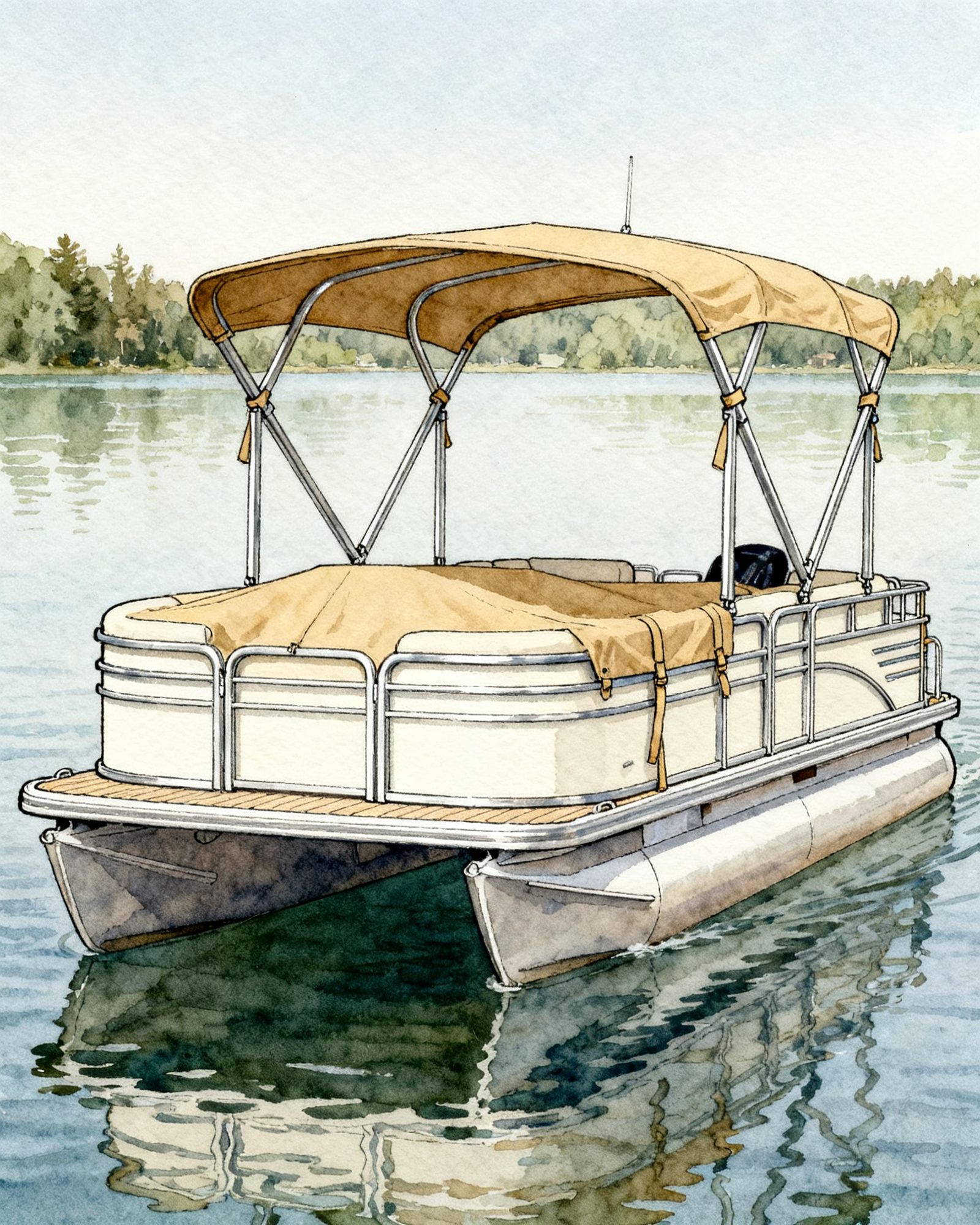
A bimini top is an open-sided fabric canopy on a folding metal frame that shades a boat’s cockpit and keeps off rain while you are at rest. Choosing among bimini tops for boats comes down to six decisions, in this order: the size (mounting width, length and height measured on your boat), the number of bows, the frame material and tube shape, the fabric, how it mounts, and how it stows. Get the size right first; every other choice only matters once a top can fit.
What a bimini top does, and what it does not
A bimini shades the helm and seats and turns light rain when the boat is still. Because the front and sides are open, it does not stop spray or wind-driven rain when the boat is moving; that is the job of a dodger, side curtains or a full enclosure, which some biminis are made to connect to. It also folds: the frame pivots on its mounts and lies down in a storage boot when the top is not needed, which is what separates it from a T-top or hard top.
A bimini also adds height and windage. A raised top catches wind when the boat is under way and at the dock, which is why it has straps fore and aft and why it is folded for trailering.
Start with size
Ready-made tops are sold by three numbers: the mounting width between the two points where the frame attaches, the length the top reaches front to back, and the frame height measured from the mount up. A top whose width range does not include the distance between your mounts cannot be fitted, whatever its fabric. The method, with headroom and clearance checks, is in how to measure for a bimini top.
2, 3 or 4 bows: what bow count changes
The bows are the curved tubes that hold the fabric up. Bow count goes with length: a longer top needs more bows to support it. A bimini maker’s measuring guide puts the common choice this way: a 3-bow top for moderate coverage and a more compact footprint, a 4-bow top if maximizing shade is the priority.
| 2-bow | 3-bow | 4-bow | |
|---|---|---|---|
| Usual length | Shortest | Middle | Longest |
| Shade | Over the helm or a small cockpit | Helm and seats behind it | Most of a cockpit or a pontoon’s seating |
| Fabric support | Fewest supports | More | Most supports, shortest spans of fabric between bows |
| Folded top | Smallest and lightest | Middle | Bulkiest and heaviest to raise and stow |
| Often fitted to | Small open boats, jon boats | Many runabouts and small center consoles | Longer runabouts, deck boats, pontoons |
The last row is a general pattern, not a rule; the length available between the windshield and the stern decides it. A 4-bow top on a short boat can overhang the stern or crowd the windshield, and a 2-bow top on a long cockpit leaves most of the seats in the sun.
Within one length, an extra bow means the fabric is held at more points, so it has less room to sag, collect water or flap. The cost is weight, a bigger folded bundle and one more set of fittings.
Frame: aluminum or stainless steel
No single frame material is right for every boat, and the trade-off is plain:
- Aluminum is lighter, so the top is easier to raise, fold and remove, and it is common on ready-made tops. Size for size it flexes more than steel. In salt water it can corrode where it touches a different metal, such as stainless fasteners or fittings.
- Stainless steel is heavier and, for the same tube size, stiffer, so it holds its shape better on a wide top.
Rinse either frame with fresh water after use in salt water. For a small boat that is folded and raised often, a light aluminum frame is usually the sensible buy. For a wide top or one that will carry an enclosure, stainless is worth considering. A marine canvas shop can say which suits a particular boat.
Round or square tube
Most frames use round tube. Some use square or rectangular tube, which, for the same outside size and wall thickness, is stiffer in bending than round tube, partly because it carries more metal, and gives a squarer look. Whatever the shape, the fittings (deck hinges, jaw slides, eye ends) are made for one tube shape and size, so replacement parts must match the frame you have.
Fabric: acrylic, polyester or vinyl-coated
The canopy fabric decides how the top looks after several seasons of sun, whether it breathes, and how it is cleaned. The three common families:
| Fabric | Strengths, as its sources describe them | Limits |
|---|---|---|
| Solution-dyed acrylic (woven) | Marine Fabricator: “high UV resistance”; water repellent and mildew resistant when treated; breathable | A “small amount of stretch/shrink”; not waterproof |
| Polyester (woven or coated) | Marine Fabricator: strong and “dimensionally stable” | Not waterproof unless coated; BoatTest’s cover report says polyester is initially stronger but weakens faster |
| Vinyl-coated polyester | Marine Fabricator: “waterproof, easy to clean, dimensionally stable” | A vinyl-coated fabric “doesn’t breathe”; degrades if its coating is damaged by solvents or vigorous cleaning |
Writing about cover fabrics, BoatTest notes that higher-end marine acrylics generally last longer, that polyester is usually rated in denier and acrylic in ounces, and that a higher denier means a coarser, sturdier fabric. Compare like with like: a denier figure and an ounce weight cannot be set against each other.
“Solution-dyed” means the color is added as the fiber is made, so it runs through the fiber rather than being dyed into the yarn or cloth afterwards. The same families are compared in more depth, for covers, in boat cover fabrics.
Waterproof or water-repellent
For a top that is often folded at the end of a wet day, breathability matters. Practical Sailor’s advice is never to roll up wet enclosures or sail covers for storage, because that leads to mold and mildew stains, and the same applies to a bimini going into its boot. A woven fabric at least lets moisture escape; a vinyl-coated top keeps rain out when raised but holds moisture in when folded, so dry any top before it is stowed for long. Whichever fabric you choose, follow its care label; cleaning instructions differ between fabrics, and cleaning boat covers and canvas explains why.
Mounts, straps and fittings
A bimini attaches in two ways:
- Deck hinges fastened to the gunwale top or the cockpit side. They need a flat, solid surface at the same spot on each side.
- Rail mounts that clamp around a rail, as on a pontoon or a boat with bow rails. They must match the rail’s tube size.
Straps then run forward and aft from the canopy to fittings on the boat and hold the raised top in place. A bimini maker’s instructions say to tighten them “evenly from side to side so the canopy sits centered and balanced,” until the canopy is firm and the fabric smooth, but not to over-tension the system. Quick-release fittings that let the frame come off without tools are worth having if the top will be removed for trailering or storage. Fitting the mounts and setting the straps is covered in how to install a bimini top.
The storage boot and stowing
The boot is the fabric sleeve that holds the folded top. Check that one is included and that it fits the folded top snugly. The same maker’s instructions say to use the straps or storage boot so the folded top cannot bounce or shift, and to secure the folded frame tightly before running or trailering, because a loosely stowed bimini can vibrate, rub against nearby surfaces and wear. When closing the top, they say to release the front straps or support arms evenly from both sides and never to disconnect one side and walk away from the other.
For a long trailer trip, Practical Sailor advises removing biminis altogether to prevent damage and chafe; trailering with a bimini top goes through the options.
Pontoon biminis
A pontoon bimini is the same idea scaled to a wide, flat deck. It usually mounts on the fence rails with rail fittings, spans a much wider width than a runabout top, and is often a 4-bow top to shade the long seating area. Because the top is large, check how it folds and where the folded frame rests, whether one person can raise it, and how its overall height compares with the garage or storage space. More in pontoon bimini tops.
Ready-made or custom
A ready-made top is the right buy when your three measurements fall comfortably inside a listed size, the mounting surfaces are flat and opposite each other, and a rectangular canopy will shade what you need. It is the wrong buy when the deck is curved or angled where the mounts would go, when a tower, windshield frame or radar arch is in the way, when you want the top to connect to an enclosure or other canvas, or when your measurements fall between sizes. Then a marine canvas shop, which fits a frame on the boat and patterns the fabric to it, is the better route. A custom top costs more than a ready-made one, and a well-fitted one avoids the compromises a standard size forces.
When a T-top or hard top is the better answer
A bimini is a folding sunshade. If what you want is a permanent roof, a different product fits:
- A T-top is a fixed frame over the console of a center console boat, with a fabric or rigid top. It does not fold and gives a handhold, a place for lights, antennas and rod holders, and shade at the helm.
- A hard top is a rigid roof on a fixed frame, usually fitted by the builder or a yard.
Both are permanent, add height that does not go away for trailering or storage, and are a bigger job than a bimini. If you want shade that disappears when you do not need it, stay with a bimini.
Before you order: a checklist
- Measure mounting width, length and frame height on your boat, and note whether the mounts are deck or rail.
- Pick the bow count that gives the length you need without crowding the windshield or overhanging the stern.
- Choose the frame: aluminum for light handling, stainless for stiffness on wide tops; check the fittings match the tube size and shape.
- Choose the fabric: solution-dyed acrylic, polyester or vinyl-coated, knowing whether you need breathability or waterproofing.
- Check what is included: deck hinges or rail mounts, straps and their fittings, and a storage boot that fits the folded top.
- Check clearance when raised, while folding and when stowed, including the trailer and garage.
- Read the care label before the first cleaning, and keep the top dry before it goes into the boot.
Common questions
Is a 3 bow or 4 bow bimini better?
Neither is better in general; they suit different lengths. A bimini maker recommends a 3-bow top when you need moderate coverage and a more compact footprint, and a 4-bow top if maximizing shade is the priority. On a small boat, a 4-bow top can be too long for the space between the windshield and the stern.
Are bimini tops waterproof?
Most are not. Woven acrylic and woven polyester shed rain when treated but let air through, so heavy or long rain can work through, and water can pool on a flat top. Vinyl-coated polyester is waterproof, but Marine Fabricator notes that a vinyl-coated fabric doesn't breathe, so it must be dried before it is folded away.
Can I trailer my boat with the bimini top up?
A bimini maker's instructions say to secure the folded frame tightly before running or trailering, and Practical Sailor advises removing biminis for a long trailer trip to prevent damage and chafe. A raised top also takes the full airflow at road speed, which strains the frame, fittings and fabric.
What is the difference between a bimini top and a T-top?
A bimini is a fabric canopy on a frame that folds down. A T-top is a fixed frame, usually over the console of a center console boat, carrying a fabric or rigid top; it does not fold, but it can carry lights, antennas and rod holders and gives something solid to hold.
Should I choose an aluminum or stainless steel bimini frame?
It depends on the size of the top and who handles it. A light aluminum frame is easier for one person to raise, fold and lift off for trailering; a stainless frame of the same tube size is heavier but flexes less, which shows on a wide top or one carrying an enclosure. If you are replacing only the fabric or a fitting, stay with the tube size and shape of the frame you have, because fittings are made to fit one tube.
Sources
Read next
How to measure for a bimini top: width, length, height
How to measure for a bimini top: mounting width between the mounts, length front to back, frame height from the mount up, plus headroom and folding clearance.
Boat Cover vs Shrink Wrap: Which Is Better for Winter?
Boat cover vs shrink wrap for winter: snow, ventilation and mildew, winter access, seasons of use, waste and cost factors, and how storage and climate decide it.
How to Shrink Wrap a Boat for Winter, Step by Step
How to shrink wrap a boat yourself: the support frame, perimeter band, heat welding, vents and doors, fire and carbon monoxide safety, and recycling in spring.
Boat cover fabrics compared: polyester, acrylic and canvas
Boat cover fabric explained: polyester, solution-dyed acrylic, cotton canvas and vinyl-coated polyester, denier vs ounces, waterproof vs breathable, labels.
How to measure a boat for a cover: length, beam and fit
How to measure a boat for a cover: centerline length, beam at the rub rail, what to add or leave out, the heights that matter and how size charts work.