Boat cover fabrics compared: polyester, acrylic and canvas
Boat cover fabric explained: polyester, solution-dyed acrylic, cotton canvas and vinyl-coated polyester, denier vs ounces, waterproof vs breathable, labels.
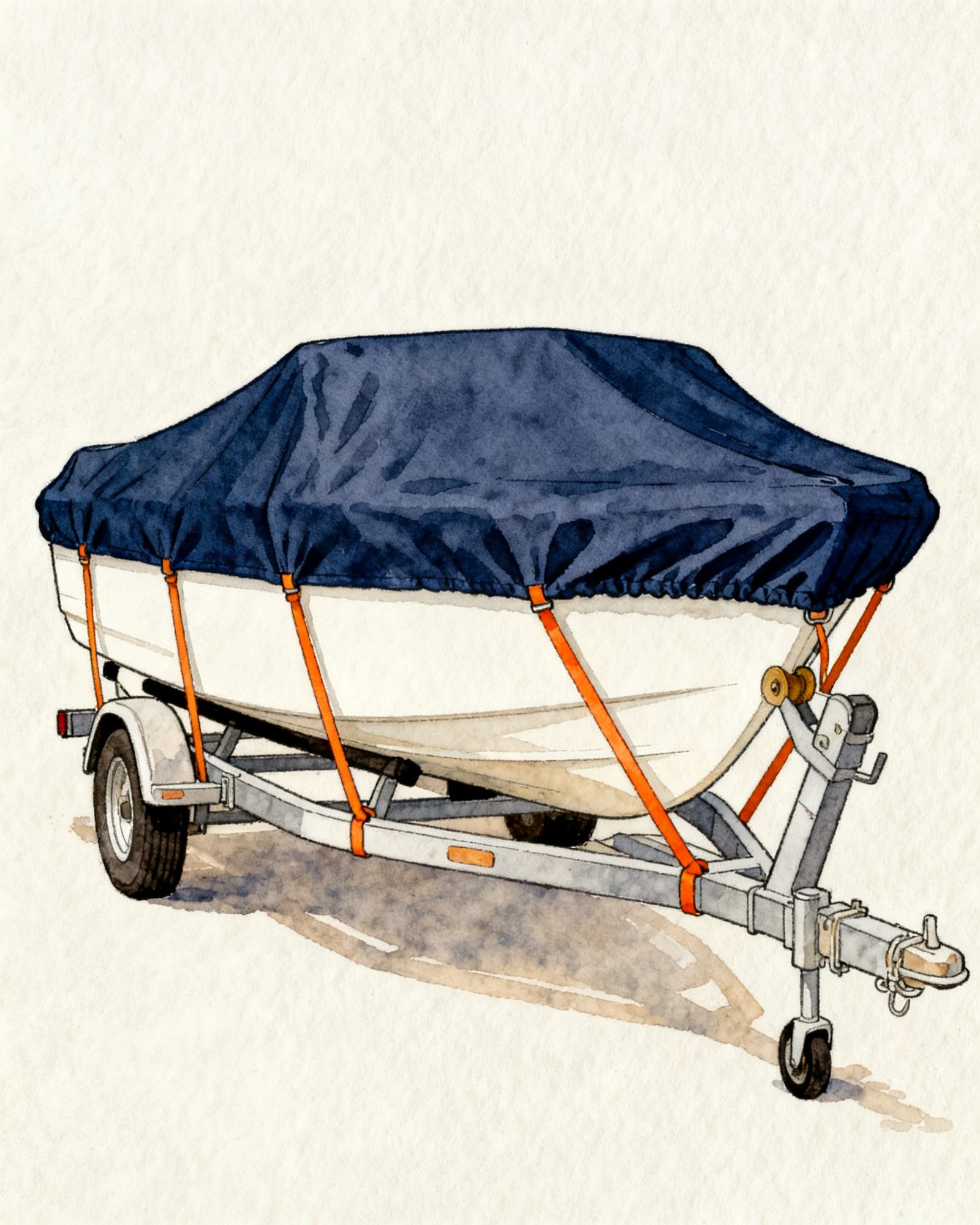
Boat cover fabric comes in four main families: woven polyester, solution-dyed acrylic, cotton or poly-cotton canvas, and vinyl-coated polyester. Polyester starts out stronger but weakens faster; solution-dyed acrylic holds its color, breathes and, in its higher-end grades, generally lasts longer outdoors; cotton canvas is the older natural option; vinyl-coated polyester is waterproof but does not breathe. The right one depends on whether the cover is towed, left outside through a winter, or kept on a boat at a mooring, and the fabric matters less than most buyers think if the cover is not supported, vented and fitted.
What boat covers are made of
Polyester
Most generic and semi-custom covers are polyester or acrylic, according to the BoatUS Foundation’s study of winter covers. The same study, as summarized by Waterway Guide on BoatTest, found that polyester is initially stronger than acrylic but weakens faster. Practical Sailor’s field comparison found a solution-dyed polyester 30 percent stronger in tension than the acrylic it was set against, and Marine Fabricator magazine describes woven polyester as strong and “dimensionally stable”, meaning it stretches and shrinks little. Polyester cover cloth is often coated; polyester coated with acrylic is, in the same magazine’s words, “very strong, high abrasion resistance, dimensionally stable.”
Polyester that is not solution-dyed is colored after the fiber is made, so the dye sits nearer the surface and tends to fade sooner in sun. Solution-dyed polyester, which one cover maker uses for its T-top covers, takes the color into the fiber the way acrylic does.
Solution-dyed acrylic
Much of what is sold as “marine canvas” today is woven synthetic cloth with no cotton in it; Practical Sailor calls these “faux-canvas fabrics”. Solution-dyed acrylic is the best known of them: a woven acrylic, colored in the “solution” before the yarn is formed. As Practical Sailor puts it, “the yarns are extruded with color already in place”, so the color runs right through each fiber instead of sitting on it. Marine Fabricator credits woven solution-dyed acrylic with “high UV resistance”, water repellency and mildew resistance when treated, and breathability, along with a “small amount of stretch/shrink”. The BoatUS Foundation summary says higher-end marine acrylics generally last longer than polyester. The trade-off is strength and stretch: polyester is initially stronger, and acrylic gives a little more under load.
Cotton and poly-cotton canvas
Cotton canvas is the older option. Practical Sailor calls it the “not-so-good-ole, biodegradable cotton canvas - with a one-year warranty”, and biodegradable is the problem on a boat: a natural fiber left damp and dirty rots. Cotton-polyester blends are also sold, and no independent comparison of them is available, so judge one by its maker’s use rating and warranty rather than by the word “canvas”.
Vinyl-coated polyester
A polyester base coated in vinyl on one or both sides. Marine Fabricator describes it as “waterproof, easy to clean, dimensionally stable”, adds that it “will degrade if the protective coatings are compromised with solvents or vigorous cleaning”, and states plainly that it “doesn’t breathe”. A vinyl fabric maker lists excellent resistance to mold, mildew, moisture and oils for the coated surface. Practical Sailor’s caution is the other half of that story: vinyl-and-fabric laminates “invite mildew by retaining condensation dampness” underneath.
Boat cover fabrics compared
| Fabric | Color and UV | Water | Breathes | Strength and stretch | Usual job |
|---|---|---|---|---|---|
| Woven polyester (coated) | Dyed after the fiber is made unless solution-dyed; fades and weakens in sun | Repels water through its coating | Many do | Strong at first, stable, weakens faster outdoors | Trailerable and universal covers |
| Solution-dyed polyester | Color in the fiber | Repels water | Usually | Strong and stable | T-top and storage covers |
| Solution-dyed acrylic | Color in the fiber, high UV resistance | Repels water when treated | Yes | Slight stretch and shrink, long-lived in sun | Custom covers, biminis, boats kept outside |
| Cotton or poly-cotton canvas | Varies by finish | Depends on treatment | Varies | Natural fiber breaks down if kept damp | Older or traditional covers |
| Vinyl-coated polyester | Coating protects base | Waterproof | No | Stable; degrades if the coating is damaged | Panels, small covers, short-term protection with good venting |
The comparison rests on Marine Fabricator magazine, Practical Sailor and the BoatUS Foundation summary; individual products within each family vary widely.
Denier and ounces: what the numbers mean
Polyester covers are usually rated in denier and acrylic in ounces, according to the BoatUS Foundation summary, a common source of confusion when shopping.
- Denier describes the yarn the cloth is woven from, not the finished cloth. The same summary explains: “The higher the number, the coarser, sturdier, and more durable the fabric.” Two polyester covers that differ only in denier can be compared on it.
- Ounces (per square yard) describe the weight of the finished cloth. Acrylic is usually sold this way, and some polyester is too: one cover maker lists its solution-dyed polyester T-top cover fabrics at 9 oz., 8 oz. and 7 oz. per square yard by grade.
Because one number measures the yarn and the other the woven cloth, there is no conversion between them.
What neither number tells you: the coating, the UV stabilizer, the thread, how the seams are built, or whether the cover was cut to fit the boat. A high-denier polyester with a weak coating and plain stitching can be outlived by a lighter acrylic with good seams. Use the number to compare like with like, never across fabric families.
Weight also matters for handling. A heavier cloth is harder for one person to throw over a tall windshield and bulkier to fold and stow, which is a real consideration for a cover that comes off every weekend.
Waterproof, water-repellent and why a cover must breathe
Water-repellent fabric makes water bead and run off; waterproof fabric stops it even when it sits there. The difference shows once water pools. The BoatUS Foundation summary is direct: waterproof and water-resistant covers are not the same, and “Stick with waterproof for boat-storage covers.”
That does not mean an airtight bag. Damp air trapped inside a sealed cover can condense on the cold underside of the fabric and drip back into the boat. Practical Sailor notes that “many of the acrylic and polyester materials are breathable”, which “lessens dreaded mold and mildew growth”, while coated laminates hold condensation. Discover Boating’s fall lay-up advice asks for covers that are “well ventilated to allow the circulation of air beneath the tarp” and calls air circulation “the best way of combating mildew”. The practical answer is a cover that sheds water on top, with built-in boat cover vents and support so water runs off before it can soak through.
Mildew, UV and fade
On synthetic cover fabrics, mildew grows mainly on what is left on the cloth (cotton, as above, can rot itself). One solution-dyed acrylic maker says its fabrics “do not promote mildew growth, however, mildew may grow on dirt and other foreign substances that are not removed from the fabric.” Discover Boating adds that “dirt and grease promote the growth of mold and mildew.” A mildew-resistant label therefore covers the cloth, not a dirty cover folded away damp. Practical Sailor’s rule: “Never roll up wet enclosures or sail covers for storage.” Stains that have already formed are a cleaning job, not a fault in the fabric.
Sunlight is the slow killer of any cover. Solution-dyed fabric keeps its color longer because the pigment is inside the fiber; on strength, the BoatUS Foundation summary found polyester weakens faster and higher-end marine acrylics generally last longer. Boating magazine notes that a fitted cover may need a waterproofing or UV treatment re-applied during its life and can last “eight to 10 years, maybe more”, while a polyethylene tarp gives “no more than three years of use”.
Seams, thread and chafe: where covers fail first
A cover is only as good as the stitching that holds it together. Check these on any cover before buying:
- Seam position. Every seam is a row of needle holes. A seam across the flat top sits where rain runs and puddles collect; seams placed lower, along the sides, see less standing water.
- Thread. A solution-dyed acrylic maker warns that bleach use and the fabric’s age may deteriorate the sewing thread and other components not made of its fabric. The cloth can outlive the stitching, so ask what thread is used and whether the maker will restitch.
- Reinforcement at wear points. The BoatUS Foundation summary reports that “sharp/wear points became evident as the covers settled”, even where they had been covered at first. Look for doubled fabric or patches at the windshield corners, the bow and the motor.
- Hem and tie-downs. Look for a shock-cord hem and straps anchored in reinforced fabric rather than stitched to a single layer at the hem edge, which takes the full pull of towing and wind.
When a seam or tear does fail, Practical Sailor calls a sewn repair “the gold standard”; tapes suit only small, low-strain spots. Sewing a structural repair is usually a job for a marine canvas shop.
Which fabric for which use
| How the boat is kept | Fabric that usually fits | Why |
|---|---|---|
| Towed often, cover on and off weekly | Heavier coated polyester or solution-dyed polyester, rated for trailering | Initial strength and abrasion resistance |
| Outside year-round in strong sun | Solution-dyed acrylic | Holds color and strength in UV; breathes |
| Outdoor winter storage | Waterproof storage cover with vents and a frame | BoatUS Foundation advice to stick with waterproof; support for snow and rain |
| At a mooring or on a lift | Acrylic or solution-dyed polyester | Long sun exposure, needs to breathe |
| Indoors or under a roof | Light breathable polyester | Keeps dust off; no weather to resist |
Two honest limits. First, a cheap cover of any fabric that flaps on the trailer or sags into a pond on top will die faster than the cloth deserves; fit and support come first, which is why custom, styled-to-fit and universal covers wear so differently, and why support poles that stop water pooling matter. Second, some covers are not built for the road at all: one T-top cover maker marks each of its fabrics “Storage Use Only - Trailering Voids Warranty”. For a choice between a fabric cover and shrink wrap over the winter, see boat cover vs shrink wrap.
Reading a cover’s label and spec sheet
Before buying, find these on the label, listing or spec sheet:
- Fiber and dye method. “Polyester”, “solution-dyed polyester” or “solution-dyed acrylic”. If it only says “marine grade” or “canvas”, ask.
- Denier or ounces. Compare within one fabric family only.
- Coating. Which side is coated and with what; coated sides need gentler cleaning.
- Water rating. Waterproof or water-resistant, in those words.
- Use rating. Trailerable, mooring, or storage only.
- Vents and support. Whether vents are sewn in and whether a support pole or system is included.
- Care label. Cleaning and retreatment instructions, kept with the cover.
- Fit. The length and beam range the cover suits; measure the boat for a cover before comparing sizes.
- Maker’s cautions. Read the instruction sheet as well as the label. One cover maker, for example, advises against using its cover in the first four weeks of owning a new boat, because compounds released by a new boat can make the cover’s dyes transfer and stain the boat or its components.
Care follows the label, not a general rule
Makers disagree, and each is writing for its own product:
- A solution-dyed acrylic maker allows, for stubborn stains or mildew on its fabric, “1 cup of bleach and 1/4 cup mild soap per gallon of clean water”, soaked in for up to 15 minutes, rinsed until all soap residue is gone and air dried. The same maker advises against bleach near bodies of water and warns that bleach and age may deteriorate the sewing thread.
- A solution-dyed polyester maker, quoted by Practical Sailor, gives a different mildew mix: “1 cup bleach with a half-cup detergent per gallon of water”.
- A cover maker’s instructions for its trailerable cover say “DO NOT USE SOAP - it can damage the protective coatings on your cover”, and call for lukewarm water and a soft brush only.
- A boat builder says “Never use bleach or a power washer” on its marine vinyl.
Practical Sailor adds that faux-canvas fabrics “should never be dry cleaned or put in a washing machine.” So the rule is the care label for that cover. Whatever it allows, the CDC warns: “DO NOT mix bleach and ammonia because it can create toxic vapors.” The step-by-step method is in cleaning boat covers.
Water repellency wears off with time and cleaning. A simple check from a treatment maker: pour water on the surface and see whether it beads. If it soaks in, the fabric can be cleaned, dried and retreated; waterproofing boat canvas explains how and what a treatment cannot fix, such as worn-through cloth or failed seams.
Common questions
What is the best material for a boat cover?
There is no single best boat cover fabric, only the best one for how the boat is kept. For a boat that sits outside in strong sun for years, a solution-dyed acrylic usually fits best because it lasts longer outdoors; for a cover that is towed and pulled on and off every weekend, a heavier polyester gives more strength to start with. Fit, support and venting decide how long either one lasts as much as the cloth does.
Is polyester or acrylic better for a boat cover?
Polyester wins on initial strength: Practical Sailor's field comparison found a solution-dyed polyester 30 percent stronger in tension than the acrylic beside it. Acrylic wins on staying power in sunlight: the BoatUS Foundation cover study, as summarized by Waterway Guide, found polyester weakens faster and higher-end marine acrylics generally last longer. Whichever you choose, a solution-dyed version carries its color inside the fiber rather than on the surface.
What does denier mean on a boat cover?
Denier describes the yarn the cloth is woven from. The BoatUS Foundation summary puts it simply: the higher the number, the coarser, sturdier and more durable the fabric. It says nothing about the coating, the UV treatment, the thread or the seams, so compare denier only between two polyester covers of otherwise similar build.
Should a boat cover be waterproof or breathable?
Both, as far as possible. The BoatUS Foundation summary stresses that waterproof and water-resistant covers are not the same and advises sticking with waterproof for storage covers, where rain and melted snow can sit on the fabric for days. A fabric that sheds rain still has to let damp air out, which is why storage covers carry vents and why fully coated fabrics need them most.
Is marine vinyl a good material for a full boat cover?
Vinyl-coated polyester is waterproof and easy to wipe clean, but Marine Fabricator magazine notes it does not breathe, and Practical Sailor says vinyl-and-fabric laminates invite mildew by holding condensation. It suits panels, small covers and short-term protection better than a full cover left on for months without good venting.
Sources
Read next
Custom, styled-to-fit or universal: which boat cover fits
Custom boat covers vs styled-to-fit and universal: how each is cut and sized, when each is the right buy, and how to find a custom fit cover for your boat.
How to measure a boat for a cover: length, beam and fit
How to measure a boat for a cover: centerline length, beam at the rub rail, what to add or leave out, the heights that matter and how size charts work.
How to tie down a boat cover for trailering
A trailerable boat cover survives the highway only when it is fitted bow first, pulled under the rub rail and strapped to the trailer frame. Steps and checks.
Bimini tops for boats: choosing bows, frame and fabric
How to choose a bimini top: 2, 3 or 4 bows, aluminum or stainless frame, round or square tube, acrylic, polyester or vinyl fabric, mounts, boots and pontoons.
How to measure for a bimini top: width, length, height
How to measure for a bimini top: mounting width between the mounts, length front to back, frame height from the mount up, plus headroom and folding clearance.