Custom, styled-to-fit or universal: which boat cover fits
Custom boat covers vs styled-to-fit and universal: how each is cut and sized, when each is the right buy, and how to find a custom fit cover for your boat.
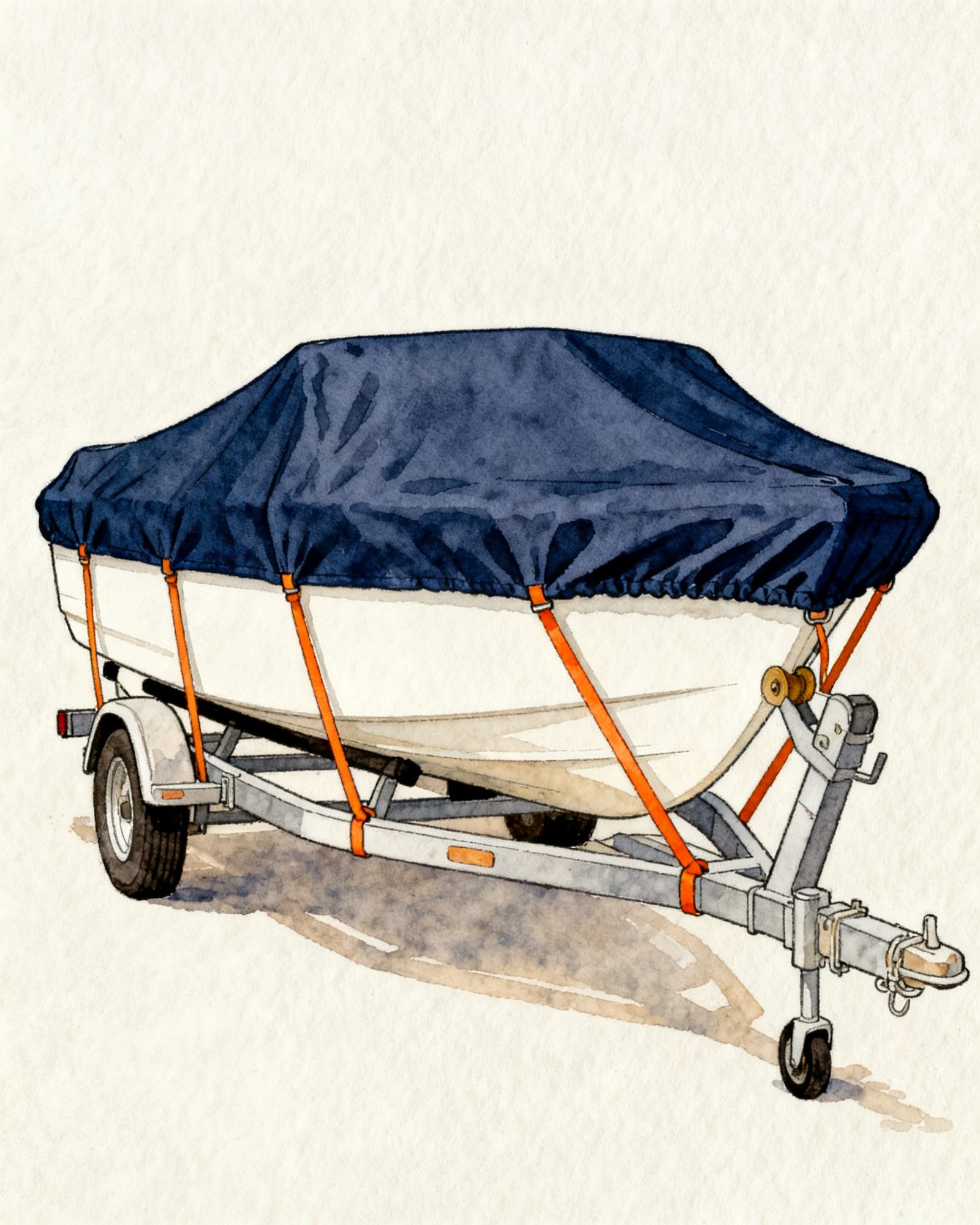
Custom boat covers are cut from a pattern made for one make, model and year, so they follow the windshield, console, rails and stern of that exact boat. That is the closest fit you can buy, and it costs the most. A styled-to-fit cover, also sold as semi-custom, is cut for a hull style, such as a V-hull runabout, bass boat, center console, pontoon or deck boat, within a length and beam range. It fits the general shape and costs less. A universal cover is sold by a size range and pulled in by elastic and straps, which makes it the cheapest and the loosest. Which one is right depends on three things: whether a pattern exists for your boat, whether the boat travels on a trailer, and how long it will sit covered outdoors. If you are looking for a cover for one particular boat by make, model and year, the last section of this page sets out what to check.
The three ways a boat cover is cut
| Custom | Styled-to-fit (semi-custom) | Universal | |
|---|---|---|---|
| Cut for | One make, model and span of model years | A hull style, in length and beam ranges | A range of lengths and beams, any similar shape |
| You order by | Make, model, year and options | Hull style, length, beam | Length and beam |
| Holds on by | Its shape, plus straps or snaps | Elastic shock cord in the hem, plus straps | Elastic in the hem and straps |
| Fit | Close, with pockets or cut-outs where the boat needs them | Good on common shapes, some slack | Loose, especially at the short end of a range |
| Cost, in words | Highest; made to order | Middle | Lowest |
| Right for | A boat with a pattern that lives outdoors or travels often | Most common boats, older boats, boats with no pattern | Short-term, indoor dust cover, a stopgap |
Custom covers
A custom cover is made from a pattern taken off a specific model. Windshield height and shape, console position, bow rails and the stern are built into the cut, so there is little slack for wind to catch or water to collect in. Because each one is sewn to order for one pattern, a custom cover costs more than the other two and takes longer to arrive. Its limit is coverage: patterns exist for popular models, not for every boat, and a pattern is cut for the boat as it left the factory, so a tower or platform added later may not be allowed for.
Styled-to-fit or semi-custom covers
A styled-to-fit cover shares one pattern across every boat of a type in a size band, for example a V-hull runabout with a walk-through windshield and an outboard. Boating magazine notes that most fitted covers “are made to fit a boat type, such as a center-console or cuddy cabin with a hardtop or a cabin cruiser.” The hem’s shock cord and the straps take up the difference. One seller says its semi-custom covers adjust to fit the beam and centerline “plus or minus 4 inches”: one seller’s tolerance, not a rule, and a few inches, not a different shape.
Universal covers
A universal cover is cut to a generic boat outline and sold in length ranges. Elastic and straps pull it onto boats of many shapes, so it always carries extra fabric somewhere. It is the right buy for a boat kept in a garage, a boat you are about to sell, or a season’s stopgap while a better cover is made. It is the wrong buy for long trailer trips, for a boat with a T-top, tower or tall console, and for a boat sitting outdoors under snow, where every loose fold becomes a place for water and ice to sit.
How each style holds up: wind, trailer and winter
Fit is a large part of what decides wear. Slack fabric lifts and flaps in wind and on the road, and each flap rubs the cover against the windshield corners, rails and cleats. A close-fitting cover moves less and lasts longer on the same fabric. For a fitted cover, Boating magazine gives a working life of “eight to 10 years, maybe more”, with the note that you may need to recoat it with a waterproofing or UV-resistant treatment along the way.
On the trailer. BoatTEST notes that “a full canvas cover that is appropriate for towing will have tie downs or straps that attach to the trailer at multiple places”, and that a mooring cover is made for a boat at a mooring, not for towing. Some covers are not made for the road at all: one maker marks its T-top covers “Storage Use Only - Trailering Voids Warranty”. Check the label before towing with any cover, and strap it as described in how to tie down a boat cover for trailering.
Snaps and drawstrings. BoatTEST describes snap-around covers as nearly as protective as full towing covers and easier to use, though the snaps can pull out, and drawstring covers as relying on a line drawn tight around the boat. Snap-on covers are usually custom work; styled-to-fit and universal covers mostly rely on elastic and straps.
Through a winter. In the BoatUS Foundation’s winter trial of nine covers on powerboats from 17 to 25 feet, reported by BoatTEST, the supports that came with the covers were not robust enough, poles broke under the load of pooling water, and sharp points that had been padded began to show as the covers settled. A better fit reduces those problems but does not remove them: any cover that sits outdoors needs support poles that stop water pooling, padding on the sharp points and a check after rain or snow. The same report warns never to tie a cover to jackstands: in strong wind or heavy precipitation the tension can pull the supports out from under the boat. If the boat stays out all winter where snow is heavy, compare a cover with shrink wrap first: see boat cover or shrink wrap for winter.
Which style is the right one for your boat
- Look for a pattern first. If a custom pattern exists for your make, model and year and the boat lives outdoors or travels often, buy custom.
- No pattern, or an older boat: go styled-to-fit. Identify the hull style (below), measure the length and beam, and pick the style and size that match. Most boats are served well here.
- Unusual boat or added equipment: go to a canvas shop. A tower or T-top added later, a one-off console, or a boat you want covered with snaps calls for a marine canvas shop that patterns on the boat itself.
- Short-term or indoors: universal is enough. Keep it for dust and light weather, and do not ask it to survive a highway or a snowy winter.
Whatever the style, measure before ordering. The method, and what to include for a swim platform, bow pulpit or trolling motor, is in how to measure a boat for a cover.
How to identify your hull style
Styled-to-fit covers are sold by hull style, so the style has to be right before the size can be. Look at the boat from the side and from above:
- Runabout or bowrider: open seating ahead of a walk-through windshield, outboard or sterndrive at the stern.
- Cuddy cabin: a small enclosed cabin in the bow, with the windshield above it.
- Center console: a single console in the middle, walkway all round, often a T-top. See center console boat covers for the console, T-top and full-cover options.
- Dual console: two consoles with a walk-through between them and an open bow.
- Bass boat: low, flat casting decks fore and aft, a trolling motor on the bow, a small console.
- V-hull fishing boat: a V-shaped bow, often tiller-steered or with a side console, sometimes with a windshield.
- Deck boat: a wide, flat bow carried almost as wide as the beam, with seating forward.
- Pontoon: a deck and fence on two or three tubes. Sellers size covers by the deck, the fence or the tubes, so check which one a chart means; see pontoon boat covers.
- Jon boat or flat-bottom: a square or nearly square bow and bench seats.
- Ski or wake boat: an inboard engine, a low windshield and often a tower.
If the boat sits between two styles, describe it to the seller and ask which pattern it was matched to.
Finding a custom cover for a specific make, model and year
Many people look for a cover by the exact boat: a model name, a span of model years, a version and a fabric. That is the right way to look, and it works when you know which details of the boat the pattern depends on.
What a custom pattern depends on
- Model years. Builders change decks, windshields and consoles over a model’s life, so a pattern covers a span of years. Two boats with the same model name from different years may not share a pattern.
- Version or trim. One model can be sold as a bowrider and a fishing version, or with different windshields and seating. The letters after a model name often mark these differences.
- Windshield. Full wraparound, walk-through or none, and its height.
- Tops and towers. A T-top, hardtop, arch or tower needs a pattern made for it, or a separate cover for the top.
- Swim platform. Built into the hull, bolted on or extended; each changes the stern of the pattern.
- Trolling motor. Some patterns are offered with and without a pocket for a bow-mounted trolling motor.
- Engine. Outboard or sterndrive, and one engine or two. The stern of a cover for an outboard boat is cut differently from one for a sterndrive.
- Rails, ladder and later additions. Bow rails and a boarding ladder fitted at the factory are usually allowed for in a pattern; equipment added after the boat left the factory usually is not.
Reading a listing for your boat
A listing for a custom cover usually names a year span, the model, one or more versions, and the fabric. Read it as four separate checks: your model year must fall inside the span, your version must be among those named, your engine and options must match any that are listed, and the fabric is a choice made on top of the pattern. A cover listed for the same model name but a different year span is a different pattern, even if the boats look alike in photographs. Write your own boat’s details in the same order (years, model, version, engine) and search with them; a listing that matches on all of them is the one to check against your tape measurements.
What to tell a cover maker
- Make, model and model year. Confirm the year from the title or registration papers rather than from memory. Look for: the model year, which can differ from the year the boat was sold.
- Version and engine. The exact version name, outboard or sterndrive, and how many engines.
- Options fitted at the factory. Windshield type, T-top or tower, bimini and where it mounts, swim platform, trolling motor, bow rails, ladder.
- Anything added later. A tower, a T-top, a platform extension or a trolling motor bracket. They are a common reason a correct pattern does not fit.
- Your own measurements. Centerline length and beam, taken with a tape, as a cross-check against the pattern.
- Photographs. A side view, the bow, the stern, and the windshield or console from above.
- The old cover’s label. If the old cover was made for this boat, look for a sewn-in label with a pattern or style number. From the same maker, a matching number means the same pattern; another maker uses its own numbers, so give that maker the boat’s details and the old number together, and ask which of its patterns fits.
Then ask the maker three questions: is the cover made for trailering, does it come with a support system, and which fabrics the pattern is offered in. The fabric choice is separate from the fit; see boat cover fabrics compared.
When no pattern exists
Older and less common boats often have no custom pattern on file. There are two good routes. A styled-to-fit cover for the hull style gives a fitted cover from stock sizes, as long as the boat is close to the standard shape for its type. A marine canvas shop can pattern a cover directly on the boat, including snaps, cut-outs for added equipment and an exact fit around a tower; it usually costs the most, but it is the only close fit for a boat no pattern covers. If the old cover fitted well, take it along and ask whether the shop can use it as a reference.
Common questions
Are custom boat covers worth it?
They are when a pattern exists for your boat and the boat lives outdoors or travels on a trailer often, because a close fit is what keeps the cover from flapping, chafing and holding water. For a boat kept in a garage, or one you plan to sell soon, a styled-to-fit cover usually does the job for much less. Compare the fabric as well as the cut before deciding.
How do I find a boat cover for my exact boat?
Start with the make, model and model year, and compare each listing's year span, version and engine with your boat. If you are not sure of the model name, look at the title, the registration papers and any owner's manual, or ask a dealer for that make to identify it from photographs. When nothing matches, a styled-to-fit cover for your hull style or a marine canvas shop are the two ways forward.
What is the difference between semi-custom and custom boat covers?
A custom cover is cut from a pattern made for one model over a span of years, so its windshield, console and stern shapes match that boat. A semi-custom or styled-to-fit cover shares one pattern across many boats of the same type and length range, so it fits the general shape and leaves some slack. For older or less common boats, semi-custom is often the only ready-made fitted option.
Can you trailer a boat with a universal cover?
Only if the cover's maker says it is made for trailering and it has straps that attach to the trailer in several places. Not every cover is, and a loose cover on the highway beats itself and the boat. Check the label: some covers are sold for storage only, and towing with one can void its warranty.
What are custom boat covers with snaps?
They fasten to snap studs set along the hull or the rub rail instead of strapping to the trailer, and they are often patterned on the boat by a marine canvas shop. Because the studs are fixed to the boat, a replacement has to line up with the ones already fitted, so tell the shop or maker they are there.
Sources
Read next
Boat cover fabrics compared: polyester, acrylic and canvas
Boat cover fabric explained: polyester, solution-dyed acrylic, cotton canvas and vinyl-coated polyester, denier vs ounces, waterproof vs breathable, labels.
How to measure a boat for a cover: length, beam and fit
How to measure a boat for a cover: centerline length, beam at the rub rail, what to add or leave out, the heights that matter and how size charts work.
Jet ski covers: fit, trailering and winter storage
How to choose a jet ski cover that fits: measuring a personal watercraft, styled vs universal, trailerable vs storage-only, straps, drying and winter storage.
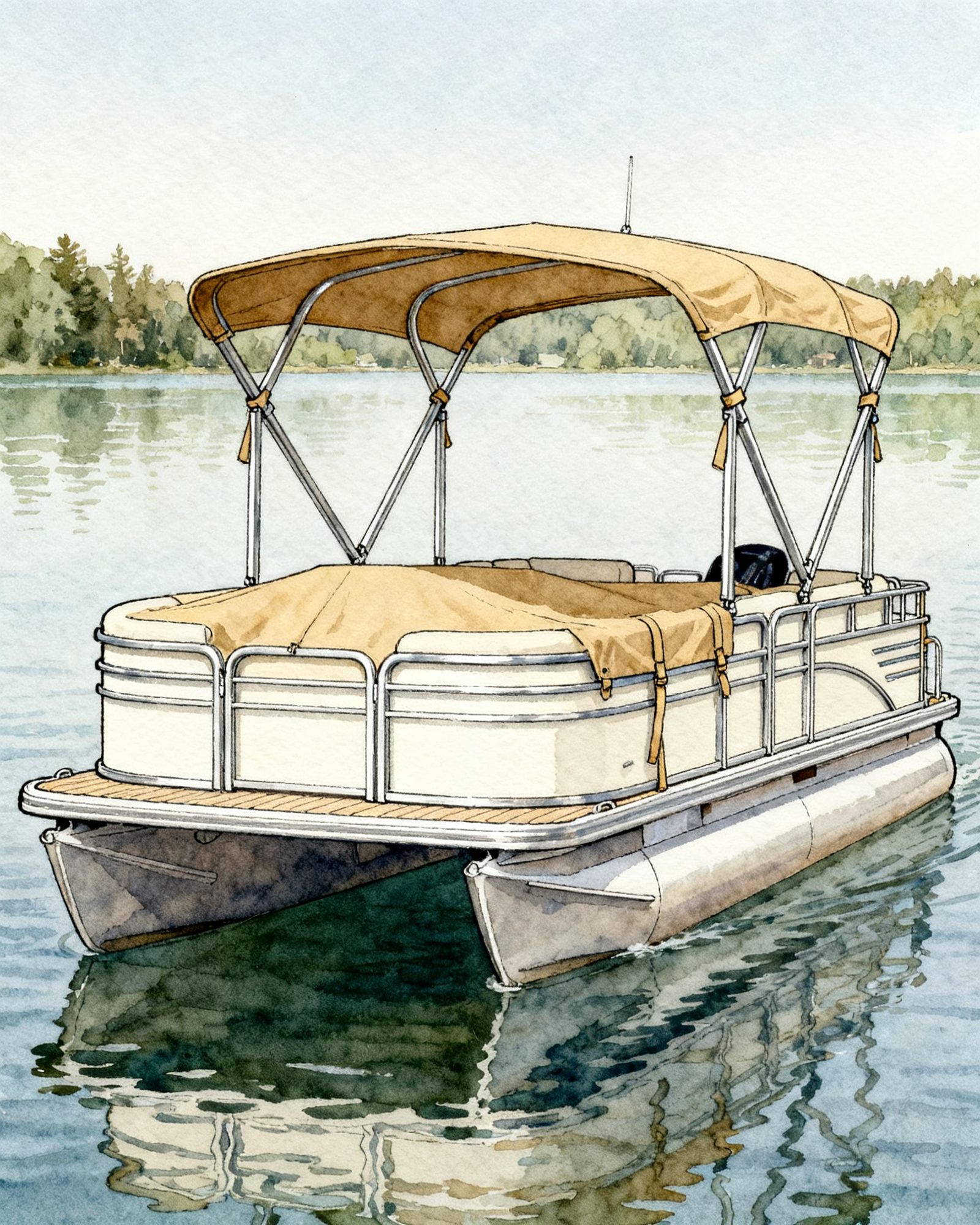
Bimini tops for boats: choosing bows, frame and fabric
How to choose a bimini top: 2, 3 or 4 bows, aluminum or stainless frame, round or square tube, acrylic, polyester or vinyl fabric, mounts, boots and pontoons.
How to measure for a bimini top: width, length, height
How to measure for a bimini top: mounting width between the mounts, length front to back, frame height from the mount up, plus headroom and folding clearance.