Pontoon boat covers: fit, support and mooring
Pontoon boat covers explained: mooring, travel and playpen styles, measuring the deck and fence, support systems against pooling, and strapping for the road.
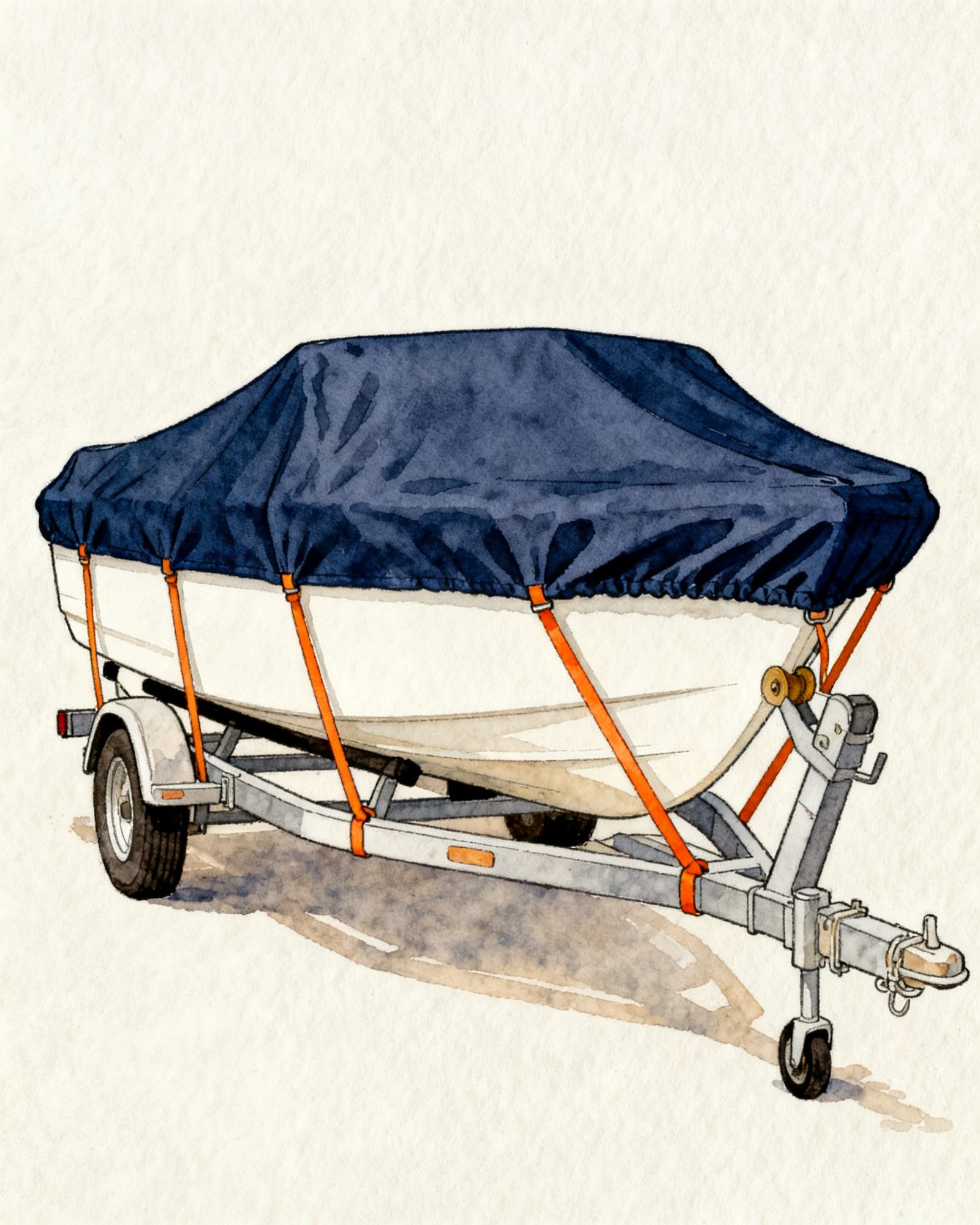
Pontoon boat covers come in three main styles, and the right one depends on where the boat lives. A full travel cover drapes over the fence and straps to the trailer, so it can stay on the road and in storage. A mooring cover fastens to the fence or rails of a pontoon kept in the water, and is not made for towing. A playpen cover covers only the fenced deck. After the style, two things decide whether it works. Size: measure the deck or fence length, the width across the fence and the fence height, and check which length the seller’s chart uses. Support: a pontoon deck is flat and wide, and a cover across it collects water unless something holds it up.
Pontoon cover styles compared
| Style | What it covers | How it holds on | Right for |
|---|---|---|---|
| Full travel or trailerable cover | Fence and deck, draped down past the deck edge | Elastic hem and straps to the trailer | A pontoon that lives on a trailer and goes on the road |
| Mooring cover | The fenced deck and seats; some also drape the outside of the fence | Snaps, clips or short straps to the fence or rails | A pontoon kept in the water at a dock, slip or lift |
| Playpen cover | The fenced deck only, fastened along the top of the fence | Snaps or clips to the fence | Quick cover between trips; leaves the outside of the fence exposed. Sellers often use the name for a pontoon mooring cover |
| Storage-only cover | Depends on the cover | Its own fittings | Indoor or yard storage; check the label before towing |
BoatTest’s buying guide puts the main rule plainly: a mooring cover is for a boat sitting at a mooring, not for towing, while “a full canvas cover that is appropriate for towing will have tie downs or straps that attach to the trailer at multiple places.” A travel cover can also serve in storage, but a mooring cover cannot go on the road.
BoatTest notes that snap-around covers are nearly as protective as full covers and easier to use, though the snaps can pull out. Because the snap studs are set into the boat, a replacement has to line up with the studs already there, a job for the original pattern or a marine canvas shop. More on these covers is in mooring covers for boats kept in the water.
Measuring a pontoon for a cover
Sellers do not agree on what a pontoon’s “length” means: some size covers by the deck, some by the fence, and some by the tubes. Read the chart’s note and measure what it asks for; if it does not say, ask before ordering.
- Stow the bimini. Fold the top down and strap it in its boot, as it will be under the cover. Look for: the highest point of the folded frame, which is now part of the boat’s height.
- Deck length. Measure along the middle of the deck from the front edge of the bow deck to the back edge of the rear deck. Look for: a front or rear deck that sticks out past the fence, which a fence length does not include.
- Fence length. Measure in a straight line along the top rail from the front of the fence to the back, with every gate closed and latched. Look for: a rail end or corner post that sticks out past the line of the fence.
- Tube length, if the chart asks for it. Measure along a tube from the tip of its nose cone to its back end. Look for: a tube that runs past the rear deck, which makes it longer than both other lengths.
- Width. Measure across the fence at its widest point, outside rail to outside rail. Then measure across the deck edge as a cross-check.
- Fence height. Measure from the deck up to the top rail. Covers are cut with a set drop down the sides, so a tall fence needs a cover made for it.
- Highest point. Measure from the deck to the top of the helm console, the stowed bimini, or a seat back, whichever is tallest.
- What sticks out. Note the motor, a ladder, a swim platform, a trolling motor, a ski tow bar or an arch. Each may need to be inside the cover, cut around, or covered separately.
A worked example. Say a pontoon has a deck of 22 feet 4 inches, a fence of 20 feet 6 inches and a width across the fence of 8 feet 2 inches. A chart sized by deck puts it in a size that covers about 22 feet; a chart sized by fence puts it in a size that covers about 20 feet. Both are “correct”: each seller labels its sizes by a different part of the boat. The mistake is mixing them. The deck length used on a fence-based chart picks a size about 2 feet too long, and the slack gathers on the flat top, where it holds water.
The general method, with what to include and what to leave out, is in how to measure a boat for a cover.
Custom, semi-custom or universal
A custom cover is patterned on one make, model and year, with the helm, gates and bimini placed correctly. A semi-custom or styled-to-fit cover is cut for pontoons in a length and width band and takes up the difference with its hem and straps. A universal cover stretches over a range of sizes and always has slack somewhere. On a pontoon, slack matters more than on most boats, because there is a wide flat roof of fabric for it to gather in. The trade-offs between the three are set out in custom, styled-to-fit or universal boat covers.
A “best pontoon cover” is the one that passes four checks for your boat: rated for towing if it travels, sold with a support system or able to take one, cut for your fence height, and allowing for the bimini, the helm and the motor.
Fabric and venting
The BoatUS Foundation trial, reported by BoatTest, separates waterproof from water-resistant covers and advises: “Stick with waterproof for boat-storage covers.” It also reports that polyester is stronger at first but weakens faster, while higher-end marine acrylics generally last longer. BoatTest’s buying guide adds that a good cover “will also have vents so that the interior of the boat can breathe.” Under a large flat cover, look for vents near the high points, and let the seats and carpet dry before covering.
Why a pontoon cover needs a support system
On a pontoon the top of the cover is a broad, nearly level sheet held only at the fence. Rain collects in the middle, its weight stretches the fabric, and the low spot gets deeper with each storm. A cover maker’s instructions describe the same mechanism on a runabout: a support pole goes under “any low areas” of the cover “that could sag and allow water to collect”.
One pole in the middle does not solve it on a pontoon. It lifts one point and leaves the fabric sagging between the pole and each side of the fence. What works:
- A pole system. Several adjustable poles joined by straps or webbing that run fore and aft, so the cover rests on a ridge along the length of the deck rather than a single peak.
- Supports spread across the width. On a wide deck, a ridge along the middle may not be enough on its own. Extra supports set either side of it, a little lower than the ridge, keep the fabric sloping from the middle down to the rails. Poles set off-center at the same height as each other leave a trough between them.
- Bows or a frame. A frame of bows across the fence, bought or built for winter, gives the cover a pitch over the whole deck.
- Tension. The straps tighten after the poles are set, not before; a loose cover forms ripples that hold water even with supports underneath.
Poles are a rain fix, not a snow structure. In the BoatUS Foundation’s winter trial of nine covers, reported by BoatTest, “the supports that came with the cover (whether included or optional) weren’t robust enough”, and “poles broke under the load of pooling water.” Placement, height and the step-by-step setup are in boat cover support poles and stopping water pooling.
Fitting around the fence, gates, bimini and motor
- Fence corners and rail ends. These are the points that wear holes. A cover maker advises covering sharp points with cloth or a sponge “to avoid stressing or tearing your boat cover.” The BoatUS Foundation trial found that “sharp/wear points became evident as the covers settled”, so check again after a few weeks.
- Gates. Latch every gate before covering; an open or loose gate pushes the cover out of shape.
- The bimini. Most covers are cut to go over a folded bimini. A bimini maker’s guidance is to use “the designated straps or storage boot to keep the folded top from bouncing or shifting”, and to “secure the folded frame tightly before running or trailering.” A loose frame under a cover rubs through it from the inside. Bow counts, storage boots and pontoon tops are compared in choosing a bimini top.
- The helm. The console is usually the highest point after the bimini. Pad its corners and any instrument visor.
- The motor. Some pontoon covers end at the transom and leave the outboard out; others include it. If the motor is left out, give it its own cover.
Putting a pontoon cover on, step by step
- Clean and dry the boat. Brush off leaves and let the deck and seats dry. Look for: water standing in seat pockets and on the deck.
- Stow the top and latch the gates. Bimini down and booted, gates closed, loose gear off the deck.
- Pad sharp points. Fence corners, rail ends, the helm, cleats and antenna mounts.
- Set the supports at a low height. Stand the poles where the cover will need lifting, on solid deck, not on cushions.
- Drape from the front. Open the cover over the bow end first, then work it back along both sides. One cover maker’s instructions say to start with the end labelled “FRONT” at the bow.
- Pull it down evenly. Work the hem down both sides so the drop is even. Look for: the cover sitting further down on one side, which means it is off-center.
- Raise the supports. Lift each pole until the fabric slopes toward the rails all round.
- Fasten and tension. Buckle every strap, then cinch them evenly. Look for: a strap pulling a new dip into the top.
- Test with water. A bucket poured over the top shows where it runs off and where it stays.
On the trailer, at the dock and on a lift
On the trailer. Use only a cover sold for trailering. One cover maker’s instructions say “you MUST use all the included straps - failure to do so will invalidate your warranty”, and that “after driving the first mile, it is a good idea to stop and check your cover to ensure that all straps are secured correctly.” The same instructions say to “remove the support pole and re-tension straps before transporting your boat.” On a pontoon, straps run under the deck to the trailer frame; keep them clear of lights, wiring and anything sharp. The full routine is in how to tie down a boat cover for trailering.
At the dock. A mooring cover fastens to the boat, not to the dock. Check snaps and clips after a windy spell; once one lets go, the wind works on the next one.
On a lift. Fasten the cover to the boat rather than the lift, so it moves with the boat when the lift is raised or lowered, and check it after a storm.
On jackstands or blocks. The BoatUS Foundation trial warns never to tie a cover to jackstands: in strong wind or heavy precipitation the tension can pull the supports out from under the boat.
A pontoon outdoors in winter
A fitted cover, a sturdy frame and regular checks can see a pontoon through a wet winter; heavy snow is harder. The BoatUS Foundation trial advises checking covers regularly, especially after snow or heavy rain, and removing pooled water; it also notes that “some yards require shrinkwrap for boats in rack storage because the extra weight, if water pooled, could cause collapse”, so read the storage contract before buying a cover for winter.
If a pontoon is shrink-wrapped instead, the job differs from a runabout. One shrink-wrap maker’s instructions say that on pontoons the wrap goes on before the perimeter band, which “is then installed over the shrink wrap just below the decking.” Follow the wrap’s own instructions, or leave it to a yard.
Common questions
What is a mooring cover on a pontoon boat?
It is a cover for a pontoon that stays in the water at a dock, slip or lift, usually fastened to the fence or rails with snaps, clips or short straps rather than strapped under a trailer. It is made to keep rain, leaves and birds off the deck between trips. It is not a towing cover, so do not put the boat on the highway under it.
Can I trailer my pontoon with the cover on?
Only with a cover its maker sells for trailering, and only with every strap fastened to the trailer. One cover maker's instructions say that not using all the straps voids the warranty, and advise stopping after the first mile to check them. Take the support poles out and re-tension before you leave.
Do pontoon boat covers need support poles?
Almost always, outside a garage. A pontoon deck is flat and wide, so a cover over it has no natural slope and water collects in the low spots between the fence rails. A pole system with several poles joined by straps lifts the cover along the middle and holds it there.
Can I leave the bimini top up under a pontoon cover?
Only if the cover is cut for a raised bimini, which few ready-made covers are. Most expect the top folded down and stowed in its boot, so the cover runs low and smooth over the fence. Fold it and strap it before measuring as well, or the height you write down will be wrong.
What is the best pontoon boat cover?
The one that matches how the boat is kept: a travel-rated cover for a pontoon that lives on a trailer, a snap or clip mooring cover for one kept on the water, and a full cover with a sturdy frame for a winter outdoors. After that, fit and support matter more than the label: a close fit with a good support system sheds water, and a loose one does not, whatever the fabric.
Sources
Read next
Mooring boat covers: snap-on covers for a boat in the water
Mooring boat covers for a boat at a slip, lift or mooring: how snap-on covers attach, fitting fasteners, keeping rain out, venting, wind, and why not to tow.
Jet ski covers: fit, trailering and winter storage
How to choose a jet ski cover that fits: measuring a personal watercraft, styled vs universal, trailerable vs storage-only, straps, drying and winter storage.
Boat cover support poles and stopping water pooling
How a boat cover support pole stops water pooling: why covers sag, where poles go, how many, strap systems, tension, snow limits and removing poles to tow.
Snow on a boat cover: load, sag and what to do
Why snow is the heaviest load a boat cover carries, the winter frame it needs, clearing snow safely from the ground, ice, and when shrink wrap is better.
Boat Shrink Wrap Cost: What Sets the Price
Boat shrink wrap cost explained without guesswork: how yards quote per foot, what raises the price, DIY costs, a cover over several winters, and what to ask.