Jet ski covers: fit, trailering and winter storage
How to choose a jet ski cover that fits: measuring a personal watercraft, styled vs universal, trailerable vs storage-only, straps, drying and winter storage.
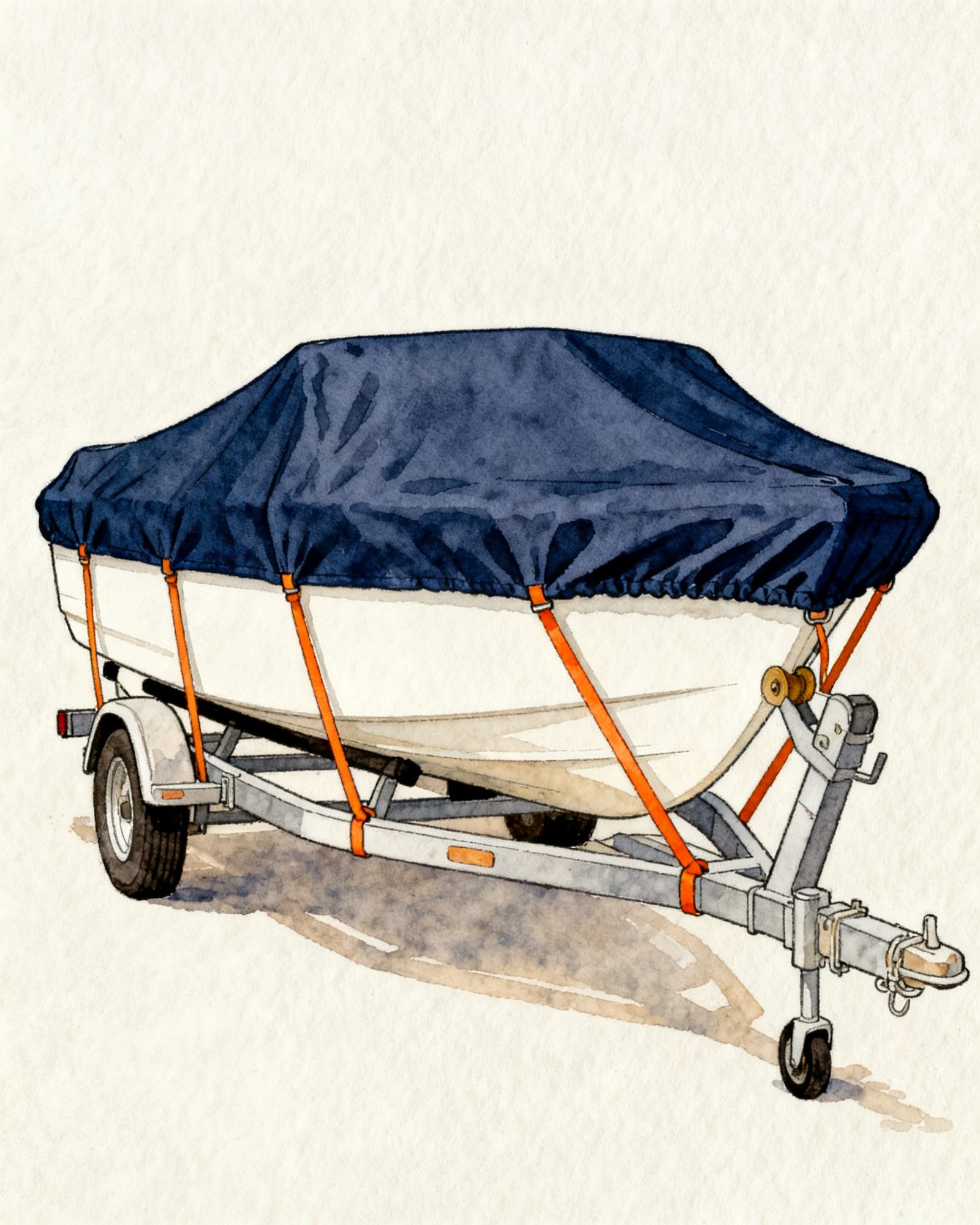
The right jet ski cover is one cut for the shape of your personal watercraft, made from a fabric that breathes, fastened with straps that run to the trailer, and labelled for trailering if you plan to tow with it on. Measure the craft’s length, its width at the widest point and its height at the handlebars before you order, and put the cover on only over a dry craft. A universal cover sized loosely for a whole class of three-seat craft can work for storage under a roof, but it is the weakest choice for a craft that lives outdoors or travels covered at highway speed.
Styled-to-fit, universal or custom: which PWC cover fits
Personal watercraft are awkward to cover. The handlebars stand up in the middle, the seat runs back in a long hump, mirrors stick out sideways, and the stern often has a boarding step or platform. A cover has to follow all of that without loose folds, because loose fabric is what flaps, collects water and wears through.
| Cover type | How it is made | Good for | Weak point |
|---|---|---|---|
| Styled-to-fit (model-specific) | Patterned for one hull and handlebar shape, often by model and year range | Outdoor storage and trailering | Fits only the craft it was patterned for |
| Universal (sized) | Sized by length and seat count, shaped for a generic PWC profile | Indoor storage, occasional outdoor use | Loose at the handlebars and stern; more fabric to flap on the road |
| Custom from a marine canvas shop | Patterned on your own craft | Modified craft, unusual hulls, accessories that change the shape | Takes longer and usually costs several times a universal cover |
A universal cover is the wrong buy when the craft will be towed covered on the highway, when it will sit outdoors through a windy season, or when it has accessories that change its outline, such as a rear rack or a fishing platform. In each case the extra slack is exactly where the wear starts. For a broader look at the three ways covers are cut, see boat cover styles compared.
How to measure a personal watercraft for a cover
Measure the craft itself, on the trailer and level, rather than relying on a figure from a brochure. Accessories added since it left the factory change the numbers.
- Length. Run the tape from the tip of the bow straight back to the farthest point at the stern you want covered. A boat cover seller’s measuring guide says to measure centerline length from the tip of the bow to the center of the stern and to include swim platforms if you want them covered; on a PWC that means deciding whether the boarding step goes under the cover. Keep the tape level, not draped over the seat.
- Width. Measure across the widest part of the hull, including any bumper or rub rail. The same guide describes it with a picture: imagine the craft clamped sideways in a vise, and measure at the points where the jaws would first touch the sides.
- Height at the handlebars. Measure from the bottom of the hull straight up to the highest point of the handlebars, with the bars turned straight ahead. This is the number that decides whether a cover pulls tight over the bars or rides up and exposes the hull.
- Mirrors and add-ons. Note anything that sticks out: mirrors, a tow hook, a rear rack, a cooler mount. Fold mirrors if they fold, and check whether a cover lists them as included in its fit.
- Write down the craft’s details. Seat count, hull length, model year range and any accessories are what styled covers are matched by.
A worked example: a three-seat craft measures 10 feet 8 inches from the bow tip to the end of the boarding step, 3 feet 11 inches across the widest point, and 3 feet 9 inches from the bottom of the hull to the top of the handlebars. A cover listed for a shorter craft will leave the step uncovered; one listed for a much longer craft will hang in folds behind the seat. The general method for every kind of boat is in how to measure a boat for a cover.
Trailerable or storage-only: read the label
Covers are sold either for storage or for storage and trailering, and the difference is in the construction, not the colour. BoatTest describes a full cover fit for towing as one that “will have tie downs or straps that attach to the trailer at multiple places.” A storage cover may have only a drawcord or a couple of buckles, enough to hold it on in a breeze but not in highway wind.
Some makers say plainly when a cover must not be towed. One cover maker’s T-top cover fabrics, for example, are each marked “Storage Use Only - Trailering Voids Warranty.” If a PWC cover carries wording like that, take it off before the trailer moves.
So, can you tow a jet ski with the cover on? Yes, when the cover is sold for trailering and fitted as its maker describes. One cover maker’s instructions for a trailerable cover say “you MUST use all the included straps” when trailering, and add: “After driving the first mile, it is a good idea to stop and check your cover to ensure that all straps are secured correctly.” No cover maker’s statement of a maximum towing speed was found for this guide, and the speed limits traded on forums are opinions with no source behind them. Treat every stop as a check, and if the cover is ballooning in the mirror, pull over and re-tension it. The full method for strapping a cover to a trailer is in how to tie down a boat cover for trailering.
Fit around the handlebars, mirrors and seat
The handlebars carry most of the load on a PWC cover: when the straps are cinched, the fabric pulls against the grips, the throttle lever and the mirror stalks. Anything sharp there can cut the cover from the inside.
- Pad sharp points. One cover maker’s instructions say to “cover sharp points (such as the corners of your boat’s windshield) with cloth or a sponge to avoid stressing or tearing your boat cover.” On a PWC the equivalents are mirror edges, the ends of the grips, a tow hook and the corners of a rear rack.
- Fold or remove mirrors where they fold or unclip, unless the cover is cut with pockets for them.
- Turn the bars straight ahead so the cover sits centered and both sides take equal tension.
- Let the hem come right under. The cover should pull below the widest point of the hull all the way round. If the hem stops at the side of the hull, wind gets under it.
Putting the cover on and taking it off
- Rinse and dry the craft. Wipe the seat, sponge water out of the footwells and leave the storage hatches open for a while. Water left inside a covered craft has nowhere to go.
- Check for a new craft. If the craft is brand new, read the cover’s instructions first. One cover maker advises against using its cover “within the first four weeks of ownership” of a new boat, because compounds in new boats can release gases that make cover dyes transfer and stain. That warning was written for boats; whether it applies to a new PWC is for the cover’s own instructions to say.
- Pad the sharp points listed above.
- Start at the bow. Find the end marked front, hook it over the bow and walk the cover back over the handlebars and seat.
- Pull the hem under the widest point all the way round, then tighten the drawcord if the cover has one.
- Fasten every strap. Run each strap around a frame member of the trailer, buckle all of them, then cinch them evenly so the cover is tight with no loose folds. Keep straps clear of lights, wiring and the wheels.
- Take it off in reverse, and fold or roll the cover only once it is dry. The same maker’s instructions say to “be sure your cover is completely dry before you store it for any extended period.”
Cover fabrics and why breathing matters
PWC covers are made from the same families of fabric as boat covers: woven polyester, sometimes with a coating, solution-dyed acrylic, and vinyl-coated polyester. Marine Fabricator describes woven solution-dyed acrylic as having “high UV resistance” and being breathable, and woven polyester as strong and “dimensionally stable”. Vinyl-coated polyester, it says, “is waterproof, easy to clean, dimensionally stable” but “doesn’t breathe.”
Breathing matters more on a PWC than many buyers expect. A craft covered after a day out still holds water in the seat seams, the hull and the compartments, and a cover that lets no vapour out keeps that moisture against the vinyl. A fabric that sheds rain but lets air move, or a cover with vents, gives the craft a chance to dry. The trade-offs between fabrics are covered in boat cover fabrics, and how vents work in boat cover vents.
Storing a PWC under a cover for winter
Winterizing the engine and its systems is a job for the owner’s manual or a mechanic. What the cover can do is keep weather, dirt and animals out while letting the craft breathe. Discover Boating’s fall lay-up advice says that “covers should be padded to prevent chafe, well secured to resist buffeting, and well ventilated to allow the circulation of air beneath the tarp,” and that “adequate air circulation is the best way of combating mildew.”
- Clean the craft first. The same advice notes that “dirt and grease promote the growth of mold and mildew.”
- Take fabric items off. Discover Boating recommends removing loose cushions and other fabric items, such as life jackets, and storing them somewhere warm and dry.
- Let water drain. Its advice for trailerable boats is to store them with the drain plug out and the bow raised, so water can run out. That was written for boats, so the owner’s manual decides whether and how it applies to a PWC’s drain plugs; any plug taken out goes back in before the next launch.
- Keep animals out. Discover Boating’s offseason advice is to clear out any food, crumbs or trash before storage and to make sure cover vents “aren’t large enough for mice to squeeze through.”
- Cover, pad and strap as above, with every strap fastened so a winter storm cannot lift the cover.
- Check it through the season. After wind, heavy rain or snow, look for straps that have worked loose, low spots holding water and rubbing at the handlebars. Clear water and snow before they stretch the fabric.
Indoor storage beats any cover when it is available. If the cover develops spots, the fix depends on the fabric; see mildew on boat canvas and follow the care label.
Common questions
Can you tow a jet ski with the cover on?
Yes, if the cover is sold for trailering, fits snugly and every strap is fastened around the trailer frame. A cover marked for storage use only should come off before the trailer moves. One cover maker's instructions say to stop after the first mile and check that all straps are still secure, and that check is worth repeating at every stop.
Should I cover my jet ski while it is still wet?
Not if you can avoid it. Water left on the seat, in the footwells and in the storage compartments has nowhere to go under a cover and turns into condensation. Wipe the seat, leave the hatches open for a while, and cover the craft once it has dried; if you must cover it wet for the drive home, take the cover off and air everything out when you arrive.
How do I get mold off a jet ski cover?
Follow the care label first, because fabric makers' instructions differ: one cover maker says to use only lukewarm water and a soft brush, with no soap, while some fabric makers give a bleach-and-soap solution for mildew on their own fabric. Clean the cover off the craft, so no cleaner reaches the seat vinyl, and never mix bleach with a cleaner that contains ammonia, which the EPA warns against. Rinse well and let the cover air dry completely before it goes back on or into its bag.
Can I leave my jet ski covered outside all winter?
Yes, under a good fitted cover, with the craft winterized first as the owner's manual describes. Strap the cover down so wind cannot work it loose, make sure air can move underneath it, and check it after storms and heavy snow. If the craft can go into a garage or shed, indoor storage is the better option.
Do I need a cover if my jet ski is kept in a garage?
Indoors a light, breathable dust cover usually does the job; a trailering cover is not needed. It keeps dust, droppings and scratches off the seat and hull, but it still needs to go on over a dry craft. A tight, non-breathing sheet over a damp craft in a closed garage can cause the same mildew a cover outdoors can.
Sources
Read next
How to tie down a boat cover for trailering
A trailerable boat cover survives the highway only when it is fitted bow first, pulled under the rub rail and strapped to the trailer frame. Steps and checks.
How to measure a boat for a cover: length, beam and fit
How to measure a boat for a cover: centerline length, beam at the rub rail, what to add or leave out, the heights that matter and how size charts work.
Custom, styled-to-fit or universal: which boat cover fits
Custom boat covers vs styled-to-fit and universal: how each is cut and sized, when each is the right buy, and how to find a custom fit cover for your boat.
Bimini tops for boats: choosing bows, frame and fabric
How to choose a bimini top: 2, 3 or 4 bows, aluminum or stainless frame, round or square tube, acrylic, polyester or vinyl fabric, mounts, boots and pontoons.
How to measure for a bimini top: width, length, height
How to measure for a bimini top: mounting width between the mounts, length front to back, frame height from the mount up, plus headroom and folding clearance.