Boat cover vent guide: why a covered boat needs to breathe
Why a boat cover vent matters: condensation under a cover, how vents move air, how many and where, adding vents to a cover, vent poles and shrink-wrap vents.
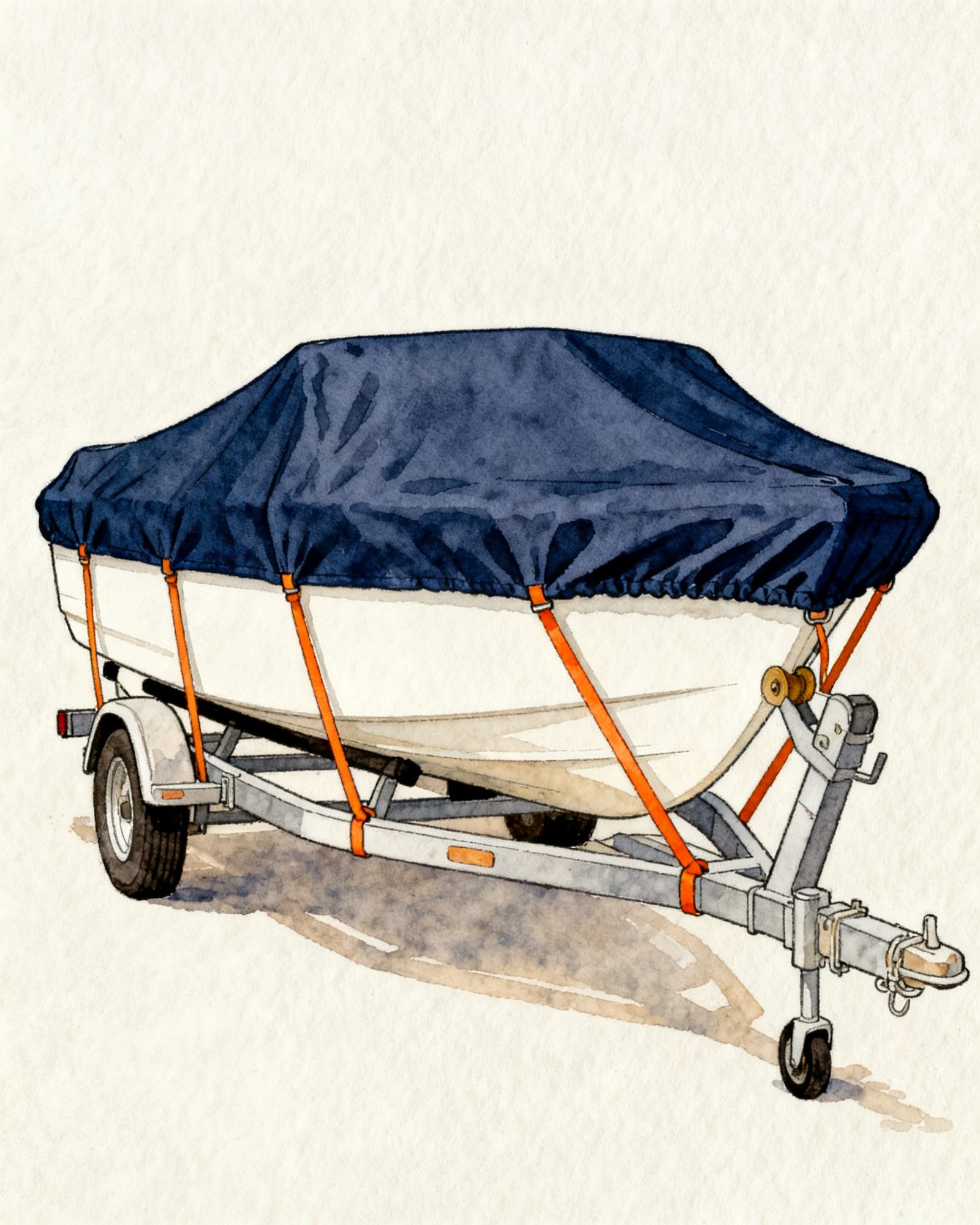
A boat cover vent lets damp air out from under a cover so it does not condense on the fabric and drip back into the boat. Any cover good enough to keep rain out also slows the air going in and out, and air shut under a cover on a cool night leaves its moisture on the underside of the fabric, on the seats and on the deck. That moisture, plus the dirt already in the boat, is what mildew grows on. Vents work in pairs, one to let air in and one to let it out, placed high and at opposite ends of the cover, with hoods that face down so rain does not fall in. BoatTEST counts them among the features of a good cover, “so that the interior of the boat can breathe”, and Discover Boating calls adequate air circulation “the best way of combating mildew”.
Why condensation forms under a cover
Air always holds some water vapor, and warm air holds more than cold air. Under a cover in the daytime, sun warms the boat and the air around it, and anything damp aboard (a cushion, a wet carpet, a puddle in the bilge, a towel left in a locker) gives off moisture into that air. At night the fabric cools first, because it faces the open sky. When the trapped air touches the cold underside, it cannot hold all its water, and drops form, the way they do on a cold glass. Next morning the drops fall onto whatever is underneath.
Three things make it worse:
- A boat covered wet. Covering after a wash or a rain shower seals the water in. Discover Boating notes that dirt and grease also promote the growth of mold and mildew, so a boat covered damp and dirty has both halves of the problem.
- Fabric that does not breathe. Practical Sailor says many acrylic and polyester cover fabrics are breathable, which “lessens dreaded mold and mildew growth”, while vinyl-and-fabric laminates “invite mildew by retaining condensation dampness”. A cover in a coated fabric relies on its vents far more than one in a breathable cloth; see boat cover fabrics compared.
- Soft things left aboard. Cushions, life jackets and blankets soak up damp and give it back slowly. Discover Boating’s lay-up advice says air circulation to all sides of cushions is essential, and better still, to remove loose cushions and store them somewhere warm and dry for the winter, along with other fabric items aboard.
The signs are easy to spot: drops on the inside of the cover, a musty smell when you open it, damp seats on a dry day, and gray or black spots on vinyl, carpet or the cover itself. If it has already started, mildew on boat canvas covers cleaning it off.
How vents move air
A vent does nothing on its own; air only moves through it when something pushes. Two things do.
- Wind. Wind blowing across a covered boat presses on the side it hits and pulls slightly at the far side. A vent on the windward side lets air in, and a vent on the opposite side or end lets it out. That is cross-flow, and it is why vents come in pairs: a single vent with no partner moves little air.
- Warm air rising. Air warmed under the cover rises and leaves through the highest opening, drawing cooler air in lower down. A vent high on the cover, under the ridge or near the top of a support pole, lets that warm, moist air escape.
On a fabric cover the vents themselves sit high, where rain and pooled water are least likely to reach them. The hem of most covers is not airtight, so some air also seeps in low around it; with a vent at each end, wind and rising warm air together sweep the whole space under the cover, not just the corner around one vent.
Where vents go and how many
The usual practice for a fabric cover is:
- At least two, at opposite ends. One toward the bow and one toward the stern, or one on each side, so air crosses the whole boat.
- High on the cover. Near the highest points, where moist air collects, and where the hood is least likely to sit in pooled water or be buried by snow.
- Hoods facing down or aft. A vent’s opening should face away from rain and spray. If the boat is towed with the cover on, an opening that faces forward catches the road wind and any rain in it, so turn the openings aft unless the vent maker’s instructions say otherwise.
- Over open space. A vent pressed against a windshield, seat back or console has nothing to breathe through. Place it where there is air below it.
- More on a bigger or more enclosed boat. A cabin, a long cockpit or a cover that comes right down below the rub rail traps more air, and more vents spread along the length help.
No general vent count for fabric covers appears in the boating sources behind this guide; a fabric cover’s vents are set by its maker. The only published count found is a shrink-wrap maker’s chart, written for shrink wrap and shown here for shrink wrap only. Do not use it to size the vents on a fabric cover.
| Boat length (shrink wrap) | Vents in the shrink-wrap maker’s guide |
|---|---|
| 0’ to 18’ | 3: two behind the windshield, one at the rear of the cockpit |
| 19’ to 24’ | 4: two in the rear of the cockpit, two forward of the windshield |
| 25’ to 32’ | 6: two in the rear of the cockpit, two at midsection, two near the bow |
| 33’ to 42’ | 8: two in the rear of the cockpit, two on the fly bridge, two amidships, two near the bow |
| 43’ and above | As above, with extras along the sides |
For shrink wrap, the same instructions add: “it is better to over ventilate the cover with additional vents rather than not installing enough.” On a fabric cover the trade-off is different: too few vents trap damp, but each vent added is one more opening to keep rain and mice out of, so add vents to a cover that sweats rather than as a matter of course.
Vents and rodents
A vent is a hole, and a stored boat is a sheltered home for mice. Discover Boating recommends vented covers or dehumidifiers for ventilation, but says to “make sure the vents aren’t large enough for mice to squeeze through.” Choose vents with narrow louvers or a mesh screen behind the opening, and check them when you check the boat. The same page advises clearing all food, crumbs and trash from the boat before storage, and patching holes around the engine, wiring, vents, under seats and in the bilge with steel wool, wire mesh or caulk.
Adding a vent to a cover that has none
Many universal and older covers have no vents. Vents for fabric covers are sold as kits: some are sewn in, some clamp the fabric between an inner and outer ring, and some sit on top of a support pole. Follow the instructions that come with the vent, and work in this order.
- Choose the spots on the boat, not on the folded cover. Put the cover on and the poles up, and mark the places, one at each end, high up and over open space. Look for: the cover sitting at least a hand’s width clear of anything below the mark.
- Check what is behind the fabric. A shrink-wrap maker’s instructions say to push against the cover before cutting to make sure nothing is behind the section, such as a seat cushion, that could block the airflow or be cut. The same check is sensible on a fabric cover. Look for: open air under the mark.
- Reinforce the fabric. A vent concentrates load on a small area, especially when the wind shakes the cover. Sew or bond a patch of matching fabric under the vent’s position before cutting, or ask a canvas shop to do it. Look for: a patch larger than the vent’s flange on all sides.
- Cut the opening to the vent’s template. Cut small and enlarge rather than the other way round. Bind or seal the cut edge as the vent kit’s instructions say, so it does not fray under the ring. Look for: a clean edge with no loose threads.
- Fit the vent with its hood facing down or aft. Tighten it so the fabric is gripped evenly all round. Look for: no gap between vent and fabric, and no puckers that will channel rain into the opening.
- Test it with a hose. Run water over the cover above the vent. Look for: no drips inside.
Cutting a cover can affect its warranty, so read the maker’s terms before you cut. For an expensive or coated cover, a marine canvas shop can sew the vents in with reinforcement.
Vent poles: support and airflow in one
Some vents are made to sit on top of a support pole. The pole holds the fabric up into a peak so rain runs off, and the vent at the peak lets the warm air out at the highest point under the cover, which is where it collects. This suits covers that need a pole anyway. The pole’s job of stopping water from pooling comes first; the options are in boat cover support poles. A vent on a pole that has slipped or fallen sits in a puddle and lets the water in, so check poles after wind and heavy rain.
Vents on shrink wrap
Shrink wrap is a closed plastic shell, so it needs vents even more than fabric does. A shrink-wrap maker’s instructions say all shrink-wrap covers “must be ventilated to eliminate moisture, condensation, and mildew during the winter storage season”. Its vents are self-adhesive and go on only after the wrap is fully shrunk: they “are not heated onto the cover at all”, and their adhesive must be hand warmed and rubbed to seal. In places with heavy snow, the same instructions say vertical orientation is best, so the vent is less likely to be buried. The full process is in shrink-wrapping a boat.
What vents cannot do
Vents slow condensation; they do not dry a wet boat. Before covering for more than a few days:
- Dry the boat. Sponge out the cockpit and lockers, and leave hatches and locker lids open under the cover so air reaches inside.
- Clean it. Mildew feeds on what is left on surfaces: food, sunscreen, fish slime and plain dirt. Discover Boating’s point that dirt and grease promote mold and mildew applies to the deck, the seats and the cover alike.
- Take soft things off. Cushions, towels and life jackets come home, as Discover Boating advises for winter.
- Dry the cover too. A cover put on wet starts its time on the boat with water already trapped under it.
- Air the boat on dry days. Opening the cover on a dry, breezy day for a few hours does more than any vent, and gives a chance to check for damp, droppings and chafe.
Common questions
Do boat covers need vents?
A cover left on for more than a few days does. BoatTEST lists vents among the features of a good cover, so that the interior of the boat can breathe, and Discover Boating calls air circulation the best way of combating mildew. A loose cover over a boat in a dry shed may get by without them; a snug cover outdoors, especially one in a coated or vinyl fabric, needs them.
Why is there condensation under my boat cover?
Damp air trapped under the cover meets fabric that has cooled overnight, and the moisture in the air condenses on the underside and drips back into the boat. The damp comes from rain that got in, a boat or cushions covered while still wet, or simply humid air. Venting, drying the boat before covering it and taking cushions off are the cures.
Can mice get in through boat cover vents?
They can if the openings are large. Discover Boating suggests vented covers or dehumidifiers for airflow but warns to make sure the vents are not large enough for mice to squeeze through. Choose vents with small louvers or a mesh screen, and patch other entry points on the boat with steel wool, wire mesh or caulk, as the same page advises.
Can I just leave the cover loose instead of adding vents?
A loose edge lets some air in, but it also lets wind under the cover, which makes it flap, chafe and pull at its straps, and it lets rain blow in. Vents move air without slackening the cover. On a trailer or outdoors in wind, a tight cover with vents is better than a loose cover without them.
Should I put vents on shrink wrap?
Yes. A shrink-wrap maker's instructions say all shrink-wrap covers must be ventilated to eliminate moisture, condensation and mildew during winter storage, and that it is better to over-ventilate than to fit too few vents. The vents go on after the wrap is fully shrunk, never heated onto it.
Sources
Read next
Boat tarp or boat cover? When a tarp is enough
A boat tarp is the cheapest cover, but it rarely fits. When a tarp is enough, when a fitted cover wins, and how to frame, tie and vent a tarp safely.
Boat cover support poles and stopping water pooling
How a boat cover support pole stops water pooling: why covers sag, where poles go, how many, strap systems, tension, snow limits and removing poles to tow.
Pontoon boat covers: fit, support and mooring
Pontoon boat covers explained: mooring, travel and playpen styles, measuring the deck and fence, support systems against pooling, and strapping for the road.
Bimini tops for boats: choosing bows, frame and fabric
How to choose a bimini top: 2, 3 or 4 bows, aluminum or stainless frame, round or square tube, acrylic, polyester or vinyl fabric, mounts, boots and pontoons.
How to measure for a bimini top: width, length, height
How to measure for a bimini top: mounting width between the mounts, length front to back, frame height from the mount up, plus headroom and folding clearance.