Center console cover options: full, console and T-top
A center console cover can mean three things: a full boat cover, a helm-only console cover or a T-top cover. How each fits, measuring, and towing.
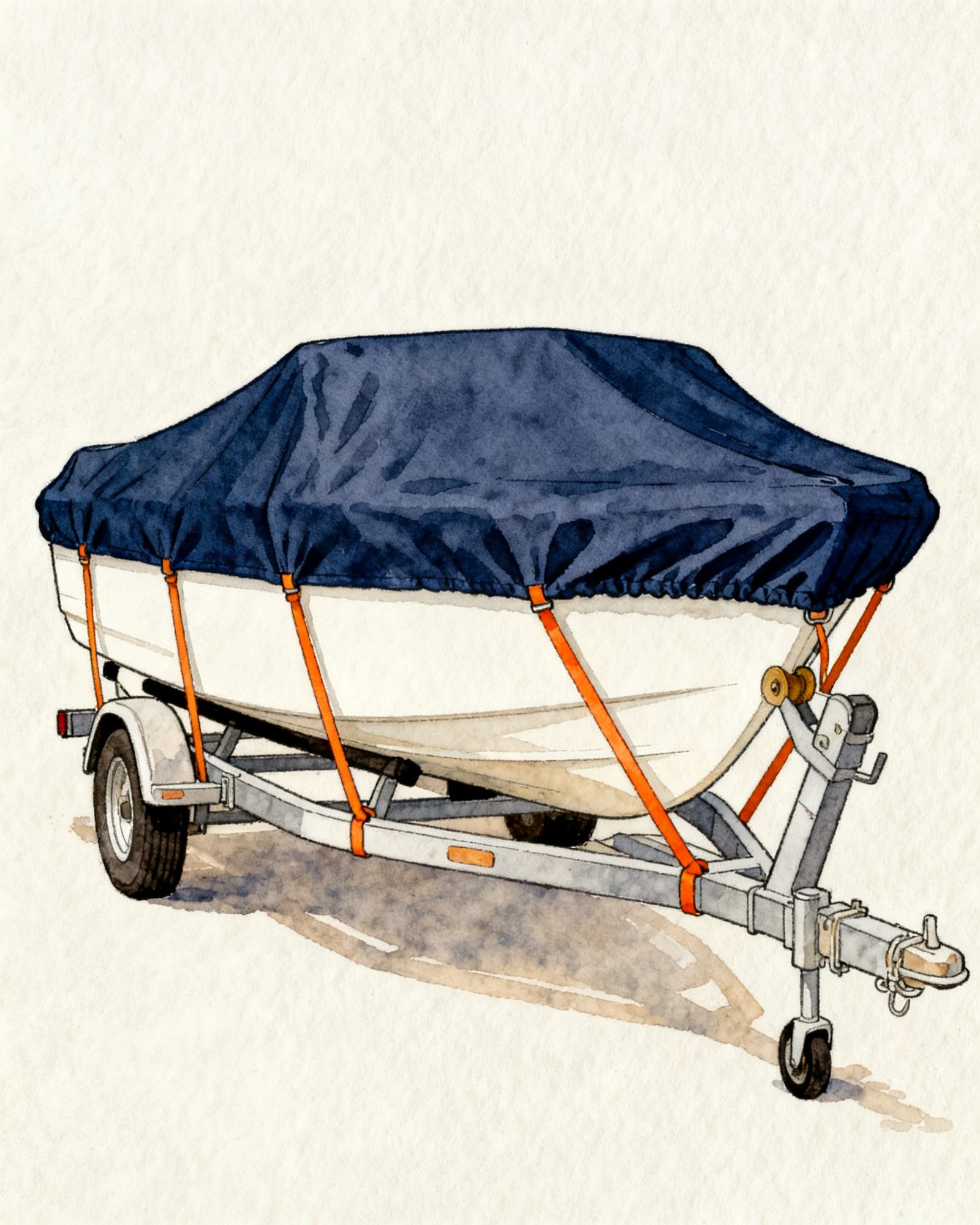
A center console cover can be three different things, and they are easy to confuse when ordering. A full center console boat cover covers the whole boat from bow to stern and down to the rub rail; it is cut either for a boat with a T-top or for one without. A console cover covers only the helm: the console, its small windshield, the wheel, the throttle and the electronics. A T-top cover protects the top itself, or the boat under it, depending on the maker. Which you need depends on where the boat lives and how often it goes out. A boat on a trailer in the yard needs a full cover. A boat in a slip that runs every weekend is often fine with a console cover between trips and a full cover for longer spells. Then measure: length and beam as for any cover, plus the console and the T-top.
Full cover, console cover or T-top cover
| Full cover, no T-top | Full cover for a T-top boat | Console cover | T-top cover | |
|---|---|---|---|---|
| What it covers | Whole boat to the rub rail | Whole boat, over or under the top | The helm only | The top, or the boat beneath it |
| How it holds on | Elastic hem, straps to the trailer | Hem, straps, fittings around the legs | Straps, drawstring or snaps at the console base | Varies by design |
| Effort to fit | More work; easier with a helper | The most work of the four | Quick, one person | Varies by design |
| Protects deck and cushions | Yes | Yes | No | Depends on design |
| Towing | Only if made for it | Only if made for it; some are storage only | Check the label | Some are marked storage only |
| Right for | Trailer or yard storage, winter | The same, on a boat with a T-top | A boat used often in a slip | Protecting the top’s canvas, or the boat below it, depending on design |
Full covers for a center console without a T-top
On an open center console the console is the high point. The cover drapes over it and slopes down to the bow and the stern, so there are two long spans of fabric with nothing under them: the open bow ahead of the console and the cockpit behind it. Both pool water. A cover maker’s instructions describe a support pole that holds up “any low areas” where the cover “could sag and allow water to collect”, and BoatTest notes that “there are poles to support the centers against water pooling.” On a center console that usually means one support in the bow and one in the cockpit; where to set them and how high is in boat cover support poles and stopping water pooling.
Things that change the cut of the cover at the bow and stern:
- Bow rails. A cover for a boat with rails is shaped over them; a cover cut without rails sits lower at the bow and will not fit a boat that has them.
- Bow pulpit, anchor roller or davit. These add length and a sharp point at the very front. Measure them into the length and pad them.
- Leaning post or seat behind the console. It raises the cockpit end of the cover and is a natural support point.
- One or two outboards. The stern of a cover is cut for the engines: one motor, two, or a motor bracket.
Covering a center console with a T-top
A T-top is the hardest part of a center console to cover, and the cover designs differ more than for any other boat. There are three common approaches.
- A full cover cut to go under the top. The cover runs from the bow to the stern under the T-top, with openings or zippered panels around the legs. The top stays exposed and shades the cover beneath it.
- A full cover that goes over the top. The cover drapes over the whole T-top and down to the rub rail, so the boat and the top are under one cover. It is the largest of the three and the most exposed to wind.
- A cover for the top only. It protects the top’s canvas or hard top and leaves the boat to its own covers.
Whichever design, the pattern has to be made for a T-top boat. A cover for a center console without a top cannot be stretched over one, and a T-top cover from one boat will not fit another with a different top height, size or leg position.
Fabric and towing. One cover maker describes its T-top covers as “100% solution-dyed polyester canvas” in three fabric grades, listed by weight as 9 oz., 8 oz. and 7 oz. per square yard. The same maker marks each of those T-top cover fabrics “Storage Use Only - Trailering Voids Warranty.” So do not assume a T-top cover can be towed: read the label first. How the common cover fabrics differ is in boat cover fabrics compared.
Console covers
A console cover is the quick answer for a boat used often. It keeps sun, rain and spray off the helm electronics, the wheel, the switch panel and the seat in front of the console, and it goes on quickly. What it does not do: it leaves the deck, the cushions and the open hatches uncovered, and it does nothing for rain collecting in the boat.
- Universal console covers come in a few sizes and pull in with adjustable straps or a drawstring. They work on consoles close to a standard shape.
- Custom console covers are cut for one console, often with snaps at its base and a cut-out or zipper for a T-top leg or a grab rail.
- Console covers on a T-top boat have to fit around or under the top and between its legs. Measure the gap between the console and the underside of the top before ordering.
A console cover is a good daily cover in a slip and a poor storage cover in a yard. For a boat kept on the water, the two work as a pair: the console cover between trips and a full cover for longer spells.
Measuring a center console for a cover
Measure the boat, not the brochure. A published length may include or leave out a pulpit or bracket.
- Centerline length. From the tip of the bow to the center of the stern, in a straight line. Look for: a bow pulpit, anchor roller or motor bracket to add.
- Beam. At the widest point, rub rail included.
- Console height. From the deck to the top of the console windshield or the highest point of the helm.
- Console footprint. The width and depth of the console at its base. For a console cover, measure around the base as well.
- Console position. The distance from the bow tip to the front of the console. Two boats of the same length can have consoles in different places.
- T-top height. From the deck to the underside of the top, and to its highest point.
- T-top size and legs. The length and width of the top, and where its legs meet the deck or console.
- Everything else. Bow rails, leaning post, outriggers, antennas, rod holders on the top, and one or two outboards.
A worked example. A 20-foot center console measures 20 feet 3 inches on the centerline with its anchor roller, and 8 feet 4 inches across the rub rail. The console stands 4 feet 6 inches from the deck, its windshield top included, and the T-top’s underside is 6 feet 10 inches above the deck. A styled-to-fit size for center consoles with a T-top, whose length range takes in 20 feet 3 inches and whose beam limit is at least 100 inches (8 feet 4 inches), is the starting point; the anchor roller, the console height and the T-top height decide whether that pattern fits. The full method is in how to measure a boat for a cover.
Custom, styled-to-fit or universal
A custom cover patterned on the exact make, model and year is the closest fit, and on a T-top boat it is often the only cover that places the leg openings correctly. Styled-to-fit covers for center consoles, with or without a T-top, are sold by length and beam band and fit common shapes. Universal covers are the weakest choice here: a center console’s high console and T-top leave a universal cover baggy in some places and tight in others. The full comparison is in custom, styled-to-fit or universal boat covers. A marine canvas shop is the right call for a T-top or tower added after the boat left the factory, outriggers, or a boat with no pattern on file.
Support, venting and the engine
Support. Plan for supports in the bow and the cockpit, and pad every hard edge: the console windshield, rod holders, the T-top frame and the bow fittings. A cover maker advises covering sharp points “with cloth or a sponge to avoid stressing or tearing your boat cover.” In the BoatUS Foundation’s winter trial of nine covers, reported by BoatTest, sharp and wear points “became evident as the covers settled”, even where they had been covered at first.
Venting. BoatTest notes that a good cover “will also have vents so that the interior of the boat can breathe.” A center console under a full cover holds damp air around the helm electronics and the cushions; vents let it out. More in boat cover vents.
The engine. Never run the engine with a full cover on or a canvas enclosure closed up around the boat. The U.S. Coast Guard lists “inadequately ventilated canvas enclosures” among the ways carbon monoxide builds up on a boat, and warns that it “can remain in or around your boat at dangerous levels even if your engine or the other boat’s engine is no longer running!”
Towing a center console under a cover
BoatTest’s buying guide says “a full canvas cover that is appropriate for towing will have tie downs or straps that attach to the trailer at multiple places”, and that a mooring cover is for a boat at a mooring, not for towing. Check the label: some T-top covers are storage-only. If the cover is made for towing:
- Fasten every strap. One cover maker’s instructions say “you MUST use all the included straps - failure to do so will invalidate your warranty.”
- Remove the support poles and re-tension the straps before leaving, as the same instructions say.
- Stop after the first mile and check every strap, as the same instructions advise.
- Pad the T-top frame and console corners again before a long trip; road wind finds every hard edge.
Strap routing and the checks on the road are in how to tie down a boat cover for trailering. In the yard, never tie a cover to jackstands: the BoatUS Foundation trial found the tension can pull the supports out from under the boat in strong wind or heavy precipitation.
Putting a full cover on a T-top boat, step by step
- Clear the boat. Remove loose gear, rods from the T-top holders and anything on the console. Look for: antennas that should be lowered.
- Pad the hard points. Console windshield corners, T-top frame corners, the anchor roller and rail ends.
- Find the front. Many covers are labelled at the bow end; one cover maker’s instructions say to drape the end marked “FRONT” at the bow.
- Work from the bow back. Pull the cover over the bow, then along both sides, guiding it around the T-top legs or over the top as the design requires.
- Close the leg openings. Zip or fasten any panels around the legs so no gap is left for rain to enter.
- Pull the hem below the rub rail all round.
- Set the supports in the bow and cockpit and raise them until the fabric slopes away.
- Fasten and tension the straps evenly, then check for new dips where a strap crosses the top.
Common questions
Do you need to cover a center console boat?
A boat that lives outdoors gains the most from a full cover, because the open deck collects rain, leaves and bird droppings, and the helm electronics and seat cushions sit in the sun. A boat kept in a slip and used often is often well served by a console cover between trips and a full cover for longer spells. Indoors, a light dust cover or no cover may be enough.
Can you put a boat cover over a T-top?
Yes, with a cover cut for it. Some full covers go over the top of the T-top and down to the rub rail, so the whole boat, top included, is under one cover; others are cut to fit under the top and around its legs. A cover made for a boat without a T-top will not fit either way, so the hull style you order must include the top.
How do I measure my center console for a cover?
Measure the centerline length from the tip of the bow to the center of the stern, and the beam at the widest point including the rub rail. Then add the console: its height from the deck and its footprint at the base. If there is a T-top, measure the height to its underside, its length and width, and where its legs stand.
Can I trailer my center console with a T-top cover on?
Only if its maker says the cover is made for towing. One cover maker marks each of its T-top cover fabrics "Storage Use Only - Trailering Voids Warranty", and a T-top is a tall, wind-catching shape on the highway. If the label allows towing, fasten every strap and stop to check them after the first mile.
What is a boat console cover?
A smaller cover that fits over the helm only: the console, its windshield, the wheel, the throttle and the electronics. Universal ones are held on with adjustable straps or a drawstring; custom ones may snap to the base of the console. One person can put it on and take it off quickly, so it suits daily use, but it leaves the deck and cushions uncovered.
Sources
- Cover maker's blog: T-top cover fabrics (storage-use-only fabrics)
- Cover maker's instruction sheet for a trailerable boat cover (PDF)
- BoatTest: How to select the right boat cover
- BoatTest / Waterway Guide: What you need to know about boat covers for winter storage
- U.S. Coast Guard Boating Safety: Carbon monoxide accumulation
Read next
Boat seat covers: protecting marine vinyl seats
Boat seat covers explained: what damages marine vinyl, seat covers vs a cockpit or full cover, pontoon seat covers, fitting them, and cleaning vinyl safely.
Outboard motor covers: full, half and vented hoods
How to choose an outboard motor cover: half hood, full or vented running cover, sizing by the cowling, moisture, covering a hot engine, and towing safely.
Pontoon boat covers: fit, support and mooring
Pontoon boat covers explained: mooring, travel and playpen styles, measuring the deck and fence, support systems against pooling, and strapping for the road.
Bimini tops for boats: choosing bows, frame and fabric
How to choose a bimini top: 2, 3 or 4 bows, aluminum or stainless frame, round or square tube, acrylic, polyester or vinyl fabric, mounts, boots and pontoons.
How to measure for a bimini top: width, length, height
How to measure for a bimini top: mounting width between the mounts, length front to back, frame height from the mount up, plus headroom and folding clearance.