Boat Antifreeze: Which Kind and Where It Goes
Marine antifreeze explained: propylene glycol vs automotive ethylene glycol, what a -50°F burst rating means, where it goes on a boat, and how to dispose of it.
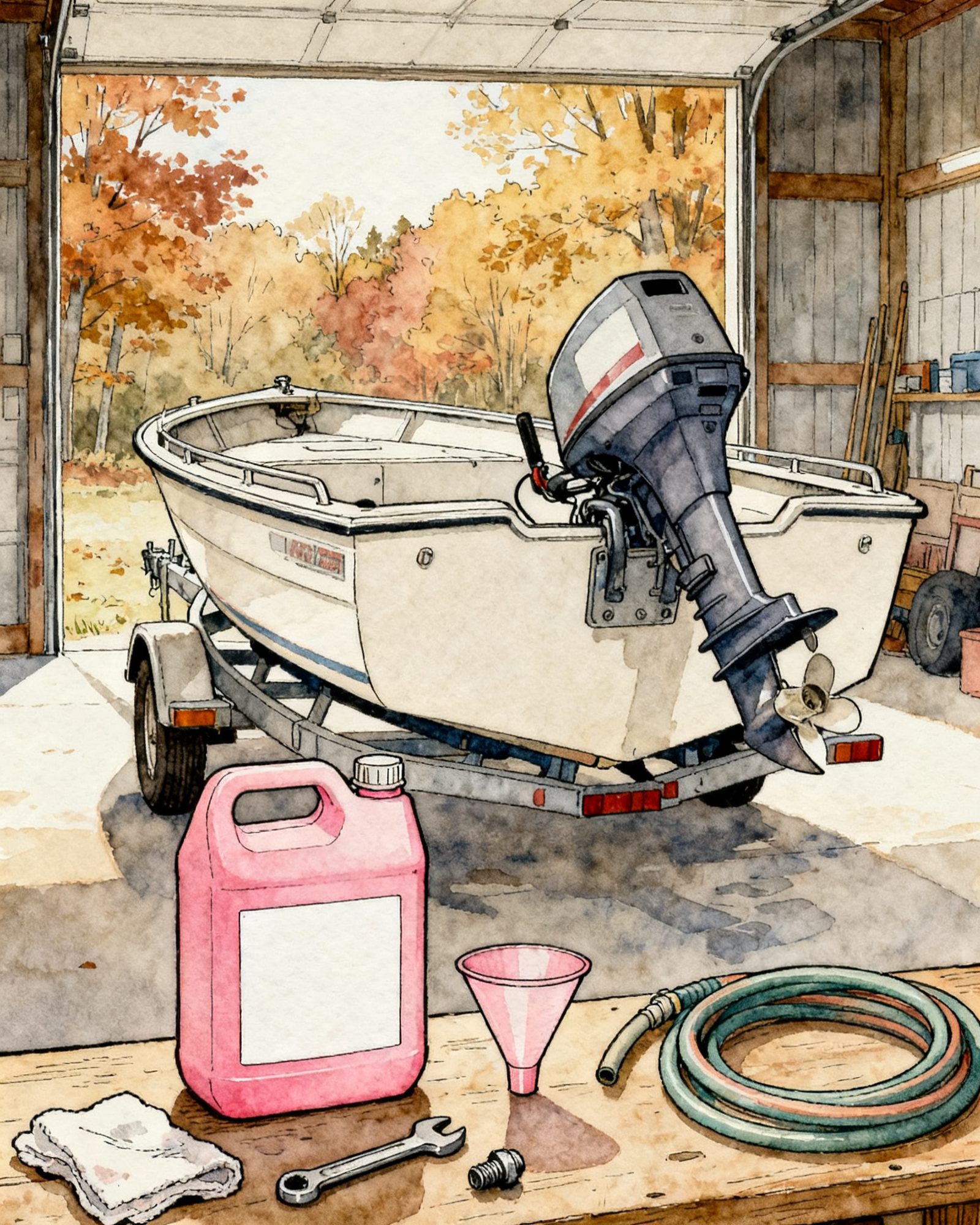
Boat antifreeze for winterizing is propylene glycol, sold as “RV/marine” or “non-toxic” antifreeze and usually pink. Marine antifreeze of this kind goes into every system that holds water, empties overboard or feeds a tap, and is not drained completely: the engine’s raw-water cooling side, the fresh-water system, the head, livewells and washdown pumps. Automotive antifreeze, usually green ethylene glycol, is much more toxic and does not belong in any of those. The number on the jug, often -50°F, is a burst rating, not the temperature at which it starts to freeze. A closed engine cooling system is a separate case: it takes the coolant its engine maker specifies. In spring, the antifreeze is flushed into a container, not into the lake.
Propylene glycol vs ethylene glycol
New York Sea Grant and the EPA give the same rule: use propylene glycol antifreeze (usually pink), which is less toxic than ethylene glycol (usually green), to winterize all systems except “closed” or fresh-water cooling systems. Discover Boating’s winterizing products page calls ethylene glycol “the green stuff”, used in car cooling systems and some sterndrive and inboard engines with closed cooling, and toxic; propylene glycol, “the pink stuff”, is the one for a boat’s drinking-water system.
| Propylene glycol (“RV/marine”) | Ethylene glycol (automotive) | |
|---|---|---|
| Usual color | Pink, per NY Sea Grant and the EPA | Green, per the same sources |
| Toxicity | FDA: “generally recognized as safe” for use in food | Swallowing larger amounts “can cause serious illness or death” (ATSDR) |
| In the body | Breaks down without forming harmful crystals (ATSDR) | Forms crystals that can collect in the kidneys (ATSDR) |
| In water and soil | Breaks down “within several days to a week” (ATSDR) | Harmful to aquatic life, like all antifreeze (Connecticut DEP) |
| On a boat | Raw-water side, fresh water, head, livewells, washdown | Only a closed cooling system whose manual names it |
Both sources say “usually”, and people also search for blue and green boat antifreeze: the color is a hint, not a guarantee. Read the label for the glycol type.
Why ethylene glycol is kept off the raw-water side
The federal Agency for Toxic Substances and Disease Registry (ATSDR) says ethylene glycol is odorless but sweet-tasting, that accidental swallowing happens because antifreeze is “a sweet tasting, brightly colored liquid”, and that exposure to large amounts can damage the kidneys, nervous system, lungs and heart. It advises against spilling or draining antifreeze on the ground “to prevent children from playing in a puddle of ethylene glycol”. Connecticut’s guidebook adds that it poses a serious health hazard to humans and animals if swallowed. Whatever goes through a raw-water engine, a head or a washdown is headed overboard, so those systems get the less toxic glycol.
Less toxic is not harmless. ATSDR notes that frequent skin exposure to propylene glycol can sometimes irritate the skin, and Connecticut’s Department of Environmental Protection says antifreeze in general “is harmful to marine and aquatic life” and should be handled with eye protection, clothing that covers the skin, and rubber gloves.
Burst point vs freeze point: reading the label
An antifreeze maker’s product data sheet defines the two numbers. The freeze point is “the temperature at which ice crystals begin to form”. The burst point is the temperature at which the fluid “overcomes the hydrostatic pressure of the pipe and bursts”. In its words, burst protection is needed when equipment or plumbing “remains idle”, freeze protection when the fluid and plumbing must stay flowable and pumpable. A boat laid up for winter is the first case.
Its own table shows how far apart the numbers are:
| Product type on that sheet | Burst point | Freeze point (ice crystals begin) |
|---|---|---|
| Glycerin-free -50 | -50°F | 2°F |
| -100 | -100°F | -24°F |
| A second -50 blend | -50°F | 15°F |
| -50 blend containing ethanol | -50°F | 20°F |
So every -50°F product on that sheet starts forming ice crystals above 0°F, at 2°F to 20°F depending on the blend. That is what burst protection allows for in idle, drained plumbing, but water left in the system dilutes the fluid. The data sheet says that if you suspect a significant volume of water in cavities or plumbing, you should consider a lower burst-protection fluid; in practice, drain first, then fill. The same figures mean a jug stored somewhere colder than its freeze point will start to form ice crystals.
Where it goes on a boat
Every system that holds water needs one of two treatments: drained completely, or filled with propylene glycol. Discover Boating’s winterizing guide covers each.
The engine’s raw-water side
Raw-water-cooled engines pump lake or sea water through the block. Discover Boating’s products page, which names outboards, stern drives and many inboards, says running a few gallons of propylene glycol through such an engine before storage displaces the water left in the cooling passages, and its guide calls antifreeze “usually preferred” for inboards, after warming the engine so the thermostat does not block it. But one inboard engine maker’s storage sheets drain the raw-water side instead and leave the plugs and the pump impeller out until spring, and two outboard makers’ manuals drain the cooling water instead, leaving the motor upright until it has drained. Which method your engine uses, and where it drains, is in its owner’s manual; the steps are in winterizing an inboard or sterndrive and winterizing an outboard motor.
The fresh-water (drinking water) system
- Drain the tank by running the faucets until they run dry.
- Bypass the water heater if the boat has one, as Discover Boating’s guide allows, so it does not have to fill with antifreeze. A bypassed heater still holds water, so drain it as its manual directs.
- Add non-toxic antifreeze to the system.
- Open each faucet in turn, starting with the one farthest from the pump, hot and cold, and close it once antifreeze comes out. Look for undiluted antifreeze, not water mixed with it.
- Do the shower and any other outlets the same way.
The head
Pump out the holding tank, then pump antifreeze through the toilet, per Discover Boating.
Livewells and raw-water washdowns
Run the pumps dry; if they still gurgle, there is water left, and Discover Boating says to add antifreeze.
The closed cooling system: not winterizing antifreeze
A closed-cooled engine holds a sealed coolant loop, like a car’s, and that coolant stays in all year. It is chosen by the engine maker, not by the jug on the shelf. One inboard maker fills its engines at the factory with propylene glycol coolant, says not to add ethylene glycol unless the system is drained completely and refilled, and allows a specific ethylene glycol coolant mixed 50:50 with water as the alternative; it tests the coolant with litmus paper and replaces it if the paper turns pink or red. Your manual decides the coolant, the mix and when to change it. New York Sea Grant’s propylene glycol rule explicitly leaves closed systems out.
Handling and disposal
Used antifreeze cannot simply be poured out.
- Never into the water or a drain. Connecticut’s environmental agency says antifreeze “may not be discharged to storm drains, septic systems or sanitary sewers or to surface waters” without its authorization. New Hampshire law, quoted in that state’s fact sheet, makes it unlawful to discharge antifreeze to surface water or groundwater without a written permit.
- Capture it. New Hampshire’s fact sheet says not to drain any engine fluids into the water or on the ground, and to capture them “in a container large enough to hold the anticipated volume of waste”.
- Keep it separate and labeled. Connecticut’s best practices: segregate used antifreeze from other wastes, label the container “Waste Antifreeze”, and never mix antifreeze with other chemicals.
- Treat engine antifreeze with care. The same guidebook warns that antifreeze that has been in an engine can become contaminated with lead or fuel to the point where it must be managed as hazardous waste. Ask your marina or town where used antifreeze is accepted.
- Use as little as the job needs. New York Sea Grant advises using “the minimum amount of antifreeze necessary for the job”; draining first is how.
In spring: flush it into a container
New Hampshire’s environmental agency puts it in one line: when winterizing, use propylene glycol rather than ethylene glycol, “and be sure to flush these fluids into a container prior to launching in the spring.” Discover Boating’s spring checklist says to flush the fresh-water system and test faucets, showers and sinks: run each one until no antifreeze comes out before anyone drinks the water, and do it before launch, catching what you can in a container. For the engine, flushing the raw-water side happens on a water supply before launch; see getting a boat ready in spring.
Common questions
Is RV antifreeze the same as marine antifreeze?
Usually it is the same kind of product: one antifreeze maker's data sheet covers a single propylene glycol line for boats, RVs, trailers, swimming pools and cabins. What matters is the label: propylene glycol, its burst rating, and whether it contains ethanol, since that maker's ethanol-containing blend starts to form ice crystals at the highest temperature of its range.
Can I use car antifreeze to winterize my boat?
Not on the raw-water side, the fresh-water system, the head or anything that empties overboard. Car antifreeze is normally ethylene glycol, which the federal toxic-substances agency says can cause serious illness or death if swallowed in larger amounts. It belongs in a closed engine cooling system only when the engine's manual specifies it. The reverse does not work either: one maker's data sheet describes its winterizing fluids as used to displace residual water in idle engine cavities and plumbing, so a car takes the coolant its own manual names.
Is pink boat antifreeze toxic?
New York Sea Grant calls it much less toxic than ethylene glycol, and the FDA classes propylene glycol as generally recognized as safe for use in food. It is still not something to dump: Connecticut's environmental agency says antifreeze is harmful to marine and aquatic life, and frequent skin contact with propylene glycol can irritate the skin.
How much antifreeze do I need to winterize a boat?
There is no honest single figure: it depends on the engine, the length of the plumbing, the water heater and the tanks. Discover Boating speaks of a few gallons for a raw-water-cooled engine; the owner's manual and the size of your fresh-water system decide. Drain as much water as possible first so less antifreeze does more.
Is boat antifreeze biodegradable?
Propylene glycol breaks down within several days to a week in water and soil, according to the federal toxic-substances agency. That does not make it safe to dump: Connecticut's environmental agency says antifreeze is harmful to marine and aquatic life, and that antifreeze that has been in an engine can pick up lead or fuel and become hazardous waste.
Sources
Read next
Boat cover support poles and stopping water pooling
How a boat cover support pole stops water pooling: why covers sag, where poles go, how many, strap systems, tension, snow limits and removing poles to tow.
Boat seat covers: protecting marine vinyl seats
Boat seat covers explained: what damages marine vinyl, seat covers vs a cockpit or full cover, pontoon seat covers, fitting them, and cleaning vinyl safely.
How to Recycle Boat Shrink Wrap in Spring
How to recycle boat shrink wrap: why it can't go in curbside bins, cutting it off clean, what to strip, how to roll it, and where collection programs exist.
Mooring boat covers: snap-on covers for a boat in the water
Mooring boat covers for a boat at a slip, lift or mooring: how snap-on covers attach, fitting fasteners, keeping rain out, venting, wind, and why not to tow.
Boat tarp or boat cover? When a tarp is enough
A boat tarp is the cheapest cover, but it rarely fits. When a tarp is enough, when a fitted cover wins, and how to frame, tie and vent a tarp safely.