Boat tarp or boat cover? When a tarp is enough
A boat tarp is the cheapest cover, but it rarely fits. When a tarp is enough, when a fitted cover wins, and how to frame, tie and vent a tarp safely.
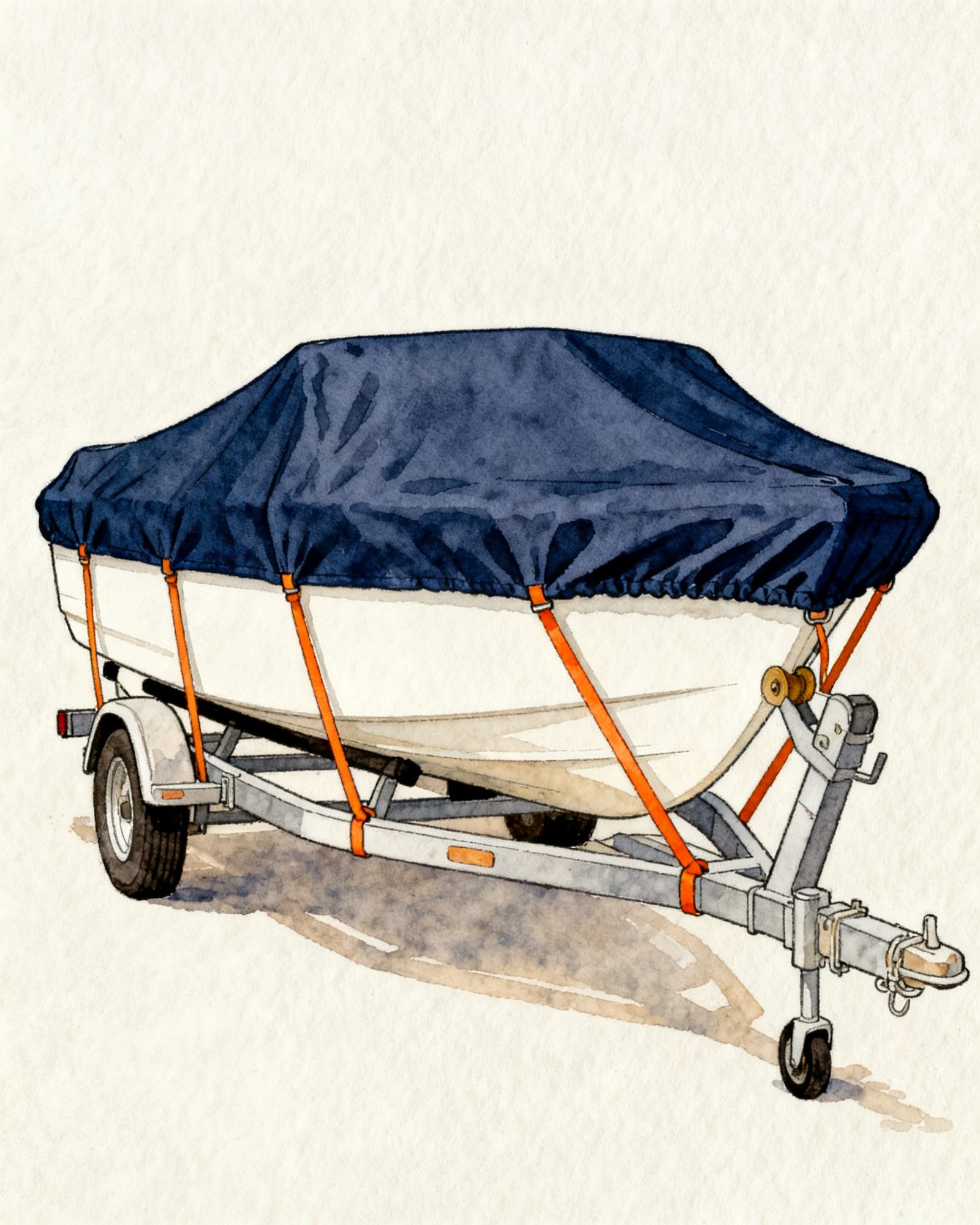
A boat tarp is the cheapest way to cover a boat, and for a boat under a roof or a short stopgap it does the job. As a season-long cover for a boat outdoors, it is usually the weaker choice: a tarp is a flat rectangle, so it rarely fits the boat, flaps and rubs in wind, collects water in every sag and traps damp underneath. Boating magazine puts it plainly: “Tarps are rectangular, so they rarely fit a boat well,” they need “some sort of internal frame or support” so rain and snow run off, and poly tarps degrade in sunlight. A fitted boat cover costs more but is shaped to the boat and ties down without flapping, and one made of a breathable fabric, with vents, lets moist air out. If you use a tarp, the frame, the tie-downs and the ventilation decide whether it works.
Tarp and fitted cover side by side
| Poly tarp | Fitted boat cover | |
|---|---|---|
| Shape | Flat rectangle | Cut to a boat type or to one boat |
| Fit | Loose; excess fabric at the ends and sides | Follows the hull to below the rub rail |
| Support | Needs a frame or ridge to shed water | Needs poles under open spans |
| Wind | Flaps unless every edge is tied | Straps and a hem hold it close |
| Breathing | Plastic does not breathe | Many acrylic and polyester cover fabrics do; vinyl-coated ones do not; vents help |
| Sun | Poly degrades in sunlight | Marine cover fabrics are made to resist UV, some better than others |
| Towing | Poor, per Boating magazine | Only covers made for trailering |
| Life | Boating magazine: no more than three years | Boating magazine: eight to 10 years, maybe more |
| Spending | Least up front | More up front, then reused for years |
The figures for life both come from the same Boating magazine article, which compares tarps, shrink wrap and fitted covers. For the tarp, that is an upper limit: a tarp that flaps loose in a storm can be finished in one night.
Where a tarp falls short
Fit and wind
A boat is narrow at the bow, wide in the middle and square at the stern; a tarp is none of those. The spare cloth gathers into folds and loose corners, and wind gets under them. A flapping tarp works its grommets loose, wears holes where it folds over the windshield and rails, and can lift off altogether. Discover Boating’s storage page warns that “if the tarp isn’t supported and secured just right, leaks, rips, and complete collapses are common.”
Chafe on the boat
Every flap of a tarp rubs whatever it touches. Over a winter, a loose tarp can scuff gelcoat, wear canvas and vinyl and polish dull patches where it slaps the hull. Discover Boating’s lay-up advice is that winter covers “should be padded to prevent chafe, well secured to resist buffeting”. With a tarp that applies twice over, because nothing about its shape holds it still.
Water pooling
A tarp draped straight over a boat sags into the cockpit and any other open space. Rain fills the sag, the weight stretches it deeper, and the water either breaks through or finds a fold and runs inside. The BoatUS Foundation’s winter cover trial, reported by Waterway Guide on BoatTest.com, found that even the poles sold with fitted covers broke under the load of pooling water. A tarp needs a frame that gives it a real slope from end to end.
Trapped moisture
Polyethylene film does not breathe. Wrapped tight around a boat and tied down below the rub rail, a tarp holds in every bit of damp from the bilge, the cushions and the morning dew. Discover Boating’s line on this is memorable: “Owners who use tarps and ropes until their vessel looks like a rolled roast? They’re asking for a mildewy mess.” Its lay-up advice adds that “adequate air circulation is the best way of combating mildew.”
Sun and towing
Boating magazine notes that poly tarps degrade in sunlight and says to “expect no more than three years of use, even in northern climes”, and that “tarps are not good for moving boats long distances over the road.” A tarp on a boat at highway speed flaps against the hull and is likely to tear free.
When a tarp is enough
- Under a roof. In a barn, carport or open-sided shed, a tarp keeps dust, bird droppings and leaves off. Wind and rain are not its job there.
- A short stopgap. A cover is at the repair shop, a storm is coming, a new cover has not arrived yet. A well-tied tarp for a few weeks is far better than nothing.
- As a roof over a frame. A tarp stretched over a ridge frame, high above the boat and open at both ends, sheds rain and snow like a tent and lets air through. This is how many owners winter a boat under a tarp, and it is a frame project, not a draping job.
- A boat with no fitted cover available. Some older or unusual boats have no ready-made cover. A tarp on a frame bridges the gap until a marine canvas shop makes one.
A tarp is the wrong choice for towing, for a boat left on its own outdoors without anyone to check on it after storms, and for rack storage, where some yards require shrink wrap. Before choosing, compare the main cover types in boat cover styles explained.
How to tarp a boat properly
If the tarp is the answer, it is worth doing well. Follow the instructions for any frame or straps you buy; this is the general order.
- Clean and dry the boat. Remove cushions and loose fabric items and store them somewhere warm and dry, as Discover Boating advises for lay-up. Pull the drain plug on a trailer boat and raise the bow so water runs out, which is also Discover Boating’s advice.
- Build a frame. Run a ridge from bow to stern, higher than the windshield and any other high point, and support it on uprights that stand on solid parts of the deck or cockpit sole. Wood, pipe or a set of adjustable poles all work; what matters is that the ridge stays straight and the tarp slopes away from it on both sides. The guide to boat cover support poles covers where supports go and why a single pole is not enough for a long span.
- Pad every sharp point. Windshield corners, cleats, the tops of uprights and rail ends will cut a tarp as it moves. Wrap them in foam, old towels or carpet scraps.
- Size the tarp. It should cover the whole boat lengthwise and reach below the rub rail on both sides with some spare for tying. A tarp that is too small strains its grommets; one far too large leaves loose folds for the wind.
- Drape it from the ridge. Center it along the ridge so the two sides hang evenly. Put the spare length where it can be folded and tied neatly, usually at the stern.
- Tie it down to the right anchor. Run straps or line from the grommets under the trailer frame and back, or to ground anchors. Webbing straps hold tension better than stretchy cords, which let the tarp lift and slap. Keep lines off the gelcoat: a rope that runs round the hull or saws across the rub rail in wind wears through the finish, so pad any point where a line touches the boat. Never tie to jackstands: the BoatUS Foundation warns that in strong wind or heavy precipitation the pull can drag the stands out from under the boat.
- Leave the ends open for air. Fold the bow and stern ends so they shed rain but leave a gap under the ridge. Air should be able to pass from one end to the other.
- Check it after every storm. Look for sags holding water, slack lines, torn grommets and new wear points, and re-tension. Covers settle; the BoatUS Foundation staff readjusted their test covers every other week.
Choosing the tarp itself
Tarps are sold in several grades of polyethylene, from light utility tarps to heavier reinforced ones with closer-set grommets; the heavier grades stand up to wind and chafe better. Vinyl-coated polyester tarps are heavier again and waterproof, but they do not breathe either, so ventilation matters just as much. A cotton canvas tarp breathes but is heavy when wet and can rot. Whatever the material, reinforced edges and corners are what stop grommets pulling out.
A tarp over a cover, and other half-measures
Laying a tarp straight onto a fitted cover is a common fix for a cover that leaks, but it brings the tarp’s problems with it: the cover can no longer breathe, and the tarp flaps against it. If a cover leaks, clean and re-treat it or replace it; if snow is the worry, build a frame and stretch the tarp high above the cover as a roof, with air moving between them. The snow side of this is covered in snow on a boat cover.
Tarp, fitted cover or shrink wrap for winter
For a winter outdoors, the choice is really among three, and Boating magazine compares all of them: the tarp is the cheapest, shrink wrap “fits snugly” and “will stand up to long distances at highway speed” but is single-use, and a fitted cover costs more up front but lasts for years and is easy to get under. Discover Boating calls a professional shrink-wrap job “by far the best way to cover a boat for winter storage.” The trade-offs between the last two are set out in boat cover vs shrink wrap.
| Your situation | Sensible choice |
|---|---|
| Boat under a roof all winter | Tarp or light cover against dust |
| Outdoors, heavy snow, nobody nearby to check it | Professional shrink wrap |
| Outdoors, used often, want to get aboard | Fitted cover on a strong frame |
| Cover away for repair for a few weeks | Tarp over a frame as a stopgap |
| Boat will be towed covered | Shrink wrap or a cover made for trailering |
| Rack storage | Whatever the yard requires; some require shrink wrap |
Common questions
Is a tarp good enough to cover my boat?
For a boat under a roof, or for a few weeks while a cover is repaired, yes. For a boat outdoors through a season of rain, wind or snow, only if the tarp sits on a frame that gives it a slope, is tied down without flapping and leaves air moving underneath. Without those, Discover Boating warns that leaks, rips and complete collapses are common.
Can I use a tarp to cover my boat for winter?
Owners do, but it takes a frame strong enough to shed snow, padding at every sharp point and regular checks after storms. If that is more work than you want, a professionally applied shrink wrap or a fitted winter cover on a sturdy frame are the stronger choices.
Can I tow my boat with a tarp on it?
Not over any distance. Boating magazine says tarps are not good for moving boats long distances over the road: wind at speed gets under the edges, the tarp flaps against the hull and grommets tear out. Take it off and stow it, or use a cover made for trailering.
Should I put a tarp over my boat cover?
Usually the cover is the problem to fix. The simple test is to pour water on the clean, dry fabric and see whether it beads up; if it soaks in, the cover needs cleaning and re-treating per its care label, not a sheet of plastic on top. If you still want the extra layer for snow, put the tarp on its own frame above the cover, not on it.
What size tarp do I need for my boat?
Larger than the boat in both directions. Measure the length from the bow to the stern and add enough at each end to fold down over the bow and the transom; then measure over the top of the frame from below the rub rail on one side to below the rub rail on the other. Choose a tarp that covers both with some to spare for tying.
Sources
Read next
Mooring boat covers: snap-on covers for a boat in the water
Mooring boat covers for a boat at a slip, lift or mooring: how snap-on covers attach, fitting fasteners, keeping rain out, venting, wind, and why not to tow.
Boat cover vent guide: why a covered boat needs to breathe
Why a boat cover vent matters: condensation under a cover, how vents move air, how many and where, adding vents to a cover, vent poles and shrink-wrap vents.
Boat cover support poles and stopping water pooling
How a boat cover support pole stops water pooling: why covers sag, where poles go, how many, strap systems, tension, snow limits and removing poles to tow.
Bimini tops for boats: choosing bows, frame and fabric
How to choose a bimini top: 2, 3 or 4 bows, aluminum or stainless frame, round or square tube, acrylic, polyester or vinyl fabric, mounts, boots and pontoons.
How to measure for a bimini top: width, length, height
How to measure for a bimini top: mounting width between the mounts, length front to back, frame height from the mount up, plus headroom and folding clearance.