Kayak cockpit covers: sizing, fitting and storing a kayak
How a kayak cockpit cover keeps rain, leaves and animals out: cockpit vs full kayak covers, measuring the coaming, fitting it, transport and outdoor storage.
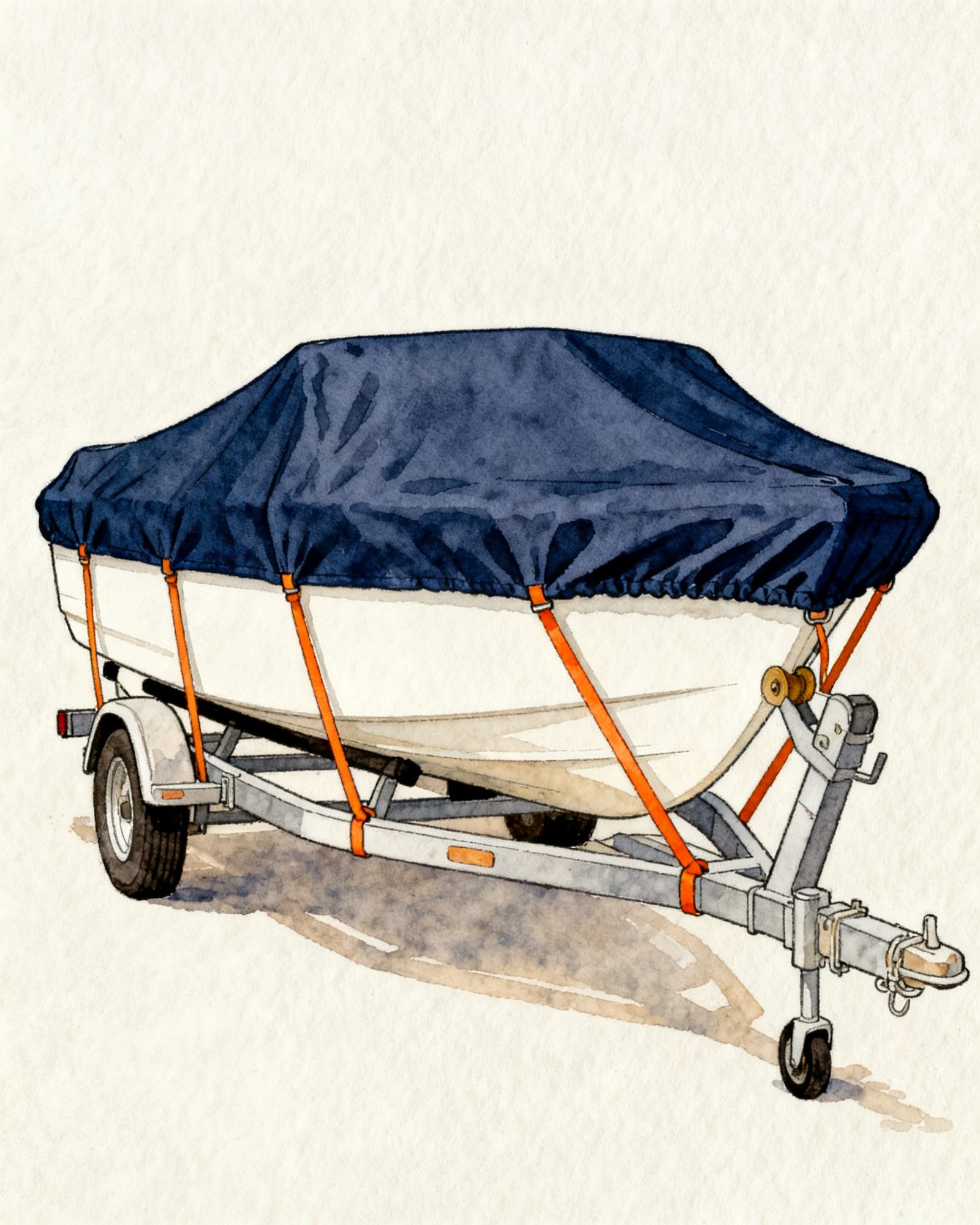
A kayak cockpit cover is a fitted panel of fabric, usually neoprene or coated nylon, that stretches over the cockpit rim of a sit-inside kayak and grips under its lip with a shock cord, the way a spray skirt does but without the hole for the paddler. It keeps rain, leaves, insects and nesting animals out while the kayak is stored or carried. To buy the right size, measure the outside of the cockpit rim at its longest and widest points and match those numbers to the cover maker’s chart. A cockpit cover protects the inside of the boat only: for sun on the hull and deck, a full kayak cover or a roof does the rest.
What a cockpit cover does, and what it does not
The cockpit is the one large opening in a sit-inside kayak, and almost every storage problem comes through it:
- Rain. An uncovered kayak lying hull-down fills like a bathtub. The water is heavy, sits on the supports at the worst points, goes stale and leaves a scum line and a smell.
- Debris. Leaves, pine needles and seeds rot in the bottom of the hull and stain it.
- Animals. A dry, dark cockpit is the kind of shelter mice, spiders, wasps and the odd snake look for. Discover Boating’s off-season advice is written for boats, but it carries over: if a covering is vented, “make sure the vents aren’t large enough for mice to squeeze through.” A cockpit cover that grips the whole rim leaves no opening to squeeze through.
- Sun on the seat and outfitting. The seat, back band, foot braces and foam are often the first parts to fade and crack. A cover shades them.
What it does not do: it does not shade the hull or the deck, which take most of the sun in outdoor storage, and it does not stop the kayak deforming if it rests badly on its supports. Those are the jobs of a full cover, a roof and the right storage position, covered below.
Cockpit cover, drape or full kayak cover
| Fitted cockpit cover | Adjustable (universal) cockpit cover | Full kayak cover | |
|---|---|---|---|
| What it covers | The cockpit opening only | The cockpit opening only | The whole boat |
| How it holds | Shock cord under the coaming lip, sized to the rim | Oversize panel with an adjustable cord, sometimes a hull strap | Drawcord or straps under the hull |
| Fit | Snug; must match the rim size | Loose; fits a range of cockpits | Sized by kayak length and width |
| Keeps out rain and animals | Yes, if sized right | Mostly; gaps possible at the ends | Yes, with the cockpit sealed underneath |
| Shades the hull | No | No | Yes |
| On a roof rack | Only models made for transport | Usually storage only | Usually storage only |
A common pairing is two covers: a fitted cockpit cover all year, and a full cover or a roof over the stored kayak. The cockpit cover keeps the inside sealed even when the full cover moves in the wind.
Neoprene or coated nylon
Neoprene stretches, grips the rim well and sheds rain, but it is heavier, and its fabric facing stays wet and slow to dry if it is packed away damp. Coated nylon or polyester is lighter, packs smaller and dries fast; its waterproofing lives in the coating, so it stops working once the coating cracks or peels. For a full cover left in the sun, the fabric matters most. Writing about marine canvas in general, not kayak covers, Marine Fabricator magazine describes woven solution-dyed acrylic as having “high UV resistance” and notes that vinyl-coated fabric “doesn’t breathe”. The guide to boat cover fabrics compared sets the main cloths side by side.
How to measure a kayak cockpit for a cover
Kayak makers usually list the cockpit size in their specifications, but they do not always say whether that is the inside of the opening or the outside of the rim, and a cover grips the outside. Measure the boat yourself.
- Find the coaming. The coaming is the raised rim around the cockpit, with a lip that sticks out. The cover’s cord hooks under that lip, so the size that matters is the outside edge of the lip.
- Measure the length. Run a tape along the centerline from the outside of the lip at the front to the outside of the lip at the back. Keep the tape straight, not following the curve of the deck.
- Measure the width. Find the widest point, which on a keyhole-shaped cockpit is near the back, and measure across from the outside of the lip on one side to the outside on the other.
- Note the shape. A round or oval rim, a long keyhole and a large recreational opening all take different covers. Write down the shape with the two numbers.
- Match the chart. Cover makers sell sizes by length and width, and their names for the sizes differ from one maker to the next, so compare your numbers, not the size name. If the kayak maker or cover maker publishes a fit list by kayak model, check that too.
A worked example: a day-touring kayak whose rim measures 2 feet 10 inches long and 1 foot 7 inches wide fits a cover whose listed range includes both numbers. If it falls between two sizes, check the maker’s advice; a stretchy neoprene cover and a coated nylon cover with an adjustable cord handle in-between sizes differently.
A tandem kayak may have two cockpits, each needing its own cover, or one long open cockpit that needs a tandem-length cover. The same principle of measuring the boat rather than trusting the label runs through how to measure a boat for a cover, the guide for larger boats.
Putting a cockpit cover on and taking it off
The method is the same as fitting a spray skirt:
- Empty and dry the cockpit. Sponge out any water and let the inside air-dry. Covering a wet cockpit seals the damp in.
- Start at the back. Hook the cord under the lip behind the seat, where the rim is widest and easiest to reach.
- Stretch it over the front. Holding the back in place, pull the front edge forward and down over the lip. This is where the cover is tightest.
- Seat the sides. Press the cord under the lip along each side with your thumbs, working from the ends toward the middle and alternating sides so the cover stays centered.
- Check the whole rim. Run a hand round the edge: the cord should sit under the lip everywhere, with no section riding on top. Leave the release loop, if the cover has one, outside and reachable.
- To take it off, pull the release loop at the front forward and then up, so the front of the cord lifts over the lip; the rest follows.
Neoprene is stiffer in the cold, so a tight cover is easier to fit on a mild day or after it has been somewhere warm.
Driving with a cockpit cover on
A cover keeps rain out of a kayak on the roof, and an open cockpit catches air at road speed. The risk is the cover itself: a storage drape that is not made for the road can balloon, pull off the rim and fly into following traffic. Use a cover only if it is sold for transport, with a firm cord and ideally a strap round the hull. Check it at the first stop. The cover never takes the place of the bow and stern lines or the rack straps that hold the kayak to the car.
Storing a covered kayak outdoors
A cockpit cover is one part of outdoor storage. The rest decides whether the kayak comes out in spring the same shape it went in.
Position and supports
- Keep it off the ground. Ground contact brings damp, insects and rodents, and a kayak on the ground is an easy home for animals.
- Support it where the hull is stiffest. The usual practice is two wide, padded supports or straps, each roughly a third of the way in from an end, which on a kayak with bulkheads puts them close to the bulkheads. Spread out like that, they share the load. Narrow bars or a hard floor under one spot can dent a plastic hull over a long season.
- Choose hull up or on its side. Stored deck down, on its side or on a padded rack, the kayak cannot fill with rain, and the cockpit cover’s main job becomes keeping animals out. Stored hull down, the cover must shed every rainfall.
- Avoid hanging it by the grab handles for a long period; the handles and their fittings are made for carrying, not for holding the whole weight for months on end.
Stop water pooling on the cover
A cockpit cover over an upward-facing cockpit is a flat sheet over an open space, and rain gathers in the middle. The puddle stretches neoprene, strains the cord, and can push the cover off the lip and empty into the boat. Tilt the kayak so one end is lower and the water runs off, or lift the middle of the cover from inside with something domed and soft, such as an inflated ball in the seat. Check after heavy rain. The same problem on bigger boats is solved with poles, as set out in boat cover support poles.
Sun and shade
Sunlight degrades plastic and composite hulls and every fabric on the boat. Shade is the strongest protection: under a deck, a roof or a carport, or under a full kayak cover. A tarp rigged as a roof above the kayak, with air moving underneath, shades it without trapping damp; a tarp wrapped tight around it does the opposite.
Damp and mildew
A sealed cockpit holds whatever moisture went in. Discover Boating’s lay-up advice for boats says that “adequate air circulation is the best way of combating mildew” and that “dirt and grease promote the growth of mold and mildew”. For a kayak that means rinsing and drying it before storage, taking out removable seat pads and dry bags, and checking under the cover on a dry day during a long layup. Practical Sailor’s advice for boat canvas, “Never roll up wet enclosures or sail covers for storage”, and store them somewhere dry and well ventilated, makes as much sense for a kayak cover.
Indoors where you can
A kayak in a garage, shed or basement avoids most of this: no sun, no snow, no rain in the cockpit. A breathable cover or a cockpit cover then serves to keep dust and animals out. The trade-offs for a bigger boat are weighed in indoor or outdoor boat storage.
Sit-on-top kayaks
A sit-on-top has no enclosed cockpit, so a cockpit cover does not apply. Its scupper holes let water drain through, and its storage wells are open. Protect it with a full kayak cover or shade, keep the hatch lids closed so animals cannot get into the hull, and store it hull up or on its side on padded supports, as above.
Looking after the cover, and when to replace it
- Rinse salt and sand off after use, and let the cover dry before packing it away; neoprene stored wet starts to smell.
- Keep a spare cover out of the sun when it is not on the boat.
- Look at the cord each season. A cord that has lost its stretch lets the cover ride up off the lip in wind.
- Replace the cover when neoprene cracks, when a coated fabric starts to peel or let water through, or when the cord no longer grips. A cover that leaks lets rain in and then slows it drying out, so it can leave the cockpit wetter than no cover would.
Common questions
Do I need a cockpit cover if I store my kayak inside?
Not for weather, but it still earns its place in a garage or shed. A cockpit left open collects dust and becomes a sheltered spot for spiders, wasps and mice. A light, breathable cover is enough indoors; a waterproof one is not needed.
Can I leave a cockpit cover on while driving?
Only if the cover maker sells it for transport; the listing or label says so. Carrying the kayak hull up on the rack does not remove the need: the open cockpit then faces the road and still catches air. After a long drive, check that the cord has not crept up off the lip at the front, where the airflow hits first.
Should a kayak be stored upside down?
Hull up, deck down, on padded supports, or on its side, are the usual choices for long storage, because they keep weight off the bottom of the hull and stop the cockpit from collecting rain. Resting a kayak hull-down on a hard, flat floor for a long time can leave a dent in a plastic hull.
Can I make my own kayak cockpit cover?
Yes, for storage. Trace the outside of the coaming lip onto paper, add enough all round to wrap under the lip, cut waterproof fabric to that shape and sew a channel round the edge for a shock cord. A homemade cover is fine on a rack in the yard; for the roof of a car, a cover sold for transport is the safer choice.
Can I use my spray skirt as a cockpit cover?
For a night or a short stop, a spray skirt with its tunnel closed off keeps most rain out. For storage it is a poor substitute: the tunnel lets water and animals in, and leaving a skirt stretched on the rim for weeks wears the material and tires its rand or cord, which you need to stay sealed on the water.
Sources
Read next
Jet ski covers: fit, trailering and winter storage
How to choose a jet ski cover that fits: measuring a personal watercraft, styled vs universal, trailerable vs storage-only, straps, drying and winter storage.
How to measure a boat for a cover: length, beam and fit
How to measure a boat for a cover: centerline length, beam at the rub rail, what to add or leave out, the heights that matter and how size charts work.
Boat tarp or boat cover? When a tarp is enough
A boat tarp is the cheapest cover, but it rarely fits. When a tarp is enough, when a fitted cover wins, and how to frame, tie and vent a tarp safely.
How to measure for a bimini top: width, length, height
How to measure for a bimini top: mounting width between the mounts, length front to back, frame height from the mount up, plus headroom and folding clearance.
How to install a bimini top: mounts, straps and tension
How to install bimini top hardware: assemble and dry-fit the frame, mount deck hinges or rail fittings, seal every hole, then set the straps and canvas tension.