What Boat Winterizing Costs and What Is Included
The cost to winterize a boat depends on size, engines, systems aboard, timing and storage. The factors in plain words, DIY supplies, and what to ask a yard.
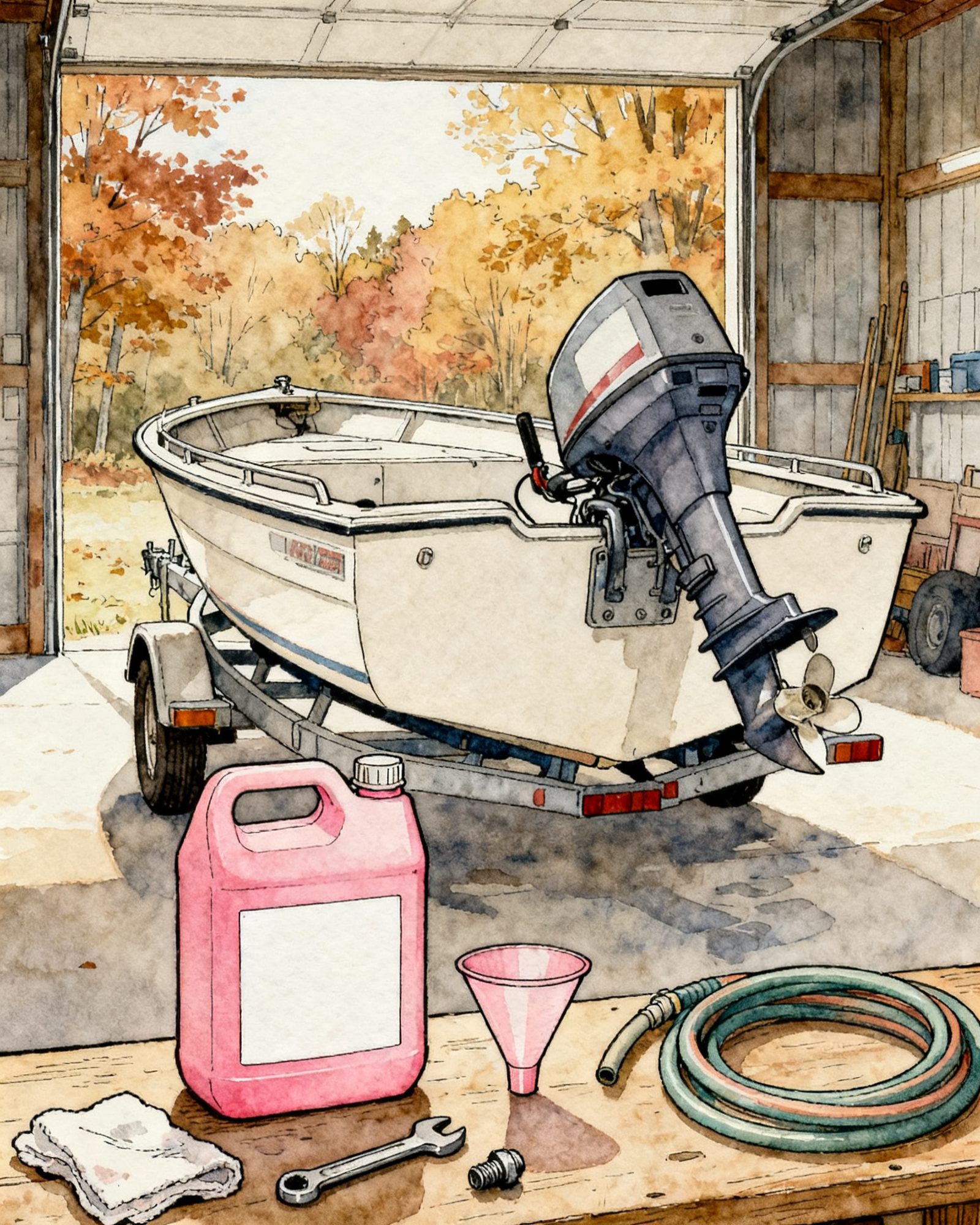
The cost to winterize a boat is set by how much there is to protect and who does the work: the size of the boat, the type and number of engines, the water systems aboard (fresh water, head, livewells), whether a yard, a mechanic or you do it, how late in the season it is booked, where the boat spends the winter and how cold it gets there. Discover Boating, the boating industry’s consumer site, names boat size, who does the work, timing, storage location and climate as cost factors, and says a professional job costs nearly twice as much as doing it yourself, with the professional price reflecting labor, quality checks, insurance and tools. This page gives no prices: rates vary by area and yard, and a figure from somewhere else says little about the quote you will get. What it gives is what moves the price, what you are paying a yard to do, what a do-it-yourself job needs, and the questions that turn two vague quotes into two comparable ones.
Why boats are winterized at all
Discover Boating puts the line plainly: if your boat is somewhere temperatures drop below 40°F, winterizing is “non-negotiable.” The reason is water. An inboard and sterndrive maker’s article on winterizing explains that water trapped in an engine “can expand when frozen, causing irreversible damage to components.” The rest of the job protects against slower damage: fuel that degrades and forms varnish over the winter, and moisture that corrodes engine internals.
The cost of skipping it is not only the repair bill. BoatUS material republished by the Virginia Department of Wildlife Resources says ice and freeze damage is often excluded from boat insurance unless it was requested as a rider, and that most insurers stop offering that rider once temperatures drop, usually by the end of October. The same article rejects the idea of leaving a plug-in space heater in place of winterizing: insurance claims show heaters tipping over, shorting out or igniting nearby materials.
What moves the price
| Factor | Why it changes the cost |
|---|---|
| Boat size | More hull, more systems, more hours; Discover Boating names size as a factor |
| Engine type | An outboard is tilted fully down for storage; an inboard or sterndrive has its block drained or antifreeze run through |
| Number of engines | Each engine is its own fuel, oil, fogging and cooling job |
| Systems aboard | Fresh-water tank and faucets, head, livewells and washdowns each need draining or antifreeze |
| Who does it | A dealer, a yard, an independent mechanic or you, with very different labor costs |
| Timing | Discover Boating says waiting until later in the season costs more |
| Storage location | In the water or on land changes what has to be done and what else is billed |
| Climate | The colder and longer the winter, the less room for a partial job |
Outboard, sterndrive or inboard
Discover Boating’s winterizing guide shows why engine type matters so much. An outboard is tilted fully down and left there for the winter, and modern outboards may use a fuel additive or an electronic “winterize” mode, while older carbureted and two-stroke models may need fogging oil. A sterndrive needs its engine block and its drive drained, antifreeze run through both if the manual calls for it, and the hoses, clamps and bellows inspected. An inboard is drained through petcocks or plugs, or has antifreeze run through it, which the guide says is usually preferred, with the engine warmed first so a cold thermostat does not keep antifreeze out of some passages.
More drain points and more steps mean more labor. The full outboard procedure is in how to winterize an outboard motor, and the inboard and sterndrive one in how to winterize an inboard or sterndrive boat.
When the engine maker says use a dealer
Some inboard engine makers say plainly who they think should do the job. One inboard maker’s winterization sheet cites the complexity of the job and “the possibility of catastrophic engine damage from freezing water in the engine” as its reason for recommending that the dealer do it, and states that “Damage resulting from improper storage is not covered by” its limited warranty. Another inboard maker’s FAQ “highly” recommends taking its engines to an authorized service center for winter preparation and warns that improper winterization can affect warranty coverage. If your engine is under warranty, read the warranty terms before you price a do-it-yourself job.
What a professional winterization is meant to cover
Yards do not work from one standard service menu, and Discover Boating’s cost page publishes none. What engine makers describe is the work itself. One inboard and sterndrive maker’s article, written to recommend winterizing by its authorized dealers, lists what the job involves:
- draining all water from the engine so it cannot freeze and crack parts;
- applying rust inhibitors and lubricants as a barrier against moisture;
- treating rubber seals, hoses and belts, which deteriorate in the cold;
- treating the fuel with stabilizer so it does not degrade and form varnish;
- changing to new oil before lay-up so fresh oil protects the internals;
- disconnecting and storing the battery so it does not lose its charge.
Discover Boating’s winterizing guide adds work beyond that list: the oil changed and, on outboards, the lower-unit oil changed and checked for water; fuel filters and fuel/water separators replaced; the fresh-water system drained and filled with non-toxic antifreeze; the head pumped out and antifreeze pumped through; livewells and raw-water washdowns run dry, with antifreeze added if the pumps still gurgle. One inboard maker’s sheet goes further, advising that because lay-up is an annual event “it is wise to perform all of the annual maintenance at this time.”
These lists come from an engine maker and an industry site, not from any yard’s price list. Use them to read a quote, not to assume what is in it. A low price may cover the engine and nothing else; a higher one may include the plumbing and an oil change. The only way to know is to ask.
What you need to do it yourself
Discover Boating lists the supplies for a do-it-yourself job: antifreeze, oil, fuel stabilizer, fogging oil, motor oil, an oil filter, corrosion protection, drain plugs, an oil suction pump, a lower-unit lube injection pump, lower-unit lube and drain plug gaskets, and possibly replacement filters. It notes that many shops sell winterization kits. Add whatever your owner’s manual names for supplying water if the engine is run out of the water: makers differ here, and at least one outboard maker’s manual says not to run its engine on the hose flushing attachment at all, only in a test tank or in the water. An engine must never run without water.
Some of that is bought once (the pumps and the flushing device) and some every season (oil, filters, gaskets, stabilizer, antifreeze). What a receipt does not show is the cost of a mistake. Discover Boating’s advice is that if you have not winterized before and have no experienced friend to help, hire a professional. Antifreeze type matters as well: boat antifreeze explains why the less toxic propylene glycol kind is the one for raw-water and drinking-water systems, and why a closed cooling system follows the engine manual instead.
Haul-out, storage and the wrap are separate questions
Winterizing the engine is one job. Getting the boat out of the water, keeping it somewhere all winter and covering it are others, and each can appear on a bill.
- Storage. Discover Boating notes that storage, indoor, outdoor or in the water, is billed separately and usually monthly. Indoor storage is the more expensive option but the most protective; indoor or outdoor winter boat storage compares them.
- In-water storage. Discover Boating says some owners leave boats in the water all year, which is acceptable in temperate areas or with full winterizing and an agitator, but if power fails and the agitator stops, the hull can freeze in place and ice damage can follow.
- Covering. Outdoors the boat needs shrink wrap or a cover. Boating magazine reports that yards charge for wrap by the foot of boat length; the factors are in what boat shrink wrap costs.
- Haul-out and launch. Ask whether hauling the boat in fall and launching it in spring are priced on their own.
The order matters too. A 2018 Maryland legislative fiscal note describes a worker who died of carbon monoxide overexposure in 2016 after winterizing a boat that had already been shrink-wrapped; the note explains that winterizing typically involves idling the engine, which emits carbon monoxide. The bill it analyzed would bar a business that winterizes boats from shrink wrapping a boat until all winterization work that requires an employee inside the boat is complete; the note does not say whether the bill became law. Whatever the rules where you are, ask the yard to finish the engine before the wrap goes on.
Questions to ask the yard and get in writing
Ask every yard or mechanic the same questions about the same boat, and ask for the answers on the written quote.
- What exactly is included? Ask them to list each task: draining or antifreeze for each engine, fuel treatment, fogging, oil and filter change, lower-unit or outdrive oil, battery.
- Is it priced per engine? On a boat with two or more engines, ask whether the quote covers all of them.
- Which systems are covered? Fresh-water tank and lines, water heater, head and holding tank, livewells, washdown pumps. Ask which are included and which are extra.
- Which antifreeze, and where? Ask which type goes into the raw-water side and the drinking-water system, and whether the engine is drained or filled.
- Are parts and fluids in the price? Oil, filters, fuel/water separators, gaskets and antifreeze may be charged on top of labor.
- Are haul-out, storage, wrap and launch separate items? Ask for each by name, and whether storage is charged by the month.
- Is the engine finished before the wrap goes on? See the carbon monoxide case above.
- Is spring recommissioning included? Removing antifreeze, reinstalling plugs and impellers, and the first start may be a separate job, priced on its own; see getting a boat ready in spring.
- Does the work meet the engine maker’s procedure? If the engine is under warranty, ask whether the yard follows the maker’s steps and keeps a record.
- Is the business insured while the boat is in its care? And check your own policy for freeze-damage cover.
- When must the boat be booked? Since later bookings can cost more, ask about the deadline.
Line the answers up item by item. The lowest quote is only the lowest price if it covers the same work.
When the do-it-yourself saving makes sense
Doing it yourself makes most sense on a single outboard on a trailer, stored at home, with an owner who has the manual, the tools and time to follow it. It makes least sense on an engine whose maker recommends a dealer, on a boat with many drain points and plumbing systems, or for anyone doing it for the first time without help. In between, a middle path is to have a yard or mechanic handle the engine while you take care of the cleaning, the cushions and canvas, and the cover.
Common questions
How much does it cost to winterize a boat?
There is no honest single figure: rates differ from one area and one yard to the next, and the work included differs too. Discover Boating's own advice is to get an estimate from your local boatyard or marine mechanic. Ask two or three for a written scope of the same boat so the quotes can be compared.
Is it cheaper to winterize a boat yourself?
Usually, in money. Discover Boating says a professional job costs nearly twice as much as doing it yourself, because the price covers labor, quality checks, insurance and tools. What you take on instead is the risk: freeze damage from a missed drain point is not something a supply kit covers.
How much does it cost to winterize an outboard motor?
An outboard is usually the simpler job: Discover Boating's guide has it tilted fully down and left there, while a sterndrive or inboard has its block drained or antifreeze run through it. The count still matters: twin or triple outboards are each their own job. Ask the yard whether it prices per engine, and whether lower-unit oil, fogging and fuel treatment are in that price.
Does winterizing include shrink wrap and storage?
Do not assume it does. Discover Boating notes that storage is billed separately, usually monthly. Ask for hauling, wrapping, storage and launch by name on the written quote, so you can see which are included.
What happens if I don't winterize my boat?
Water left in an engine can freeze, expand and crack parts. An inboard and sterndrive maker calls that damage irreversible, and the BoatUS material republished by Virginia's wildlife agency notes that many insurance policies exclude freeze damage unless it was added as a rider.
Sources
- Discover Boating: How Much Will It Cost to Winterize My Boat?
- Discover Boating: How to Winterize a Boat
- An inboard and sterndrive maker: Winterising your marine engine
- Virginia Department of Wildlife Resources: Boat Winterizing - Truths or Myths?
- An inboard engine maker's storage and winterization procedures (PDF)
Read next
Boat Antifreeze: Which Kind and Where It Goes
Marine antifreeze explained: propylene glycol vs automotive ethylene glycol, what a -50°F burst rating means, where it goes on a boat, and how to dispose of it.
Boat Shrink Wrap Cost: What Sets the Price
Boat shrink wrap cost explained without guesswork: how yards quote per foot, what raises the price, DIY costs, a cover over several winters, and what to ask.
Outboard motor covers: full, half and vented hoods
How to choose an outboard motor cover: half hood, full or vented running cover, sizing by the cowling, moisture, covering a hot engine, and towing safely.
Pontoon boat covers: fit, support and mooring
Pontoon boat covers explained: mooring, travel and playpen styles, measuring the deck and fence, support systems against pooling, and strapping for the road.
Boat Cover vs Shrink Wrap: Which Is Better for Winter?
Boat cover vs shrink wrap for winter: snow, ventilation and mildew, winter access, seasons of use, waste and cost factors, and how storage and climate decide it.