Outboard motor covers: full, half and vented hoods
How to choose an outboard motor cover: half hood, full or vented running cover, sizing by the cowling, moisture, covering a hot engine, and towing safely.
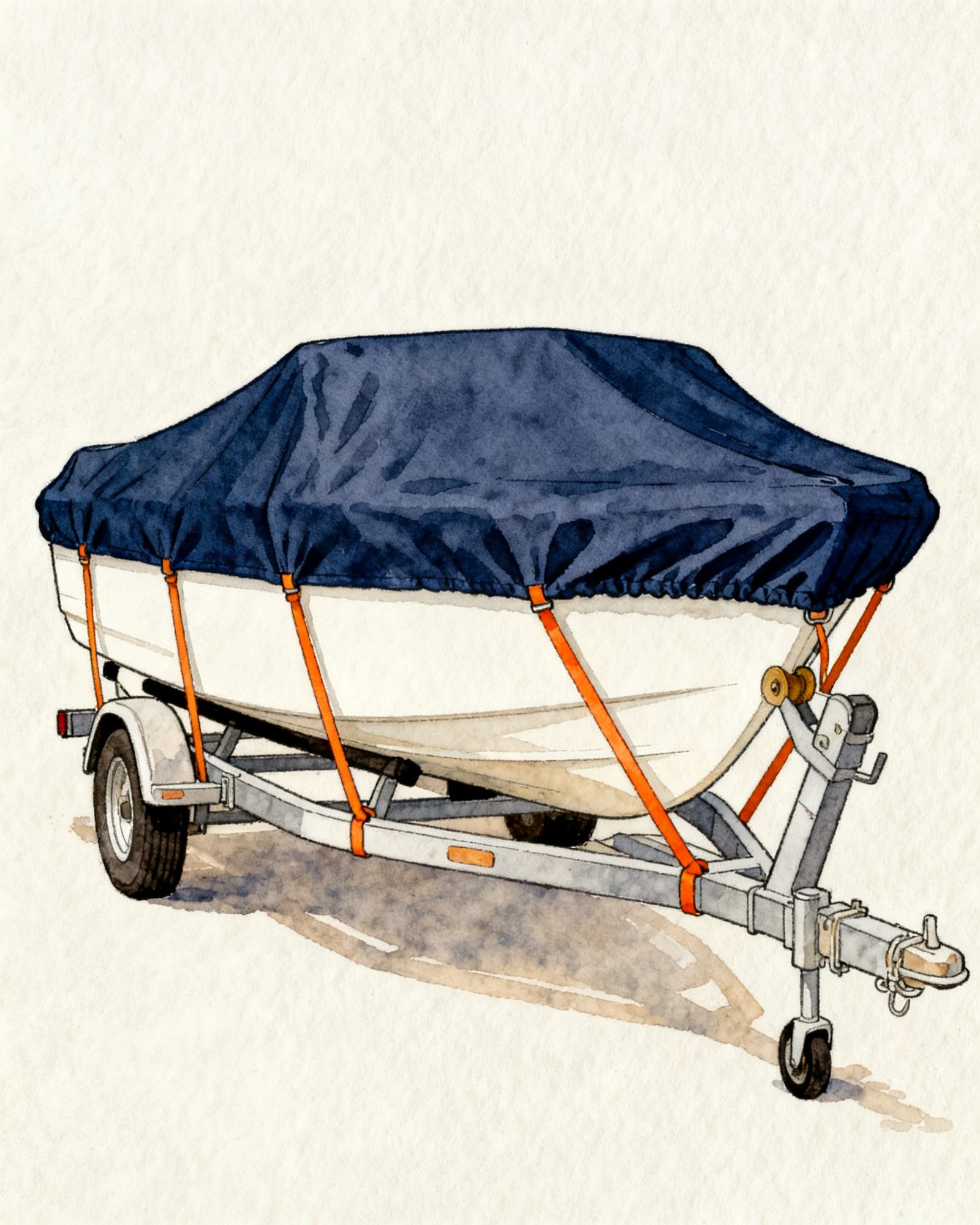
An outboard motor cover is a fitted fabric hood for the engine on the transom, and there are three kinds. A half cover, also called a hood or cowling cover, fits over the cowling only and is the everyday storage cover. A full cover runs from the top of the cowling down over the midsection and the gear case, usually with a zip or drawstring, for longer storage and some towing. A vented cover, sometimes called a running or splash cover, is cut for particular engine models and sold to stay on while the engine runs. Size any of them by the cover maker’s engine list or by measuring the cowling, not by horsepower alone. Then three habits do most of the work: cover only a cooled, dry motor, choose a fabric that breathes, and never start the engine under a storage cover.
Three kinds of outboard cover
| Half (hood) cover | Full cover | Vented running cover | |
|---|---|---|---|
| What it covers | The cowling only | Cowling, midsection and gear case | The cowling, with openings |
| How it holds on | Elastic or drawstring under the cowling | Drawstring or straps under the cowling and down the shaft, often a zip | Shaped to the cowling, sometimes snaps or straps |
| Use with the engine running | No | No | Yes, if its maker says so for your engine |
| Typical use | Between trips, on the water or on the trailer | Long storage; towing where the maker allows it | Kept on all the time against sun, spray and gear |
| Weak point | Leaves the lower unit open | Takes longer to fit; must be dry inside | Fits only the engines it is cut for |
Gear-case and propeller covers are a fourth, smaller item. They slip over the lower unit and the propeller only, to keep the blades from catching people and gear in a yard or a garage and to keep the gear case clean. They are not weather covers.
Boat-lift motor covers are something else again: they cover the electric motor of a boat lift, not the outboard. The name causes confusion in listings.
When a motor cover helps, and when it is not needed
A motor cover earns its place when the outboard is outdoors and exposed. Sun fades cowling paint and decals over time; rain sits in the cowling’s seams; birds use the top as a perch; salt spray dries on it. A cover takes all of that. A motor that sits under a cover for weeks still needs a look now and then: lift the cover to check for damp and for insects or other animals nesting in the sheltered space.
It adds little when:
- The boat cover already covers the motor. Many fitted boat covers are cut with room for the outboard and drape over it; under one of those, a second cover is optional. Check how your boat cover was cut: the stern of a pattern differs for an outboard, two outboards, or a sterndrive (I/O), which has no outboard cowling to cover.
- The boat lives indoors. Dust is the only enemy, and a light cover or none is enough.
- The motor is still wet. A cover over an engine that needs to dry out after flushing or washing does more harm than good; cover it once it has dried.
Where the boat cover stops at the transom and leaves the motor out, a separate motor cover closes the gap. The ways boat covers are cut for different engines are in custom, styled-to-fit or universal boat covers.
Sizing an outboard cover
Listings size covers in two ways: by a list of engine models, or by a horsepower range. A model list is the more reliable, because the cover was cut for those cowlings. A horsepower range is wider: engines of similar power do not all share one cowling size or shape. When the listing gives the cover’s own dimensions, measure the cowling and compare.
- Height. From the top of the cowling down to the split line or latches where the top cowl meets the lower cowl, and again down to where the cowling meets the midsection. Look for: which of the two the listing’s height refers to.
- Length. From the front of the cowling, where the cables and hoses enter, to the back, in a straight line at its longest point, not following the curve over the top.
- Width. Across the widest part of the cowling.
- For a full cover, the shaft. From the lower edge of the cowling down to the bottom of the skeg, with the motor in the position it will be stored in.
- What sticks out. A tiller handle, steering connections at the front, a motor bracket, a trolling motor mounted beside the outboard.
A worked example. An outboard’s cowling measures 2 feet 4 inches tall, 2 feet 9 inches front to back and 1 foot 8 inches across. A half cover listed for “about” that horsepower range but stated at 2 feet 6 inches front to back will ride up at the front and leave the cable entry open. The dimensions, not the horsepower band, decide.
Two motors need two covers. A motor with a tiller handle needs a cover with room or a cut-out for it. The method for measuring the whole boat, including what to do about the outboard when sizing a boat cover, is in how to measure a boat for a cover.
Running covers: what “vented” means
A vented outboard cover is sold as a cover that may stay on while the engine runs, and it is cut for particular engine models rather than a size range. An engine draws its air through openings in the cowling, so a cover that sits on a cowling it was not cut for can partly close them. Before running with one:
- Check that the cover’s maker lists your exact engine model and says the cover may stay on while it runs.
- Look at the fitted cover with the engine off: no part of it should lie over the cowling’s air openings.
- Follow the engine’s owner’s manual on what may be fitted over the cowling.
A half or full storage cover is not made for this. It comes off before the key goes in.
Moisture: the cover must breathe
A motor cover that keeps rain out but holds damp air in does the motor no favors. BoatTest notes of boat covers in general that a good one “will also have vents so that the interior of the boat can breathe”, and Discover Boating’s fall lay-up advice is that “adequate air circulation is the best way of combating mildew.” The same reasoning applies to the smaller space under a motor cover.
- Choose a fabric that breathes. Marine Fabricator, a trade magazine for canvas makers, notes that a vinyl-coated fabric “doesn’t breathe”, while it describes woven solution-dyed acrylic as breathable. For a long winter under a full cover, a breathing fabric is the safer choice.
- Leave the bottom of a half cover open to the air rather than cinching it tight around the midsection for months.
- Do not seal a motor in an unvented plastic bag or film for storage; the damp has nowhere to go.
- Cover a dry motor. After a wash, a flush or a wet trip, let the cowling and the lower unit dry before covering. A cover maker’s instructions say to make sure a cover itself is “completely dry before you store it for any extended period”; the same logic applies to the motor under it.
More on how venting works under covers is in boat cover vents.
Let a hot engine cool first
After a run, the cowling and the powerhead under it are hot. Let the motor cool before putting a storage cover on, and look for water on the cowling and in its seams. A cover pulled straight over a hot, wet engine holds the heat and the damp against it, which is the opposite of what the moisture advice above asks for. If the boat has to go onto the trailer straight after a run, put the motor cover on at the first stop, once the engine has cooled.
Towing with an outboard cover
Check the label first. Some motor covers are made for storage only; others are sold for trailering. On the highway, a loose cover flaps against the cowling without pause, and that rubbing wears both the cover and the paint under it.
- Use a cover sold for towing, with a soft lining against the cowling.
- Fit it snug. Pull the drawstring or straps tight under the cowling, and on a full cover, fasten every strap down the shaft. A cover maker’s instructions for a trailerable boat cover say to “cinch all straps tight and adjust their length as necessary to get a tight fit.”
- Close every zip and flap. An open zip on a full cover becomes a sail.
- Stop and check. The same instructions advise stopping after the first mile to check that all straps are secured. Check the motor cover at the same stop.
- Check again at fuel stops. Drawstrings loosen with vibration.
If the boat cover goes over the motor, pad the top and corners of the cowling first: a cover maker advises covering sharp points “with cloth or a sponge to avoid stressing or tearing your boat cover.” How the boat cover itself is strapped for the road is in how to tie down a boat cover for trailering. How the motor itself is supported on the trailer is a question for the engine manual or a mechanic, not for the cover.
Fabric, lining and color
Outboard covers use the same fabrics as boat covers. Marine Fabricator describes woven solution-dyed acrylic as having “high UV resistance” and a “small amount of stretch/shrink”, woven polyester as strong and “dimensionally stable”, and vinyl-coated polyester as waterproof and easy to clean but non-breathing. For a cover that sits in the sun every day, UV resistance matters most; for one that goes on the road, a soft lining and a snug cut matter most. Camouflage and other colors are a matter of taste: the fabric and the fit decide how the cover performs. The fabrics side by side are in boat cover fabrics compared.
Putting a cover on, step by step
- Let the motor cool and dry. Look for: water in the cowling seams and on the lower unit.
- Set the motor’s position. Tilt it to the position it will be stored or towed in, before fitting the cover.
- Find the front. Most covers are shaped, with the opening for cables and hoses at the front.
- Pull it on from the back. Hook the cover over the rear of the cowling, then work it forward and down both sides.
- Tighten the drawstring or straps under the cowling. On a full cover, close the zip and fasten the straps down the shaft.
- Check the front. The cable entry should be covered without the cover pulling hard on the cables.
What a motor cover does not do
A cover keeps weather off the outside of the motor. It does not winterize the engine, flush it or protect it from freezing water inside; those jobs belong to the engine’s owner’s manual or a mechanic. Covering is the last step after the motor has been prepared for storage, not a replacement for it. The lay-up steps themselves are in how to winterize an outboard motor.
Common questions
Are outboard motor covers necessary?
Not always. A motor in a garage, or one fully inside a boat cover cut for the outboard, gains little from a second cover. A motor left outdoors, or one that sticks out past the boat cover, is in the sun and rain every day, and a cover keeps its paint, decals and the top of the cowling out of the weather.
Can I run my outboard with the cover on?
Only with a running cover whose maker lists your exact engine and says it may stay on while the engine runs. A half or full storage cover can close off the air intake on the cowling, so it comes off before the engine starts. The engine's owner's manual has the last word on what may be fitted over the cowling.
What size outboard cover do I need?
Start with the cover maker's list of engines or horsepower range, then check the cover's stated dimensions against the cowling itself: height, length front to back and width. Engines in the same horsepower band do not all share one cowling size, so a measurement settles what a horsepower band cannot.
Should I put a cover on a hot outboard?
Wait. Let the motor cool after running and let any water on it dry before you put a storage cover on. A cover pulled straight over a hot, wet cowling holds the heat and the damp against it, and a cooled motor is also easier to fit the cover to without burning a hand.
Do outboard covers cause condensation?
A cover that does not breathe can, because damp air under it has nowhere to go. A woven fabric that breathes, an open bottom on a half cover, and a motor that is dry when covered all help. Avoid sealing a motor inside an unvented plastic bag or a non-breathing coated fabric for long storage.
Sources
Read next
Center console cover options: full, console and T-top
A center console cover can mean three things: a full boat cover, a helm-only console cover or a T-top cover. How each fits, measuring, and towing.
Boat seat covers: protecting marine vinyl seats
Boat seat covers explained: what damages marine vinyl, seat covers vs a cockpit or full cover, pontoon seat covers, fitting them, and cleaning vinyl safely.
Mooring boat covers: snap-on covers for a boat in the water
Mooring boat covers for a boat at a slip, lift or mooring: how snap-on covers attach, fitting fasteners, keeping rain out, venting, wind, and why not to tow.
Boat Cover vs Shrink Wrap: Which Is Better for Winter?
Boat cover vs shrink wrap for winter: snow, ventilation and mildew, winter access, seasons of use, waste and cost factors, and how storage and climate decide it.
Snow on a boat cover: load, sag and what to do
Why snow is the heaviest load a boat cover carries, the winter frame it needs, clearing snow safely from the ground, ice, and when shrink wrap is better.