Fuel Stabilizer for Boat Storage: Ethanol and the Tank
How to use fuel stabilizer for boat storage, why ethanol fuel separates, how full the tank should be over winter, portable tanks, E15 and fuel safety.
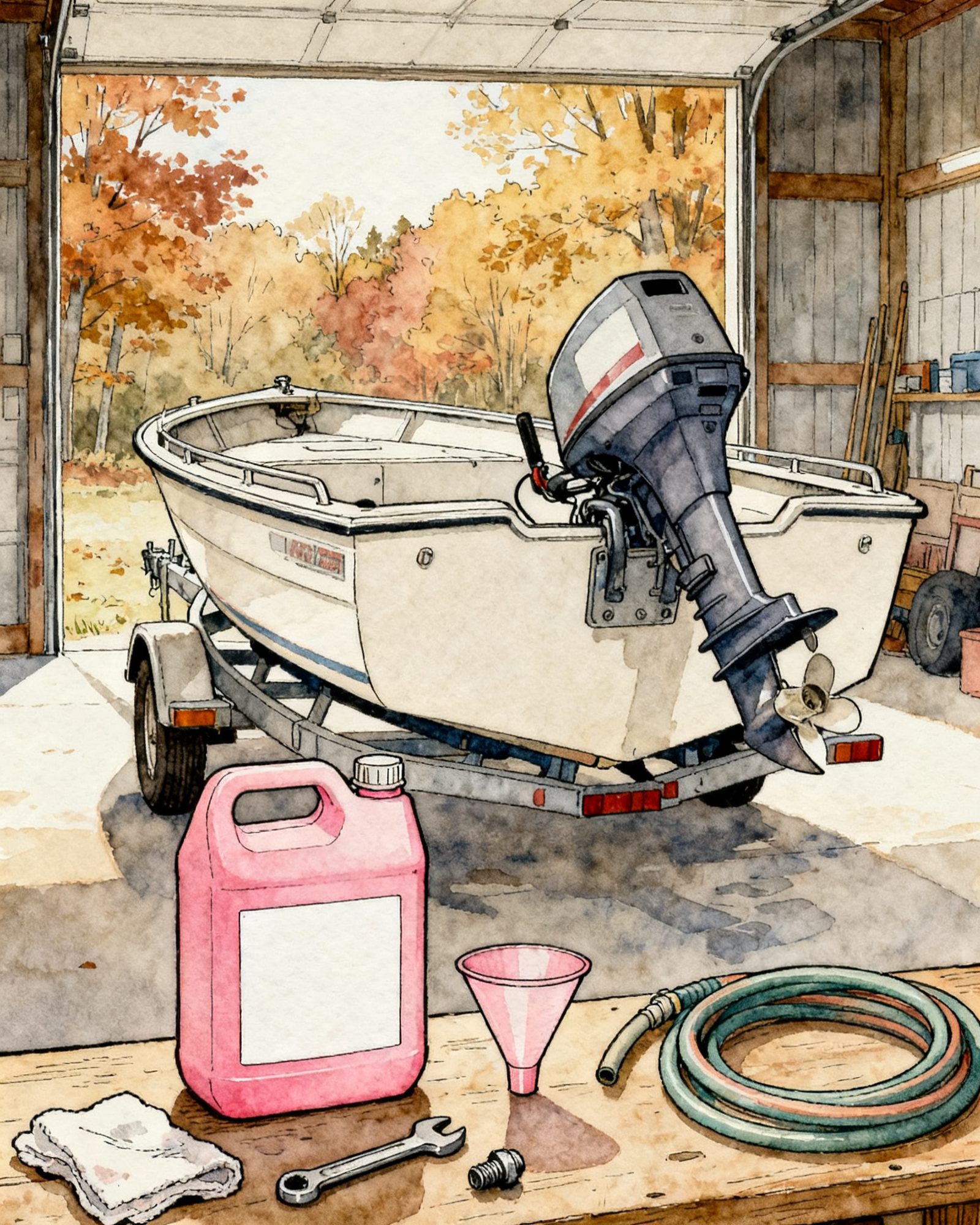
To use a fuel stabilizer for boat storage, add a marine stabilizer to fresh fuel in the amount its label gives, then run the engine on water, outdoors, long enough for the treated fuel to replace the untreated fuel throughout the system: two outboard makers’ instructions give 10 minutes. How full to leave the tank is where advice splits. Engine makers’ documents, Discover Boating and a university extension service range from full to 7/8 full to 95% to “nearly full”, and some makers drain a portable tank or the whole fuel system for long storage instead. Your engine’s owner’s manual decides. Stabilizer slows fuel ageing; it cannot repair fuel that is already stale or separated, and E15 has no place in a boat.
Why boat fuel goes bad over winter
Gasoline ages in storage. One outboard maker’s guide says gasoline will oxidize, with a loss of octane and volatile compounds and the production of deposits. A sterndrive and inboard maker’s winterizing article adds that fuel left in the system over winter can degrade and form varnish that clogs fuel lines and injectors. It can happen fast: Discover Boating says modern gasoline, “especially gas that contains ethanol, can begin to go sour in just a few weeks,” and a maker’s Canadian storage page says it can cause starting problems after only 30 to 60 days in a float bowl or a partly full tank, sooner in warm weather.
The worst of it ends up in the smallest places. One outboard maker’s bulletin explains that the little gasoline in the vapor separator deteriorates faster than the fuel in the tank because of its small volume and nearness to engine heat; another maker’s manual says gasoline kept there for a long time forms gum and varnish that can make the float valve stick.
Ethanol, water and phase separation
E10 is gasoline with 10% ethanol, as a University of Florida extension article explains, and ethanol draws water. Boats sit unused for long periods, and while E10 sits it takes in water vapor through the tank vent; over time the ethanol and water separate from the gasoline and sink. This is phase separation. In severe cases, the extension article says, a milky, rusty-brown layer forms at the bottom of the tank, where the fuel pickup sits on many motors, and can clog filters, cause misfiring or stop the engine.
One outboard maker’s manual explains why boats suffer more than cars: in cars, ethanol blends are normally used up before they absorb enough moisture to cause trouble, “but boats often sit idle long enough for phase separation to take place,” and alcohol can wash protective oil films from internal parts, leading to corrosion in storage.
E15 and higher blends
Engine makers’ own documents cap ethanol at 10%: one outboard maker says not to use gasoline containing more than 10% ethanol, another’s manual says its fuel system will withstand up to 10%, and an inboard maker prohibits more than 10%. One outboard maker’s guide says: “Use of fuel labeled E15 is prohibited by U.S. EPA Regulations.” The EPA’s required pump label for E15 (up to 15% ethanol) says to use it only in 2001 and newer passenger vehicles and flex-fuel vehicles, and: “Don’t use in other vehicles, boats, or gasoline-powered equipment. It may cause damage and is prohibited by Federal law.” Read the pump before you fill a portable tank. Discover Boating, an outboard maker and an inboard maker all suggest ethanol-free gasoline where it is sold.
How to stabilize boat fuel for storage
Your manual may change the order or add steps; check it first. New York Sea Grant’s marina pollution-prevention guide also says to check the engine maker’s warranty before adding fuel stabilizers.
- Run the tank low on your last trips. Discover Boating suggests planning a late-season trip to use up most of the current fuel, so the tank is refilled with fresh fuel for storage.
- Fill with fresh fuel to the level your manual gives, and add the stabilizer as the label directs. One maker’s manual fills the tank with fresh fuel first, then adds the stabilizer following the label. Use a marine-specific product, as Discover Boating advises; it calls stabilizer especially important for carbureted engines. A Virginia wildlife agency writer prefers the engine maker’s own stabilizer, mixed exactly to the label.
- Run the treated fuel through the engine. Two outboard makers run the engine in water for 10 minutes after adding stabilizer, so that treated fuel replaces the untreated fuel throughout the fuel system and the vapor separator. One inboard maker’s sheet brings its engine up to operating temperature and runs it for at least 15 minutes so the stabilizer enters the fuel system. Discover Boating suggests a short run on the water. Run it in the water, in a test tank, or on a flushing device only if your manual allows running on it; makers differ, as the outboard winterizing guide linked at the end of this page sets out. What to look for: the engine running cleanly at idle, with cooling water flowing. Do this outdoors, never in a garage: the exhaust contains carbon monoxide.
- Then follow the manual on draining. Some manuals now drain the vapor separator, or the fuel hoses, pump and filter, into an approved fuel container; others leave the treated fuel in place. One maker’s manual has you check the drained fuel for water or other contaminants and repeat until there are none.
- Change or fit a fuel/water separating filter. Discover Boating lists replacing fuel filters and fuel/water separators in its winterizing steps; one outboard maker recommends a primary fuel/water separator for boats with built-in tanks, and another strongly recommends a boat-mounted water separating fuel filter.
How much stabilizer? Only what the label says for your tank’s capacity: products differ, so a dose copied from a forum for another product can be wrong. One maker’s bulletin adds that all stabilizers have a shelf life and deteriorate over time, so an old bottle from the back of the garage is not a good bet.
Full, nearly full or empty: what the sources say
This is the most argued point in boat storage, and the sources do not settle it. Those who keep the tank full or nearly full give the same two reasons: air space in the tank lets damp air in to condense and speeds fuel ageing, while a tank filled to the brim has no room for fuel to expand as it warms. Those who drain point to ethanol: one outboard maker’s manual says long storage of alcohol-blend gasoline in the tank should be avoided, and one inboard maker drains a tank of alcohol fuel as completely as possible.
| Source (by kind) | The tank over winter |
|---|---|
| One outboard maker’s fuel bulletin | Fill the tank with fresh gasoline and add stabilizer; a partly filled tank promotes deterioration |
| Another outboard maker’s owner’s manual | First fill the tank with fresh fuel when adding stabilizer; its fuel section also says long storage of alcohol-blend gasoline in the tank should be avoided |
| A third outboard maker’s storage guide | Store it “7/8 full” to limit condensation; never plug or cap the vent |
| A university extension service, quoting other sources | 95% full with stabilizer, rather than empty; 95% leaves room for expansion |
| Discover Boating | Nearly full, with a little room for expansion |
| BoatUS material, republished by Virginia’s wildlife agency | Nearly full, with room for expansion; never plug the vent |
| One inboard maker’s winterization sheet | Fuel without alcohol: fill and stabilize. Fuel with alcohol: drain the tank as completely as possible and stabilize what remains |
| A Virginia wildlife agency writer | Either pump it completely dry, or fill it and add stabilizer |
The fueling side matters too. A boating-safety handout from the BoatU.S. Foundation says to aim to fill a tank no more than 95 percent full, because on hot days fuel expands and leaks out of a completely full tank, and a New Hampshire fact sheet says not to top off when refueling to reduce the risk of overflow. Whatever level your manual gives, do not overfill, and wipe up any spill.
Keep the fuel, or drain it
The makers also split on how long fuel can stay. One outboard maker’s US bulletin keeps stabilized fuel for storage of 30 to 90 days; for more than 90 days it drains the vapor separator and a portable tank, but keeps a built-in tank filled with fresh fuel and stabilizer. The same maker’s Canadian page drains the fuel system and the tank completely for storage of more than 60 days. Another maker’s manual drains the fuel hoses, fuel pump, fuel filter and vapor separator before storage. One inboard maker’s sheet keeps alcohol-free fuel in a full, stabilized tank but drains a tank of alcohol-blend fuel as completely as possible, and a Virginia wildlife agency writer says either pump the tank dry or fill and stabilize it. These are different documents for different engines and markets; use the one for yours.
Portable tanks
A portable tank makes the job easier. Discover Boating suggests using it to mix stabilized fuel and run it through the motor. Then:
- Draining. One maker’s bulletin drains the portable tank for storage over 90 days and disconnects the fuel line; one direct-injection outboard’s guide disconnects a quick-disconnect fuel hose whenever the engine is in storage.
- The vent. One outboard maker says to close the vent of a portable tank when it is not in use, and another says to close the vent screw of the fuel tank cap, if there is one, for storage. “Never plug the vent” comes in BoatUS material about a boat’s built-in tank, and from a third outboard maker, which does not say which kind of tank it means and gives the reason that the vent lets the fuel system expand and contract. So close a vent screw on a tank cap only where your engine’s instructions say to, and never plug the vent of a built-in tank.
- Where to keep it. Out of direct sunlight, in a well-ventilated place away from heat sources and open flames, as two makers’ documents say. The University of Florida article notes that many portable tanks have no vents, so keep them cool and out of the sun.
- Filling. A BoatU.S. Foundation handout says to always fill portable tanks of less than six gallons on the dock, not in the boat.
Leftover and stale fuel
Leftover fresh fuel in a portable tank or can: one outboard maker’s bulletin passes on an EPA suggestion to add it to a car’s gas tank, provided the car’s tank is fairly full. Stale or separated fuel is different. New York Sea Grant says waste gasoline is not considered hazardous waste if it is recycled or burned as a fuel, that household hazardous waste programs may accept unwanted gasoline and gas/oil blends from individual boat owners, and that gasoline which cannot be reconditioned should be disposed of as hazardous waste. A New Hampshire fact sheet says never to drain any engine fluid into the water or onto the ground.
Fuel safety
- The BoatU.S. Foundation handout quotes the Coast Guard: most fires and explosions on boats happen during or after fueling. Before fueling, switch off engines, put out open flames and do not smoke; afterward, wipe up spills.
- Gas fumes are heavier than air and collect in the bilge. On a boat with a blower, the handout says to run it for at least four minutes after fueling, sniff for fumes, and not start the engine until they are gone.
- One outboard maker’s manual: “Fuel and fuel vapors are extremely flammable and can be explosive.” Work outdoors or in a well-ventilated place, and keep the battery away from the fuel tank.
- Run the engine only on water and only outdoors.
Fuel, then the cover
Do every fuel and engine job before the boat is covered or wrapped. A shrink-wrap maker’s instructions tape over the fuel vents before wrapping and remove the tape afterward; a vent left taped all winter is a plugged vent. The order of work is in how to shrink wrap a boat. For the rest of the lay-up, see how to winterize an outboard motor or how to winterize an inboard or sterndrive, and for the oiling step that comes right after the fuel, fogging a boat engine for storage.
Common questions
Should I fill my boat gas tank for winter or leave it empty?
Most sources say store a built-in tank full or nearly full rather than empty, because air space lets moist air in and speeds fuel ageing; they differ on how full, from full to 7/8 full to 95%. Some makers drain a portable tank, or the whole fuel system, for long storage instead, and one inboard maker drains a tank of alcohol-blend fuel as completely as possible. Follow your engine's manual, and do not overfill: fuel expands when it warms.
How much fuel stabilizer do I put in my boat?
The amount on the product's label, for the number of gallons you are treating; doses differ from one product to another, so there is no single figure. Know your tank's capacity before you pour, and add it as the label says. Discover Boating advises a marine-specific stabilizer.
Does fuel stabilizer prevent phase separation?
Sources differ. A local marina owner quoted in a University of Florida extension post recommends stabilizer to inhibit separation and passes on that manufacturers say the correct dose inhibits it for 12 months: a second-hand figure, not one from a maker's own document. BoatUS material republished by Virginia's wildlife agency says that once separation has happened, no amount of additives or stabilizers can help. Treat fuel while it is fresh and keep water out of the tank.
Can fuel stabilizer fix old gas?
No. One outboard maker's fuel bulletin says plainly that stabilizers will not reconstitute stale fuel, and that stabilizers themselves have a shelf life. Old or separated fuel has to come out of the system and be disposed of properly.
Can I use E15 in my boat?
No. The EPA's required E15 pump label says not to use it in boats and that it is prohibited by federal law, and one outboard maker's guide says use of fuel labeled E15 is prohibited by U.S. EPA regulations. The engine makers' documents summarized here cap ethanol at 10% for their outboards and inboards.
Sources
- An outboard maker's fuel bulletin: avoiding fuel problems and storage (PDF)
- An outboard maker's storage guide: prepping for extended storage
- UF/IFAS Extension: E-10 fuel advice for boaters
- Discover Boating: Winterizing your boat's fuel tank for long-term storage
- U.S. EPA: Model E15 misfueling mitigation plan, with the required pump label (PDF)
Read next
What Boat Winterizing Costs and What Is Included
The cost to winterize a boat depends on size, engines, systems aboard, timing and storage. The factors in plain words, DIY supplies, and what to ask a yard.
Boat Antifreeze: Which Kind and Where It Goes
Marine antifreeze explained: propylene glycol vs automotive ethylene glycol, what a -50°F burst rating means, where it goes on a boat, and how to dispose of it.
Fogging a Boat Engine for Winter Storage
What fogging oil does, when to fog a boat engine, and how it is done on carbureted, fuel-injected and direct-injection outboards and on inboards, safely.
Winter Boat Storage: Indoor or Outdoor?
Indoor vs outdoor boat storage for winter: dry stack, heated or unheated buildings, a garage, a yard, a trailer or the water, and how to cover each.
Jet ski covers: fit, trailering and winter storage
How to choose a jet ski cover that fits: measuring a personal watercraft, styled vs universal, trailerable vs storage-only, straps, drying and winter storage.